Let’s review some games! I’m not sure how many I’ll get through or how in depth they’ll be – I tend towards jotting down dot points impressions that make sense only to me, and strenuously resist being turned into coherant paragraphs. I hope these will be interesting and useful.
11 Likes
my creation by dino
play time: 20min
This was a confusing experience.
It began at the IFComp website listing which claimed this is both Twine and parser-based — how does that work, perhaps a Twine game with text input? My mind drifted to this recent forum discussion on whether certain authoring systems can only create either parser or choiced-based games. The downloaded folder has both a .gblorb and an index.html file, so then I thought perhaps this has both Twine and parser versions. I’ve seen that done before, it’s interesting to compare the differences in implementation. But the html files only led to a browser-playable version of the gblorb, so the Twine listing appears to be just an error and I was overthinking it.
Over the next 20 minutes I went through this cycle several times. Some aspect of the game would be thought-provoking and lead to interesting musings in my little notebook, only to realise the source is an error and I was looking for meaning where there perhaps is none.
Upon launching a parser game, my instinct is to first type ABOUT then EXAMINE every noun in sight. We start the game in the middle of a bed in a small bedroom, with the bed, a bookcase, a nightstand, and a basket. And a baby. The intro, the ABOUT text, the game summary, they are all very insistent that there is a baby and the baby is crying.
So it was very disconcerting when X BABY was met with You can’t see any such thing. X BED? You can’t see any such thing, despite laying in the middle of it. X BASKET, X BOOKCASE, X NIGHTSTAND? The same.
At this point I thought this was intentional. The summary and game intro had a surreal, unsettling quality: the rattling windows, the too-big bed, the sense of isolation and confinement. None of the immediate nouns being apparently implemented gave the impression of floating in a void, strangely detatched from reality, which fit right in with the surreal first impressions. Maybe this is some sort of dream realm or representation of the protagonist’s mental state. Maybe you’re being haunted by this disembodied baby that you can hear but not see, why not?
Then X ME yielded the default As good-looking as ever, a distinctly not-surreal statement, and my hopes began to falter. Then I tried moving north and south, and realised what’s going on.
Different parts of the bed are implemented as separate rooms. I do like this as a design choice — it emphasises that the bed is, currently, the protagonist’s whole world, that just moving from one end to another take significant effort. I was particularly taken by the description of the “out of the bed” area, the protagonist dragging himself halfway off the bed and reaching out with one hand braced on the cold floor. Very evocative.
However, this does mean Inform assumes that objects (and babies) are not visible or interactable outside of the ‘room’ area they’re in, and the author has not taken steps to correct this. Now I could try to rationalise this — if the protagonist is laying on his back he will see only the ceiling, and naturally cannot see a baby on the floor next to the bed, nor a low bookcase. But trying to read to the baby from the bottom of the bed does not work because you can’t see any such thing, and none of the furniture seems to be implemented at all, and the reasoning falls apart.
I could keep going with the overthinking. Maybe the response to LISTEN being the default You hear nothing unexpected means the baby’s crying is so constant it has become expected background noise. Maybe the the end monologue concluding with “(the end)” but not actually ending the game is saying something about the unending, inescapable demands of single parenthood. These were enjoyable musings, but almost certainly not intended by the author.
I realise I haven’t yet said anything about the actual plot of the game, which is revealed in a long monologue at the very end of the game. It is an unusual ‘twist’ that makes the story less surreal and more mundane that it first appears, yet I enjoyed the characterisation of the protagonist as a new parent exhausted and in pain, making a valiant effort to find humour and express genuine love for his child. The 6-paragraph-long passage, after a game mostly consisting of short (or non-existent) descriptions, felt like a cathartic release, a sudden outpouring of emotion.
Or mabye I’m just overthinking again.
7 Likes
The Reliquary of Epiphanius
by @CescoGio
I will say upfront that I did not manage to finish this game. I got softlocked about an hour in when the flashlight battery ran out in the crypt, so I couldn’t examine anything, but also couldn’t leave to charge the battery since I hadn’t finishing examining everything… But I did see that the author has uploaded an updated version, so I’ll give it another go later on.
I went into this game looking forward to a classic text adventure experience, and that’s precisely what I found. The premise is that your father has gone missing while researching an ancient monastery, leading you to follow in his footsteps to search for clues on his whereabouts and his research.
Firstly, I was impressed by the presentation of the interface. Love the little maps for each location! And the music is well-suited to the game and not distracting. Only small complaints are that in some places (eg the tower) there is no space between paragraphs, and I don’t think the font is the most readable for small text on screen.
The puzzles are intuitive and fairly straightforward, mostly in the vein of picking up items and realising where to use them. In some places the hints may in fact be too obvious, such as one instance where the game explicitly tells you that you need something long to push the stone (emphasis original to the game).
I enjoy a large map to explore and this certainly delivered on that front. The writing was excellent at establishing atmosphere and sense of place, with each ‘area’ (the semi-abandoned town, the forest, the monastery ruins) feeling distinct and immersive. Especially appreciated the illustrated map and descriptions of the entire landscape in-game, which gave just enough guidance to make exploration feel really exciting. Stumbling on the lake beach and ruins in the forest was such a thrill. (side note, I appreciate the forest design with each room having different exit configurations, that make it a lot easier to keep track of where you are)
That said, it’s clear that some locations received more attention than others. For example most of the village is great, but the tower could do with more thorough testing: the tourist information panel has the exact same information as looking at the panoramal; the box explicitly says it has a transparent door but you still can’t look inside unless it’s opened; doesn’t quite make sense that you can’t sit on the bench. My excitement at finding the lakeside beach was hampered by there being nothing to see or do there, the lake, mountain, and embankment don’t appear to be implemented corectly despite those nouns being bolded. At one point the game describes a pile of artifacts, “and likely much more, if one were to dig” but the game doesn’t recognise digging as a verb.
In general the fundamental design and structure of the game is excellent, but some more polish and thorough testing would be beneficial.
4 Likes
Dead Sea
by Binggang Zhuo
playtime: 40min
At the heart of this game is a quite compelling story. Our protagonist wakes in a strange graveyard with no memory of who they are or how they got there. They wish to go home, but with no conception of where that is they follow the only road out, enter a castle in the sea, and stumble into a tragic tale of love and desperation. They can watch as story plays out to its natural conclusion, or intervene and continue discovering the whole truth. There is an interesting magic system around capturing souls of the dead and glimpses into the wider history of the world.
It is a shame that this story is hampered by awkward design decisions.
The game is structured much like a parser game, with the player exploring the map, collecting and using items, talking to people. But it’s implemented in such an awkward way. For example, to leave the starting area our protagonist needs to trade a chilled Fanta for the Duke’s invitation. To get that you have to defeat an orange slime enemy with a freeze ray, take it apart with a sword, then collect the remains in a bottle. These items are all in a cart, except for some reason you only can take one at a time, so the fetch quest becomes unnessarily trekking back and forth several times between the two locations. (Later on you need to catch worms as fish bait, I ended up trekking between the worm-site and fishing-site 5 times because the fishing is luck based, consumes your worm even if you don’t catch a fish, and you can only carry one worm at a time.)
This first scene establishes a curious blend of high fantasy (dukes, castles, souls of the dead) with Fanta drinks and freeze rays. I was looking forward to seeing how these disparate elements would interact, but sadly the game does not expand on the concept, and as a result the non-fantasy elements feel rather tacked on. Also, why do you need the Duke’s invitation to leave? What is he inviting people to? Why am are you even heading to the castle? These questions are never answered.
The initial confusion could be interpreted as reflecting the protagonist’s own disorientation, waking in an unfamiliar place and following the only available paths in the hope of finding answers or a way home. The later mention of fate suggests being unwillingly swept along by destiny. I’d be willing to take this interpretation if there was more introspection or a clearer sense of the protagonist’s thoughts/desires beyond an desire to return home, which is not mentioned again. Instead, it feels like the player is simply solving puzzles and advancing along the only route of plot progression, without understanding of what I’m doing or why.
The inventory system has designated slots for left hand, right hand, and pockets, plus a special items section. If you have an item in each hand and then pick up another, it replaces the oldest one. I found this out the hard way when I had a plot critical item in hand, then decided to arm myself with sword and salt before going on, not noticing my plot-critical item had disappeared into the ether and I’d soft-locked myself. Now I’d also been seeing statues that “reset chapter parameters”, with no explanation of what that means. I prayed at one hoping to reset to a point before losing that item, but nothing seemed to happen? I was able to back button my way out of being actually softlocked, but the experience was rather frustrating.
Once you get past this point, the story becomes more of a focus, and I found this last section a lot more enjoyable. I loved the part where you uncover backstory through poetic fragments in paintings, each fragment opening up a new door to go through. I appreciated the author’s efforts at introducing elements early on, tying them back in a satisfying way towards the conclusion. Finding the extra story for the good ending was very satisfying. I wish the game had more focus on the castle and the story there and less on the awkward beginning parts.
4 Likes
The Little Four
by Captain Arthur Hastings, O.B.E.
playtime: 1hr 40min
Slice-of-life is one of my favourite subgenres of fanfiction. Especially for those canons that tend toward intrigue and action, it is nice to read slower paced stories that give the characters time to rest and breathe, exploring personal lives and relationships: the quiet intimacy of late-night conversations, sharing dreams for the future, talking about what matters to them. It is often fascinating to compare interpretations of what they are like in more mundane, domestic sitatuations, small personal details that round out a character and in turn make me appreciate the source material more. All that is to say that I was very much looking forward to this slice-of-life featuring Poirot and Hastings, and it lived up to all my expectations.
The premise of this story is that Captain Hastings, following the death of his wife Dulcie, has returned to London with his four young children and taken up residence in the same apartment building as Poirot. Despite being a longtime Christie fan I’m unfamiliar with the two books most relevant to this game. It’s been ten years since I’ve read The Big Four, from which this game takes its name, and I don’t remember much of it, but I feel the author does a good job at giving enough context to understand both the character dynamics at play and the significance of The Big Four to this story. I haven’t read Curtain, the final Poirot novel, which I believe details the circumstances of Dulcie’s death and the lives of their children. I do know that in canon Dulcie passes away after her children are grown; I was initially wary that this game kills her off early so that Hastings and the young children can spent more time with Poirot; however the result is so charming that I can’t bring myself to mind much.
There is a small mystery here, but it is not the focus and is probably the weakest part. I enjoyed it, but it only took up about 15 minutes of my total 100 minutes of play time. The heart of the experience is exploring the two apartments, one occupied by Poirot and Hastings and the other by the children (if this was a graphical game it’d be called a walking simulator).
There’s a lot of characterisation to be gleaned from a person’s home, their bedroom, their study – how they’re decorated and organised, the objects they choose to display. The gameplay is walking through the house examining their rooms and belongings, with Hastings describing and explaining the background and telling anecdotes, giving a lovely look into their daily lives as a family. I smiled at small character details, Poirot having Hastings’ books in his study organised by height, Hastings’ wariness of modern-style furnishings, their considerations for buying a car. I especially loved the explorations of their relationship with the children; it’s nice to read how involved Poirot is with their lives and upbringing. Poirot making dinner and introducing Belgian dishes to the children! Grace making a little stuffed cat with a moustache as a gift!
In general the author did an excellent job at capturing the voice and essence of Poirot and Hastings, exploring aspects of their characters that Christie never focused on yet feel entirely natural and in keeping with canon. The last scene, of the two of them sitting and talking after putting the children to bed, was everything I could have hoped for.
This is a limited parser game, with little to do other than walking around examining things. Most verbs are disabled, the player dissuaded with a variety of in-character custom responses; even an accidental empty command becomes “I was momentarily dumbstruck.” I do wish that some more actions were accounted for – for example, trying to open the refrigerator gives “It wasn’t something I could open” (I’m exploring someone’s home, of course I want to snoop on what’s in their fridge!). However, the overall attention to detail is evident, making for a cohesive and immersive experience.
I also appreciate the small touches, such as the most important nouns in descriptions being bolded (though many non-bolded words can also be examined), which turn into italics after examination to help keep track of what you’ve seen. The descriptions are responsive to the things you’ve seen or done.
Only small complaint is with the status line. It is quite useful to list the exits and current objective, but it is all on one line and to accomodate the entire length requires setting the text width to far wider than is my preference. If the objective is too long it overlaps the exits. For example the status late-game in the dining room reads, on my preferred layout settings: DininCurrent objective: check on the children and head bExits: N Erot’s
I’ve also notices some inconsistences in how paragraphs are formatted, sometimes indented and sometimes not. The game has been updates several times since I downloaded it though so perhaps that has been touched up.
This is definitely among my favourites of the competition so far, and I fully intend to revisit it in the future.
7 Likes
Apologies for jumping in so quickly—I happened to refresh the forum at just the right time, and you brought up such excellent points that I was excited to respond!
The stubborn generic responses and occasional crossed wires (caused by my shamefully tangled code) should hopefully have all been fixed in the recent updates, along with most of the indentation and spacing inconsistencies. Very sorry for any confusion!
I have another small update in the works for tomorrow and really appreciate all your notes, especially about the status line. It felt cramped to me as well, but I hadn’t realized just how bad it could get for players with smaller window sizes. I’ll see if there’s a quick-fix I could apply to make it legible for everyone (simply expanding the status line to 2 rows might work?)
I know reviews are more for the players than for us authors, but regardless: thank you for the valuable insight! Another reviewer also shared feedback about in-game issues, and I’m adding a section to the credits for these kinds of cases. I would love to credit you too, if that’s something you’d like.
(Going ''meta'' for a moment to give some background information)
I love that you thought about those details from the canon! Dulcie’s treatment is definitely something I gave a lot of consideration to; I adore her and hoped to do her justice. The canon timeline is actually a little odd so I had to reconcile a few disparate elements:
Curtain was originally written near the start of WWII and stored away just in case something happened to Christie. It ultimately ended up being published by her family in 1975! I decided to treat the time it was written (~1941) as being the time it would have taken place, as that made a lot more sense. For example, Poirot comments on Hastings’ appearance when they reunite, stating that Hastings still looks young despite the greying hair at his temples and must be getting attention from the ladies. This works very well for a 55-year-old Hastings in 1941 (he was about thirty in 1916); maybe a bit less so for an 89-year-old in 1975!
Dulcie got engaged in The Murder on the Links from 1923, and no children are mentioned in The Big Four which was published in 1927 (though Dulcie herself and her safety are major topics), so the kids all being adults around WWII seemed impossible. I put this down to Christie not knowing when the war would end or what year the book would be published in the event of her untimely death, but in hindsight I felt it was justified to age down the kids according to the 1941 timeline, pushing right up against the canon “limit” of 1927 for the earliest birth with the eldest being twelve in 1939.
I also made the decision to age Dulcie up from 17 to 22 in her initial appearance. It seemed like a reasonable change considering Hastings is still much older than her in either case, and shifting her overall lifetime by a few years (with her passing around 1937 rather than around 1940) helped separate the tragedy of her death from that of the looming war.
In the end I’m not sure I made all the best choices for my little version of the timeline, but I certainly tried to make them with care, and it warms my heart to see fellow fans enjoying the story! If I can help spark the passion for Christie’s fantastic works in any new readers, that would be the icing on the cake. I’m a little behind on completing it (hopefully in the next week or so), but I’ve been filling out the webpage linked in-game with a list of all my references for anyone curious—I took a lot of inspiration from the more domestic scenes in the books as well as the celebrated TV series starring David Suchet and Hugh Fraser.
Thank you so much once again for the thoughtful review and for your incredibly kind words! They really, truly mean a lot. I had plans for all sorts of little improvements and additional interactions, which I had to put off until after the comp for want of time—I’m very much looking forward to sharing a better version of the story once it’s ready!
4 Likes
Thanks for replying, and your timeline notes makes a lot of sense! I didn’t know the timeline weirdness about Curtain (teenage me resolved to read every other Christie book first, which at my current rate will take another 10 years), and glad to hear that the spacing inconsistencies are fixed. Feel free to credit me if you’d like to!
3 Likes
Some of the later ones written after Curtain are pretty bad as she ended up getting dementia. I love Christie’s work but books like Postern of Fate are hard to read due to overall vagueness. It might be worth striking a few books off the list. Although I did enjoy some of the Poirot books written in later years, like Hallowe’en Party, even though Wikipedia says that contemporary reviews saw clear signs of Christie’s decline in the book.
2 Likes
Some of the earlier ones are also a mixed bag, like The Big Four itself. Imo she was a lot better at mystery fiction than spy fiction.
5 Likes
Yeah there’s a reason I have not reread The Big Four in the 10 years since I first read it. In the game there’s a bit where in-universe Ariadne Oliver says it’s one of the weaker books and I instinctively agreed.
I did absolutely love the earlier Tommy and Tuppence spy/thriller books, because the dynamic between Tommy and Tuppence is delightful enough to overlook any plot wackiness.
4 Likes
Warrior Poet of Mourdrascus
by Charles M Ball
playtime: 1h4 40min
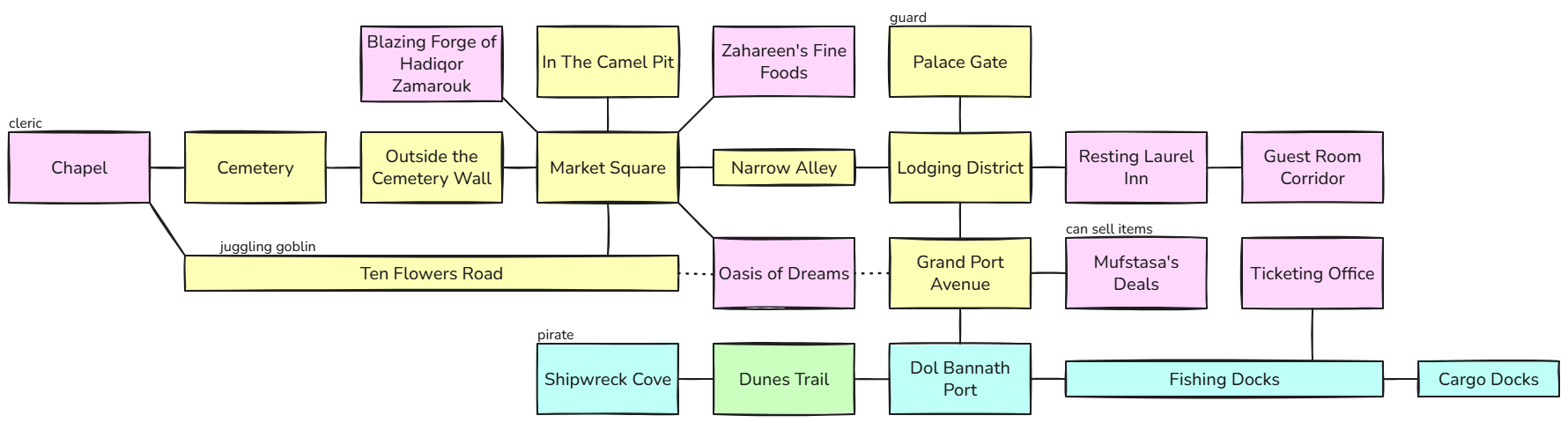
A promising start! The premise here is that you are a student warrior poet, about to embark on a career of adventuring; however, just before graduation, your advisor steals a precious artefact and flees, so naturally you’re tasked with tracking him down to earn your degree. This game, the first of what I hope will be many instalments, takes place in the port city you’ve followed him to. Explore the city, talk to its inhabitants, discover the professor’s next destination, and secure passage to pursue him further.
The highlight for me was the writing and the characters. The locations are interesting and varied, with engaging descriptions that capture the dynamic vibe of a bustling city and market, which makes exploration is enjoyable even when there isn’t much you can do yet in a particular place.
The game is generally really responsive to what you know and what you’ve seen. Conversations with NPCs use the TALK TO command and are of the type where, instead of picking a topic, the conversation simply happens based on your knowledge; if you’ve encountered relevant information you automatically share it. This is nice as it makes the interactions feel more natural and integrated into the narrative, and the author’s good at writing interesting dialogue. However, sometimes this system works a bit too smoothly, because my character is making connections before I do. For example, I talked to one character simply because they were there, and the character immediately goes oh I see you have something I need, can I trade it from you? – even though I hadn’t yet realised that was what I needed to do!
Many puzzles here are narrative and conversation-based and follow that pattern: you do something or find a clue, figure out who to approach with that information, and hopefully gain more clues in the ensuing conversation. The progression is generally smooth and satisfying once you’re on the right track; however, one minor complaint is that the system feels somewhat rigid. There’s essentially one main chain of conversations that drives the plot forward, which you start by finding a specific clue. Talking to people before getting that the info to prompt the relevant conversations usually doesn’t work, and I spent some time aimlessly wandering around until I looked at the walkthrough and realised I hadn’t examine something thoroughly enough. This is a downside of the otherwise good conversation system, you can’t just go to the inn or the docks and ask if anyone has seen someone matching the professor’s description, as one might expect.
To mix things up here’s also a combat system that I found pretty fun. It’s simple to control – choose to attack with either a weapon or poetry magic and hope for a good roll. There are opportunities to increase your ability scores and acquire better weapons and armour, but the combat encounters feel fairly manageable even with the starting equipment. As a result, getting better weapons feels less about immediate necessity and more like preparing for the next stage of the adventure.
Overall, a very well put together experience, I’m very much looking forward to future installments.
5 Likes
The Promises of Mars
by George Larkwright
playtime: 55min
This game immediately impresses with its excellent presentation. On the title page, the pixel art and beautiful orange and grey colour combination gives a striking first impression. This continues into the game itself, with a well-designed UI featuring separate map and inventory panes, plus nice font choices and typography (I’ve since downloaded Lekton for myself). There are options to change font and font size, which I always like to see. There is a lot of attention to detail put into the design, which makes for a pleasant and immersive experience.
This is a puzzle game set in an scifi future where the population of Mars has retreated underground following climate catastrophe. A large part of the gameplay is based on exploring, collecting items and using items; but there is a major focus on narrative also. There is a lengthy introduction, the narration of the protagonist’s progress through the city is interspersed with memories of her sparse life in underground bunkers, her observations on the abandoned streets as someone whose only experience with things like hot dog carts and playgrounds is through her mother’s stories.
I’ve played several parser puzzlers this Comp, and it’s had me thinking about how a choice-based interface can create a different kind of vibe and experience. The result here feels very smooth and directed. The player makes decisions such as the order in which the protagonist (referred to only as The Girl) explores locations, what to examine, which item to use to solve a puzzle. At times the game itself takes over, having the Girl act on her own. These moments (from small sentences where she finds and take items to longer ‘cutscenes’) are narrated in the same voice as player-driven actions, which makes the puzzle-solving and the storytelling feel nicely intertwined. For instance I appreciated how the comms link to Command is a diegetic hint system, but the Girl also uses it on her own initiative when the situation calls for it, like reporting a system failure or asking to unlock a door (which naturally doesn’t work).
But sometimes the game is too smooth, to the point of reducing the sense of challenge. At one point the Girl finds a storeroom and cycles through a list of tools: angle grinder, drill, pliers, and so on, before landing on a folding ladder. “That could be useful,” she thinks. She takes the ladder." The cycling text is a neat effect, but it also felt a little too convenient, erasing the potential puzzle of deciding for myself which tools to take. Later on the Girl comes across a passage blocked by debris and makes this observation: “Another apartment block […] has a second storey balcony — if she can reach it, and then climb to the next balcony over, the Girl might be able to circumnavigate the wall.” Again, instead of asking the player to find a way forward, the solution is handed over right away.
In a way it feels like the Girl has more agency than the typical text-adventure protagonist. She’s capable and clearly knows what she’s doing, instead of being subject to the player’s flailing. That’s a cool effect, though it does mean less is left in the player’s hands. Still, I was glad to see the puzzles ramp up in complexity by the endgame.
The prose itself is melancholic and well-written. the ending twist is perhaps too obvious, but the story engaging and thought-provoking. I do wish we got more introspection from the Girl but what is there is quite serviceable. I only wish there had been more space for the Girl’s introspection; what we do get is effective, but it feels like there was room for more depth.
3 Likes