That’s what I’m starting to see, the different genders doesn’t change the character just the name and pronouns.
And to be clear, Choice of Games is (as far as I can tell) okay with both options here—the player character needs to be fully customizable, and if there are any romance options, there have to be both male and female ones. But it’s completely fine to have those be separate characters whose genders are fixed in the story and not specified by the player (or to have no romance options at all).
My favorite CoG game (to nobody’s surprise) is Night Road, which takes this route. Julian, Lettow, and Raúl are always male, Dove, Elena, and Vani are always female, but you can choose which of them you want to pursue.
3 Likes
This is why many adventures resort to the AFGNCAAP trope and many just avoided romance or relationship options altogether. This is probably also a big reason adventure game prose naturalized to second-person so the game could refer to “you” uniformly instead of “he/she/they” in its prose. The wasn’t likely intended to be exclusionary as back at the beginning with limited storage they were squeezing every bit of text they could onto a floppy for larger games and some games barely had room on a disc for one version of events.
Leather Goddesses of Phobos in its time was progressive in that many adventure game protagonists were default male, and they were trying to get over the bias that “women do not play computer games” So you could choose your PC gender at the beginning by entering a restroom. This also changed the gender of your trustworthy companion into “Tiffany” or “Trent” to match what you chose.
Of course this still had the issue of binary gender and heteronormativity - any of the game’s mild sex scenes would shift the other character into the opposite gender as the player so nobody was allowed to be gay or bisexual.
AFGNCAAP works a little better in a parser game where the gameplay is mainly concerned with immediacies like which key in what openable box opens which door rather than something like CoG where the interaction is less about physical manipulation and more about a longer term story that gives space and time to let relationships flourish. It makes sense in that context that it would take into concern the player’s actual preferences to bridge suspension of disbelief. If a significant other is an important part of the plot, it wouldn’t do to force a player into a situation they wouldn’t find themselves in by personal choice.
I wouldn’t say intended to be exclusionary; rather, the idea of women playing computer games wasn’t prominent at the time. I think it’s Drew Cook who’s pointed out various ways that the Zorks incidentally refer to the player character as male despite being “you”. The exclusion just happened incidentally, by default, instead of being deliberate.
In this case, though, I suspect it was due to implementation limits instead of just never thinking about it. If you use the names from the opposite version of the game (like calling your companion Trent when they’re actually Tiffany), there’s a joking response like “ah, I see you swing both ways; in this playthrough, though, it’s Tiffany”.
I’m not sure I’d chalk it up to parser versus choice; look at the contortions Jigsaw has to go through to write a believable romance without ever mentioning either character’s gender.
1 Like
I have a decent player customisation I think, which allows for a variety of pronouns, among other things.
Here’s the demo which includes the PC creation, would genuinely love to know what people think!
https://mossandquillstudios.itch.io/terradapt-the-return-demo
To the thread title, I’d say, "When implimentation requires more effort than the developer deems reasonable or when the level of inclusion breaks the narrative and/or setting.
Note, I say this as someone who considers a PC who is a predefined character with a fixed sex, gender, age, race, nationality, etc and PCs that are a complete blank slate the player can customize to be a self-insert or an original character of the player’s creation are equally valid, and while I usually play the male PC in games with an option to play as male or female, I wouldn’t want Nintendo to give Samus a male partner in the next metroid game just for the sake of inclusion.
As for dating sims… while I see nothing wrong with games catering specifically to androphiles or gynophiles, if a game is to offer potential romantic partners of multiple genders, I think I’d rather the game just have a decent mix of potential partners instead of options that flip all potential partners to the player’s preferred gender and leave it to the player to decide who to romance/platonize.
3 Likes
The answer to your question “how inclusive” depends on your goals as an author. If you want to write what you know (which is common writing advice) it is perhaps better to focus on your own experience, or experiences of those close to you.
If you are planning to publish for a specific platform with specific requirements (Choice of Games has been mentioned) then be sure you understand their expectations.
If you’re writing to an audience who like to customize their own paper-doll representation of the character with features like hair color, eye color, etc, by all means do that. It won’t make the rest of your programming any more difficult, since for most genres these feature details won’t have any impact at all on the more important choices the character makes during game play.
For my own tastes, I don’t like games that start with a long period of character creation. Just plop me into the story and let me define my character by the choices I make during game play. Be sure that those in story choices are interesting and inclusive.
4 Likes
With regard to pronouns specifically, here’s part of the profile editor in the latest version of Guncho:
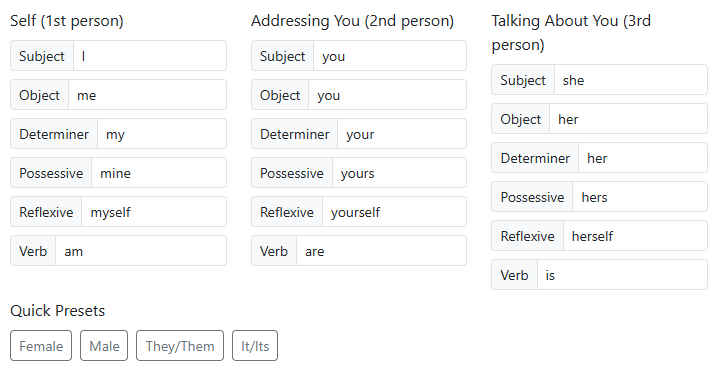
IMO if you’re offering personalized character creation, there’s little point in catering to only some of the “nontraditional pronouns” audience: whatever set of options you pick, it still won’t cover everyone, so you’re either committing to an indefinite number of additions or conceding to leave some people out. Using 100% custom options moves all the gender-word logic out of the game, it removes the hazard of having to decide which sets of pronouns are worth including, it covers every(?) identity that’s recognized today, and it will cover any other identities that are recognized in the future.
5 Likes
Although it doesn’t save you from worrying about subject-verb agreement (most people who use they/them pronouns expect the plural form of the verb to match how “they” is generally used elsewhere in English, right?)
2 Likes
Yeah, that’s the tricky bit: English generally allows plural pronouns to stand in for singular ones (not just singular “they”, but also singular “we” and singular “you”, which got so popular that it completely replaced the properly singular “thou”), but they still take plural verb forms (I am, thou art, she is, but we/you/they are). This means the verb is different depending on whether a noun or a pronoun is closest to it.
Which is a right nuisance in writing parser responses! But in choice-based text it’s generally not too bad, because the sentences you’re writing probably never apply to random objects in the world, only to the player. So you can just hardcode “is” when it comes after a name and interpolate a variable when it comes after a pronoun.
2 Likes
True, you do still need a tiny bit of logic to switch between singular and plural verbs based on whether the verb field is set to “is” or “are”.
Huh. I never thought to use is/are as a key for other verb agreements. First person breaks that mold, so for the parser I’m working on I wound up with this lookup table that includes a few common contractions and a couple of very common verb agreements:
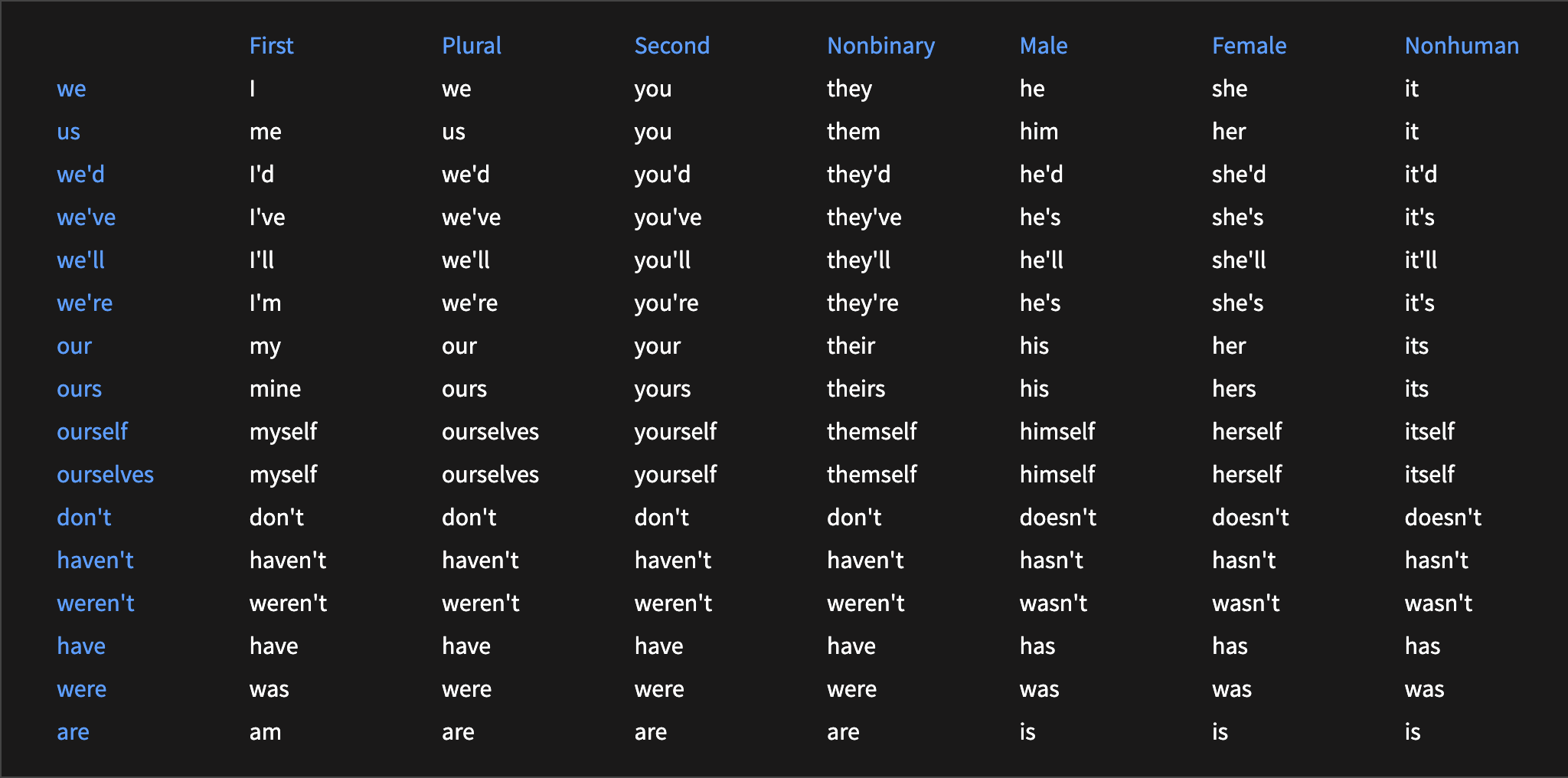
But then for most verb agreement uses a block of logic that considers singular / plural / proper name before using this kind of interesting end-of-verb algorithm.
if (
  subject_has_propername ||
  ["nonhuman", "male", "female"].includes(
    this.game.getInput().getSubject().pronouns
  )
) {
  if (
    verb_name.endsWith("ch") ||
    verb_name.endsWith("sh") ||
    verb_name.endsWith("x") ||
    verb_name.endsWith("s") ||
    verb_name.endsWith("z") ||
    verb_name.endsWith("o")
  ) {
    return verb_name + "es";
  } else if (verb_name.endsWith("y") && !/[aeiou]y$/.test(verb_name)) {
    return verb_name.slice(0, -1) + "ies"; // Change "y" to "ies"
  } else {
    return verb_name + "s"; // Default case
  }
} else {
  return verb_name;
}
I’m at a point where an author can add a completely new set of pronouns, yet I’m still testing against hard coded values in some places, as in the above block, which is a thing I have yet to resolve, but this thread suggests a way to handle that. Nice!
Not for the first time, I envy languages where pronouns either don’t really exist, have no impact on verb conjugation(are is, am, be, are, etc. different conjugations of the verb to be? I’m not sure because my English grammar classes back in K-12 never used conjugation to describe verb variants, so I’m not sure what is and isn’t conjugation when talking English verbs), or the default pronouns don’t carry gender and animation information… And thank Webster English lost gender for inanimate objects(as I understand it, Anglo-Saxon had gender for inanimate objects and old Norse did as well, but between lots of trade between the Anglo-Saxons and the Norse and their languages disagreeing on which objects had which gender, English lost this aspect at some point… Though modern German still has them, and as I remember from the semester of German I took in Uni, there really is no way to deal with gendered objects other than memorizing which ones are masculine, feminine, and neuter… I imagine this makes translating parsers with tons of medium dry goods from English to German a real pain if the parser wasn’t written with pronoun handling to begin with… Though, considering that Japanese has singular, dual, and plural first person pronouns while, as far as I know, lacking singular/plural verbs, I wonder if there are any languages where singular/dual/plural forms exist for both nouns/pronouns and verbs… and I also find myself wondering what a conlang optimized for simple parser implementation would look like.
1 Like
Yes.
Inform (and other languages, probably) already include support for referring to things as “it”, “he”, “her”, etc.
Obligatory “not a linguist” but Google turns up results for Sanskrit, Ancient Greek, Arabic, and more.
2 Likes
Yeah, a lot of the older Indo-European and Semitic languages have singular/dual/plural distinctions on both nouns and verbs, though in both families, even the earliest-attested languages were already losing the dual. Even in Homer and the Epic of Gilgamesh, the dual is only used for a few specific words, usually ones that are most often found in pairs (hands, eyes, etc). In Latin, it only survives as various exceptions to the usual rules (words like duō “two”, ambō “both”, octō “eight”, vīgintī “twenty”, frēnī “reins”); they aren’t even seen as dual any more, just as plurals that look different from all the other plurals.[1]
(There are exceptions, though; as Hidnook mentions, Arabic and Sanskrit kept their dual forms even as most of their relatives lost them. In those languages, you still need to mark it every time you use exactly two of something.)
Outside Indo-European and Semitic, there are a bunch more; dual marking is widespread in the Austronesian languages, for example. A couple languages even have a special marking for exactly three things (Tok Pisin is the most famous one). Or instead of a dual, they’ll have a “paucal” marking, for a small number of things instead of a large number; this one shows up in various Slavic languages.
My favorite example comes from the Tanoan languages of North America, which have an “inverse number system”. You don’t mark explicitly whether a noun is singular, dual, or plural; instead, you mark if it’s not the amount you’d expect. “One person” is normal, but “one eye” or “one grain of rice” is unexpected: normally you’d expect two eyes and many grains of rice.
“Twenty” being literally “two tens” is intuitive enough, but in Proto-Indo-European, “eight” was literally “two fours”: the singular shows up in Avestan as the noun ašti, “the width of four fingers”. ↩︎
6 Likes
Yep, they are. “Conjugation” is just a fancy word for inflection of verbs; you can always call it the more general “inflection” if you want (conjugation is special because it covers more than just gender/number/animation (GNA) agreements, like tenses). Inflection that’s not conjugation (ie. inflection of pronouns like the tables above, nouns, etc.) is properly called “declension”.
The descendants of Old Norse, the Scandinavian languages, still do, too 
Yes, grammatical gender requires memorization, and doesn’t really have anything to do with natural gender. But Inform supports grammatical gender out of the box. Not every parser needs to be as flexible as Inform, but
And Inform also makes it possible (and relatively easy, if not exactly straight forward) to refer to things with different grammatical genders as well. I’m currently writing a language extension which does that.
2 Likes
Yes, just like playing Monopoly. It’s cool that you can pick your counter to be a Sports Car or a Battleship, or a little Furry Dog. But having the Top Hat has no bearing on how well you do in the game.
@Doug_Egan your last sentence here captures the main reason I dislike the cog model and it’s format that is used so many twine games . I don’t find the choices interesting or inclusive at all.
In alot of choice of games titles it often feels like my choices don’t matter at all. The fanbase seem to enjoy having ten choices where 9 out of 10 of them are fake and lead to the exact same thing . Also the weird notion that characters must be exact replica of the player . This is funny in the cog model because the characters always make choices that I wouldn’t even consider an option or that are out right stupid. This doesn’t bother me in preset characters but it does in cog style games .
Also due to the lack of predefined characters they never remotely feel like real ppl and the relationships often feel shallow. This wouldn’t be a problem if so many of the writers weren’t trying to aggressively create Last of us , Detroit being human style games in text format. In my opinion Last of us does not work with a model of you being able to choose Joel sexuality or gender neither does most of the games in the genre it belongs to so cog and twine games have always been kind of funny to me because so many of them feel like text versions of interactive movies but they lack the character depth ,plot depth, writing skills etc that make the cinematic versions of this format exciting . You can’t make characters as interesting as Joel and Ellie yet write them in a weird ill defined way where so many different demographics can latch on them. I like that Ellie is a canon lesbian . I like that she has her own desires and wants outside of the player wishes cog game creators seem to try to do this but it does not work with giving the player so much control over choosing the personality ,sexuality , shit some games allow you to choose the gender of the NPCs . I just don’t feel like this leads to creating interesting well thought out stories .
3 Likes
Timely thread for me. I’ve been working on interactive fiction that plays on discord.
Is the following drop down for gender acceptable for character choice for people who want to play non-binary players?
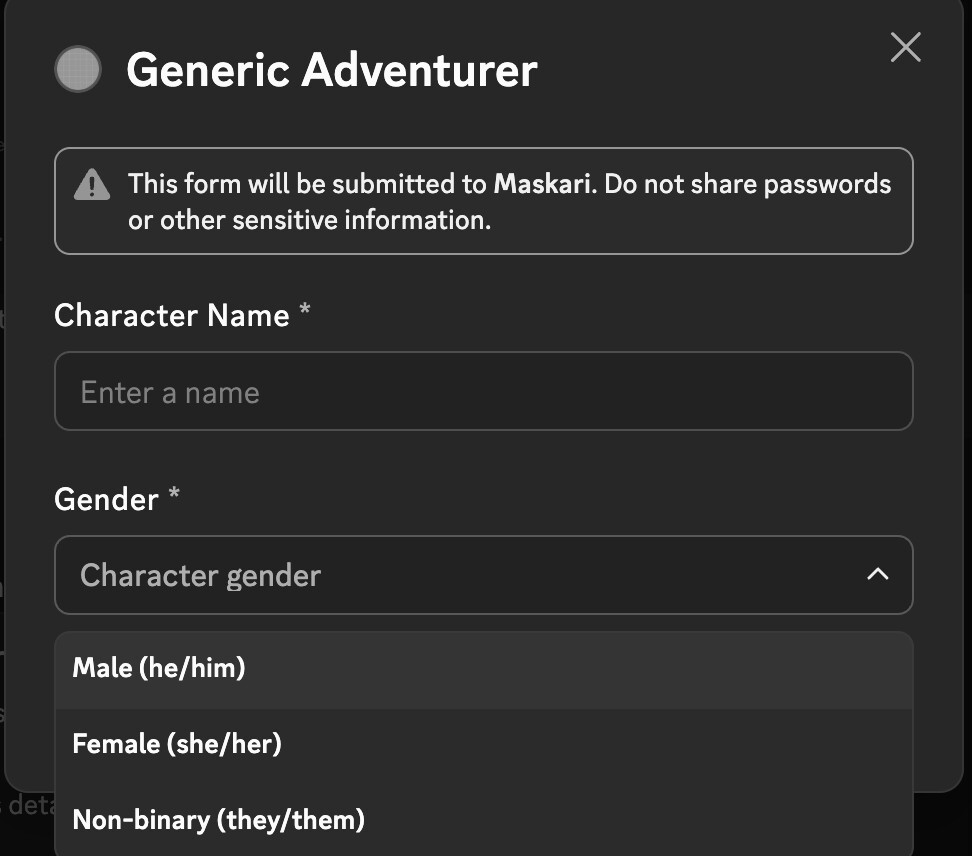
2 Likes
One of the biggest things I’ve learnt from what everyone has said and linked to is that offering an option to enter their own pronoun seems to be important and also the best way to be as inclusive as you can be! I don’t know if that’s possible with they was you’re writing.
2 Likes