You seem to be speaking from personal experience…
7 Likes
So my dad was reading through this thread (I haven’t read through too thoroughly, so I apologize if this was already hashed out; I’m just the messenger).
One thing he wants to point out is the balloon gas would be stored under high pressure, if it’s not in the balloon itself.
The other thing he wants to say is that, based on his experience in chemical engineering, the engineering rooms for the ship would be on upper floors, because they would be closer to the balloon. This is because engineers tend to prefer shorter routes between their workplace and the locations which have problems or require maintenance. Putting engineering at the top allows for more efficient maintenance and repair routes, and also keeps locomotion machinery more organized.
He also wants to say that the ordering of floors is completely a moot point if the player character never goes there, and the information is never mentioned. He also reiterates that this is from chemical engineering experience and he has not flown a vacuum ship before.
EDIT: Oh, I think he might have still been reading when he asked me to post this. There is a very large chance all of this has already been hashed out. I apologize for both of us ahead of time, if that’s the case.
EDIT 2: Ahahaha wait, he’s still reading so he has yet to see this: HI DAD! 

10 Likes
Another point in favor of flipping the decks! That’s what I’ve done at this point: the cargo hold and the “boilers” and such are all on top, the larger deck, and navigation and such are down on the smaller deck below.
4 Likes
Okay, he has more, but I only understand this at a surface level. (Also he’s still reading.)
He points out that you might be able to use a heat pump instead of a membrane (I think he means using a beefed up refrigerator-style loop). Additionally, the ground stations could be handling all of the gas processing, so the airship only gets the final product before lifting off. One suggestion he has is processing liquid nitrogen on the ground and offloading it into a pressurized chamber on the ship. When it needs to land, it can fill the balloon full of nitrogen. This might also be cheaper from a corporate perspective.
EDIT: He also reiterates that the details revealed in the story only need to be as detailed as you want them to be. A lot of stuff could be solved in the ground station with more advanced engineering and machines, and the balloon is managed as a simpler component of this system.
5 Likes
That’s good to know! The player character will almost certainly understand none of this, but it’ll be fun to throw some details in scenery descriptions for people who know about the engineering involved.
4 Likes
Oh! Actually, a specific question for anyone reading the thread now: are there any particular substances that might be associated with engineers on a ship like this, things that might have a peculiar smell or be very rare outside of the ship? Is it likely that there’d be special sealants used to contain the plasma, for example, or that the types of fuel used on a ship like this would have different needs from a train or a (non-airborne) ship so the player character wouldn’t have smelled them elsewhere?
4 Likes
Agreed. Usually when I’m researching this kind of thing, I’m not putting detailed explanations in the story, but I’m just dropping clues that people familiar with the tech could identify and understand the larger system from.
3 Likes
Okay, another from dad: If you’re going with the idea that the ground station is doing all the complex engineering, then the stand-out detail of a ship engineer might the inverse case: Their uniforms would be clean to an uncanny degree, because everything would be tightly sealed, so very little would spray. Ground crew engineers might be the ones who get a lot of substance traces on them.
If you’re going the liquid nitrogen route, then that could leave a trace. He’s seen at his old job that liquid nitrogen can instantly freeze fibers on safety gloves, which cause accelerated wear and tear in specific places. This might even happen if you brush past a pipe that channels the stuff.
EDIT: Depending on how much heat you need to handle for some of these systems, ship engineers might get heat burns on their uniforms, as well as freeze burns. He also says if someone is careless and tries grabbing a frozen pipe, it can rip the skin off of your hand. That could also be evidence that someone was in engineering at the wrong time.
EDIT 2: Oh, he’s got some major ideas now. Please hold.
6 Likes
Oh my gawd, here’s a really cool one that he just explained to me:
Very specific people would be working in engineering. The number is finite and very regular. Over time, dust will accumulate, even if you clean the rooms. If a ground crew fixes a burst, the dust gets sprayed into the corners and creases of the walls, and the dust microbiome would match the specific engineering team for the ship by a major statistical margin.
That dust can also accumulate on the uniforms of engineers and get into the fibers and such.
You could take a sample from the room, and take samples from the clothes, and depending on the equipment available (either petri dishes, or a mass spectrometer, or some kind of other fine analysis tool) you can determine that someone has spent time in engineering for that specific ship, because the dust microbiome/signature matches between the engineering rooms and uniforms.
6 Likes
A funny one-off, which I think he’s pulling from personal experience:
If someone works in engineering and likes to wear really heavy perfume, then if you smell that perfume on anyone else, then that could place someone in engineering.
If you’re shipping grain or other dusty materials in your airship, then engineers might use ionization guns to prevent static charge sparks from blowing up the cargo hold. A side-effect of this is airship engineering uniforms might have a high factor of ionization, due to exposure to these guns. Over time, you can start to smell the ionization.
EDIT: If you have low-oxygen areas for any reason, then engineers will need to wear breathing equipment to enter these areas for maintenance. This creates unique locations for sweating on a person, and you can swab the equipment if it hasn’t been wiped down yet. Also, this means engineers would have facial hair regulations. Anyone breaking these regulations likely is not an actual engineer, and should not be there. Anyone following these regulations has the potential to be a ship engineer.
EDIT 2: Engineers need to follow frequent protocols, which will develop into unique habits and quirks from person to person. These can leave visible traces or patterns. If one of these patterns suddenly changes one day, then something has happened, and somebody didn’t want the manager to find out.
EDIT 3: Ahahaha now he’s just listing off all the silly things the engineers did at the chemical plant.
EDIT 4: If you’re really set on looking for a specific airship substance, then the pipe port that connects the ground crew tube to the airship will require a motorized seal with magnetic systems. The motor on the external half of the connection (where it attaches to the ship) will not be shielded because that’s cheaper. Corporate will buy a very specific brand of lubricant in bulk for that motor, because it’s well-tested and cheaper. So if some engineer was the one who assisted with this connection system, then there would be a trace of that very specific brand of grease/lubricant on their uniform. That’s one of the few times where airship engineers might get their clothes dirty, if they wipe their hands off on their clothes.
Therefore, the calling card of an airship engineer could be:
- A spotless uniform, with the exception of stains from
No. 57-A Mechanical Lubricantfrom Alharia Corporation. - Maybe sweat stains near the shoulders from long-term sessions with a respirator vest.
- No other kinds of stains on the uniform.
- The lower arm parts of each sleeve might be worn down from liquid nitrogen damage.
- The possible smell of ionization, if the airship transports grain.
EDIT 5: Again, this is all from my dad; I’m just the messenger.
EDIT 6: Ahahahaha he opened the thread again, saw all of this and was like “Hey, woah, you actually typed everything verbatim!” Yes, dad, I’m a messenger; that’s what messengers do, silly!
9 Likes
now, what airship is ? an EU one (hydrogen), US one (helium) or a fantasy, final or otherwise, one ? each one has different basic layout and handling…
Best regards from Italy,
dott. Piergiorgio.
2 Likes
Steampunk-esque fantasy, which is how I’m justifying any map decisions that need to be made for puzzle reasons even if they don’t line up with real ships. I’m fond of the plasma idea even if I don’t totally understand the physics behind it.
1 Like
On steampunk, I can only refer to the ultimate source, if you can absorb 120+ Gbytes of tens of thousands of scanned pages:
https://archive.org/details/pub_engineer?sort=date&tab=collection
https://archive.org/details/pub_engineering?sort=date&tab=collection
the two major engineering magazines of the Victorian era…
HTH and
Best regards from Italy,
dott. Piergiorgio.
3 Likes
Your dad’s idea opens up a good possible option for hiding physical evidence:
- Figure out which part of engineering gets least attention
- Rub some evidence into the dust in that part of engineering
- Have a burst happen
- Have a reason to not be on the vessel when it lands
- Wait for the ground crew to be inspected after they finish fixing the leak
- Watch the arrests of the air crew from a nice safe distance
Personally, I like the idea of having a few different options, with different text for each one as a reward explaining how this was spotted and enabled justice to be brought against the guilty.
4 Likes
So, I’m not a smuggling expert, obviously, but I did have a fun idea. What is one of the oldest and most persistent forms of smuggling as soon as there was a border to prevent the movement of people? Human smuggling.
You could wait until the inspection personnel are nearby and yell for help from inside a locked closet. Some judicious bruising and recently escaped restraints should do the job nicely. The best part about this approach is that it incriminates and detains the crew and ship while simultaneously getting you off the ship, as the inspection team “rescues” you.
6 Likes
For anyone who’s still following this, if you’re curious how the map eventually ended up:
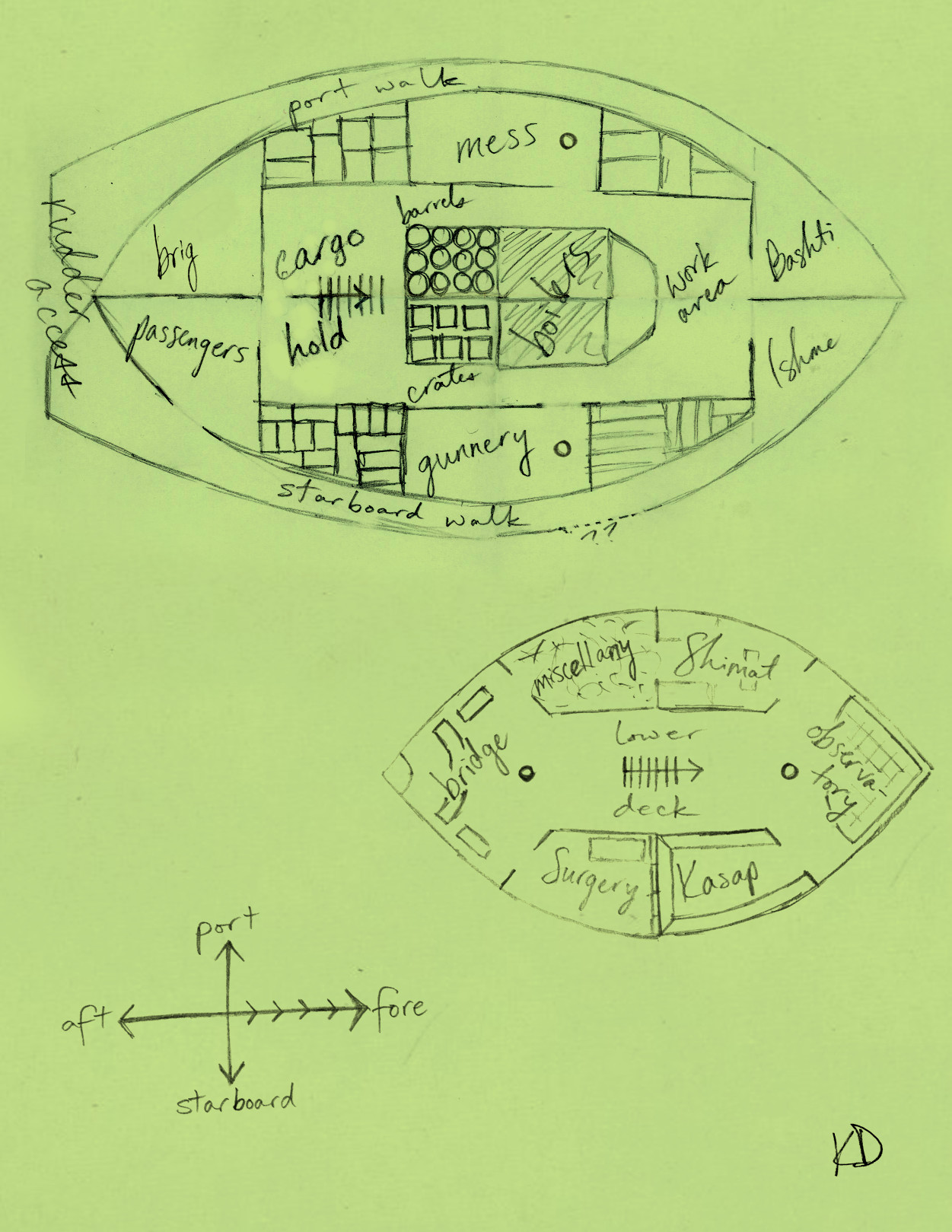
Discourse doesn’t like the size of the full-res version, but you’ll see it in the feelies once IFComp opens!
13 Likes
I like the hand-drafted feel. Definitely better than a clean computer printout.
5 Likes
I actually went to some effort for that! The library scanners gave me a very clean version without any smudges and I re-introduced them from another scan to make it be clearly pencil on paper.
I figure, best to lean into the stylization—I want it to come off as good pencil work rather than messy computer work.
8 Likes
I like this map!. It has a treasure map look.
5 Likes
Did you already settle on tech details? For example did you use some steampunk tech like “ether” or so?
1 Like