I thought it could be funny to make a thread on our preferred inspirations for ECTOCOMP.
Not only the main one inspiration you are going to use, or what are you looking for creating your ECTOCOMP entries. Even, as players, what kind of games would you like to play?
Recently, I’ve seen this video on “The Wind in the Willows”:
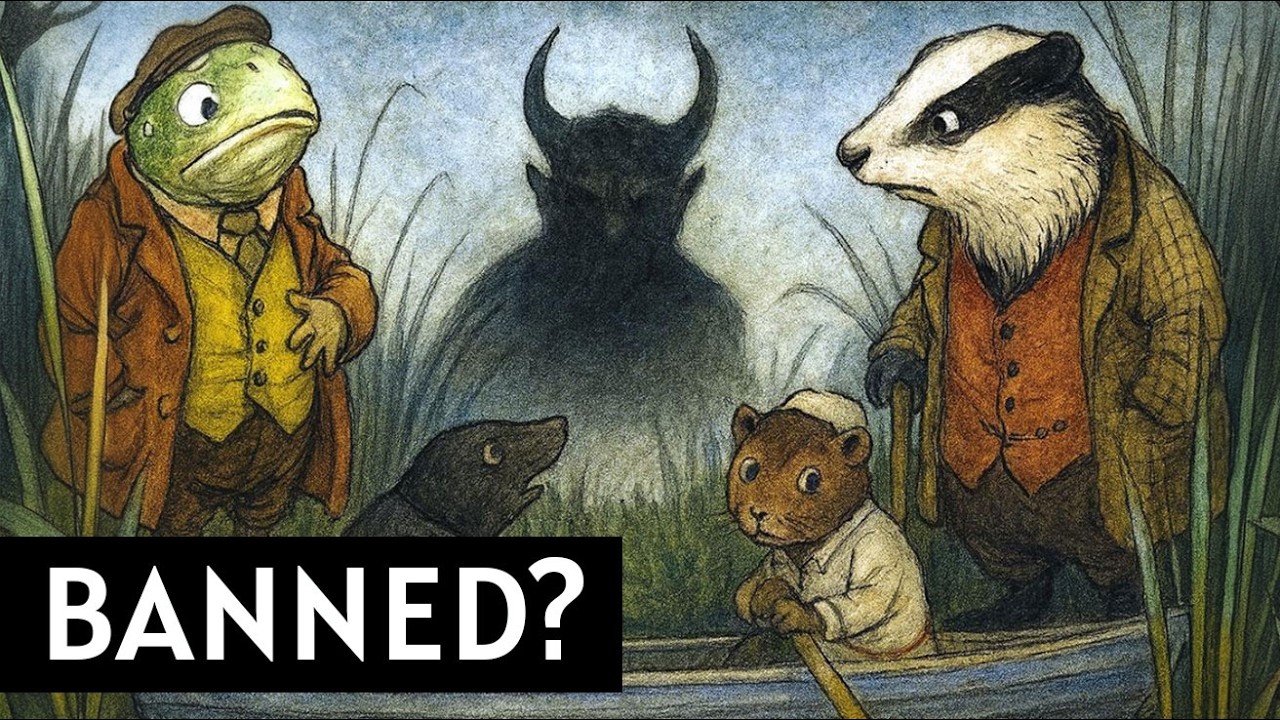
It fits quite well with children’s tales with anthropomorphic animals, a-la “Over the Garden Wall”. I’ve always had a liking for those.
But, the one I like the most is the one I have always insisted on the rules of the comp, you know: that one about “telling traditional scary tales around the fire, eating sweet wheat porridge.”
But those are for playing, for creating stories myself. I fear I am still in the loop for supernatural stories mixed with real-world issues, but probably this year, that would make a turn for something a little animistic. Let’s see how it goes.
We’ll see if I can actually manage to scrape something together (I’m still fighting that IFComp burnout) but I’m considering writing something about drowned towns.
I just read Ghost Wall by Sarah Moss and it has me back down the bog body rabbit hole again, but I’m not sure yet if I have an appreciably new/interesting angle on it. We’ll see!
not according to relevance, in no particular order
alchemy, not as the art of changing things into gold, but as a philosophy of constant refinement and as a discipline which neatly straddles scientific and supernatural
the journey of a soul to the afterlife
liminal spaces between life and death
Carmilla
the vibe and style of those weird Victorian pamphlets I accidentally stumbled across once
and of course, all time bangers in Naarel’s toolbox:
I’ve always wanted to enter ECTOCOMP, but I always seem to be too busy on other projects. This year is no different, with ten games needing to be finished.
I’ve also wanted to write a good horror game. The Witch’s Apprentice would have been ideal for ECTOCOMP, as it’s set on Halloween and is a little tongue-in-cheek. A Taste of Terror would have been a good fit, but this was entered in ParserComp.
I’ve got an idea for one game that would be suitable, but I’ve only got the beginning and the end and no middle.
I’m thinking about adapting one of the games from the BDB Project. At least four of them look suitable for ECTOCOMP. One delves into the occult, one appears to be set in a haunted house, one transports you to a fifth dimension and one deals with lycanthropy (i.e. werewolves). Let’s see what happens over the next month.
Last year, there were a surprising number of requests for a sequel to Familiar Problems, but I had no idea how to actually do that because we’d mined most of our ideas for the first game. Last week Sarah had a flash of brilliance and pitched a related but distinct concept for a sequel that gives us tons of new material to work with!
So if everything works out, we’ll be returning to Promethean University, but with a new player character this time…
One week into ECTOCOMP last year, 43 rhesus monkeys escaped from a medical research facility in South Carolina. Despite the mostly whimsical framing in the news, I thought it could make a chilling IF, whether you’re on team monkey or team human. Not sure I’ll revisit the idea this year, but I’d definitely play that game.
(I guess they did manage to recapture all the monkeys. One more point for team human.)
I usually choose topics for our team (an autocrat, I know), but this time it went spontaneously. We were thinking of a topic for our school’s biology conference and Underground promissed many unexplored corners. It was a matter of time when an idea appeared to organize an escape room for younger students. The challenge for Ectocomp was announced on a workshop and the 5 games by OneBoatCrew are just a fraction of games written in Slovak (actually, how does one start a thread for slovak speakers here?) The students from our SIF team plan to chose the most inspiring game for live enactment. This is all just passtime…and sorry for the typos - the time was pressing.
Inspiration? Hm. Well, for my parser games, the inspiration typically was a thought or an image—the introduction of …Grind… and the end scene of I Have No Verbs motivated me to build the games following from/leading to them, while the simple thought of “what if the typical zombie home invasion scenario was turned in its head” motivated that game.
My two poetry works were written in a somewhat improvised fashion around the themes of rhythm and cycles; for example, I knew the rough direction of “Eternal Recurrence” when I was writing it, but “A reversal of expectations” only gained the ending and title that it did because I found myself needing an alliteration for seconds and an internal rhyme for treacle.
There were other influences as well. The choice of a silkworm for a protagonist in …Grind… was influenced by this (which I found out about via an xianxia-inspired Worm fanfic), though I suppose this had very little bearing in the game’s writing.
I’m imagining a transcript (I mean, a misnomer since I think all your students games are Twine? Please correct me if I’m wrong) being read out like a monologue.
If you mean enactment, then the rough idea is to have rooms with NPCs - actors representing prople or objects from the game which give you directions, items or cues. The transformation process will be a challenge, but since the authors knew, they were supposed to design the game in such a way that it were easily adaptable.
When Drew Cook playtested I Got You, he said the game had a cinema verite feel to it. And I think that comes from these two sources: essayistic documentaries and found footage horror.
Right before I started working on I Got You, I was getting into documentaries and how people analyze its machinations in delivering the message it wants to tell. When I mean essayistic documentaries, I’m thinking of Harun Farocki’s Respite, which teaches you how to interrogate historical video footage (in this case, propaganda for a Nazi concentration camp): what are the circumstances that made this work necessary to its creators, can we glean more historical details than what the footage is telling, and so on.
I’m also into found footage horror films where the only thing you see on the silver screen is a terrible camera, naturalistic dialog, and incomprehensible horrors. People are probably familiar with the original Blair Witch movie, but one of my favorites is Final Prayer (also called The Borderlands) where three people representing different stages of faith in religion and science are trying to grasp the miraculous horrors in the church. The footage is grainy, the script is heavily improvised, and you have to be very engaged in their banter to get something out of it – then, the final scene that ends in despair.
What I like about found footage and documentaries is that you have to pay attention to the form as much as the narrative content. The camera is the unreliable narrator and their subjectivity. You are always skeptical of the image and audio you’re being presented because what if they’re just imagining the shadows of the curtains as a monster? They’re genres where one has to particularly pay attention to form, and I hope I did something like that in I Got You. It’s very fun to strip the game to just the narrator’s subjective experiences while exploring relevant social themes.
Translating our subjectivities onto a game or the silver screen is going to be claustrophobic, and I think that’s gonna be what I’ll be researching into my next few games soon. It’s so interesting to see what is present and missing when I try to get into my characters’ head, especially when I can’t rely on an omniscient third person narrator. The readers also have to work with me in figuring out what is omitted and why something is present, and what that ultimately means. It’s fun.
 )
)