Hello! I’m new here and really impressed by the quality of interactive fiction in this community. I’ve noticed a lot of the projects are entirely text-based. As a newcomer, it got me thinking: does the absence of graphics change the immersion for you, or do visuals actually add to the experience? I’m also wondering if the lack of images is a stylistic choice, or if it’s simply due to the technical difficulty of creating them. What are your perspectives?
3 Likes
I should note, to begin, that you’re not really asking what the subject line asks. Obviously IF does not need visuals. If it did, we wouldn’t have forty years’ worth of text-only games.
I’m also wondering if the lack of images is a stylistic choice, or if it’s simply due to the technical difficulty of creating them.
That’s a bit of a false dichotomy too. Choosing the medium you are working in is an artistic choice, not a stylistic choice.
3 Likes
Hi Jess. I’ve got no doubt you’ll get a lot of very long and thoughtful replies to this, but the short version is that text games have a very long history. They were the first kinds of computer games, before graphics were even a thing. Graphics were added to text games later, and graphical games eventually took over and became the dominant art form, but text games still have a dedicated community of people who enjoy them and make them, much like Amish people who still choose to churn butter by hand. It’s very much a choice of art form.
2 Likes
A thing needs whatever its creator thinks it needs.
5 Likes
7 Likes
Personally, my experience is that it’s a lot easier for a game to have immersive text than immersive graphics. Good graphics can enhance good text, but mediocre ones can drag it down.
So I tend to include graphics wherever I think they can enhance my writing, but I don’t put them in just for the sake of having them.
A mix of both. If I were a great pencil-and-paper artist and could make accurate drawings of all the characters and locations in my games, exactly as they exist in my mind, that would be fantastic! But I’m not, and I can’t.
Even if I could, though, the graphics would be subordinate to the text. I love the flexibility of text, how language can use just a handful of words to convey a game state that would be difficult or impossible to draw—one of my current WIPs has sections where a bunch of different dreams are intersecting each other at chaotic angles and causing chaos at the boundaries. I don’t know how I’d ever draw that.
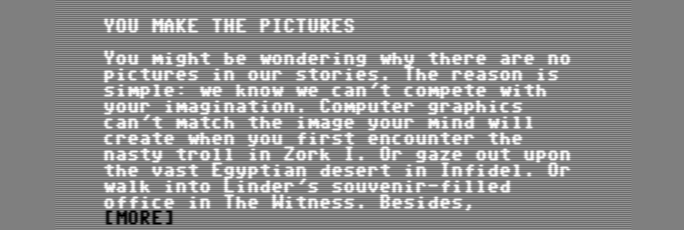
Plus, I like the accessibility factors of text. Both for screen readers and Braille displays, and also for running these games on ancient devices like a Commodore 64. In a world of planned obsolescence, I like being able to archive my work and assume it’ll still be playable decades from now.
7 Likes
The British author Anthony Burgess once interviewed fellow British author Graham Greene, and one of the things they discussed was having their novels adapted to the screen.
As I recall they were specifically discussing Greene’s The Human Factor being adapted. One of the characters has a bulldog, who is described as (from memory), “licking himself with the gusto of an alderman slurping soup”. Burgess comments that there’s no way to capture the diction.
I think there’s a lot of that sort of thing in IF. I’m certainly not against the visual arts in the abstract, but I don’t think any illustrations can accomplish the same sort of narrative inflection that text can.
4 Likes
Does IF benefit from visuals? I think when the experience becomes more game mechanics than storytelling, then it benefits from visuals. Otherwise, then I think it’s a purely stylistic choice.
Visuals can enhance the user interface and make the games more accessible. For content, some games hide important, physical information in the visuals. Interestingly, I find that some games with large maps benefit from room pictures because I can discern where I am more quickly. Reading a sentence takes a few seconds longer than glancing at an image. So larger games, that involve a lot of exploring and backtracking, benefit from visuals in ways that even some authors might not realize.
As to why there are less visuals in IF games… I think graphic art is more difficult to produce, thus less people are considered competent at it. You spend 12 years in English class, but Art class is entirely optional (sadly). By extension, people are more critical of visual art because it’s easier to produce objectively bad art. This critical nature extends to one’s own art as well and you get people not even attempting art to avoid friction because creating an IF story is difficult enough on it’s own.
TL;DR: We are lazy and generally suck at art and our egos won’t let us accept bad art.
3 Likes
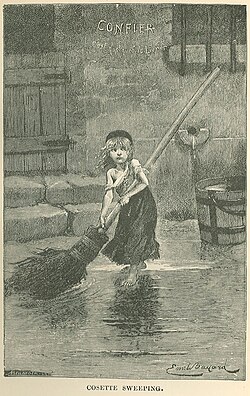
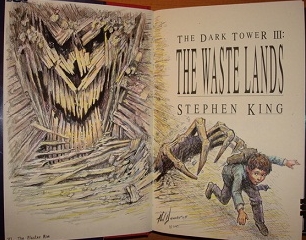
5 Likes
@jess After sampling the community thoughts here, what do you think? Is your experience of a text narrative improved by the addition of images, or does that depend? If so, on what?
1 Like
Thanks for asking, @Pinkunz ! As a visual designer who actually dynamic-routed into this space through Interactive Films and a love for exploration-heavy games, my perspective is definitely shaped by my professional background. In design, I constantly think about how to maximize the efficiency of information transmission. From that lens, I lean toward a blend of text and visuals. To me, images aren’t a compromise. They are a powerful enhancement of the text. Just like classic illustrations in traditional literature. A well-crafted visual can instantly lock in the tone of a world, lowering the friction of cognitive processing and elevating the player’s immersive experience.
That said, I deeply admire and respect the pure-text purism shared by many here. After all, even the most complex interactive films have to originate from pure text before they translate into cinematic language.
As a side note, with AI text-to-image tools lowering the barrier to asset creation, it’s fascinating to observe why this community doesn’t just rushed to embrace it. I suspect it ties back into what others mentioned about “artistic choice” and the author’s strict control over their vision. AI-generated art often lacks that deliberate, soulful intentionality and can’t meet the precise emotional nuance an author wants. It’s a beautiful paradox of our time while technology drastically accelerates production efficiency, its homogenized nature might actually restrict or dilute genuine creative expression.
Partially that, and partially that this community is pretty heavily anti-AI in general. This is a niche hobby that hasn’t been commercially viable since the 80s; the vast majority of us are doing this because we love doing it. Automating away the writing, coding, and (in some cases) illustrating means paying money to not do the thing we love. So what would be the point?
Efficiency just isn’t the goal; there are people here still working on projects that started in the 80s or 90s. The goal is stuff like, “can I adapt Hamlet into the form of a 1970s Scott Adams adventure that runs on a TRS-80?” So I think the bit about diluting the genuine creative expression is spot-on.
(I’m speaking in broad strokes, though. Some people here are fine with AI for coding but don’t want to use it for writing. Others are experimenting with using it to improve command parsing, or for things like text-to-speech. It takes all sorts.)
4 Likes
if ur IF game heavily features pictures, then it’s a VN - maybe a subcategory of IF or maybe an entirely different thing.
(also if you’re counting VNs as IF then there are a lot more VNs than pure text games, so the majority of IFs do feature visuals, not text (atleast, these days). i’m assuming this based on itch - so many VNs on there)
Not sure it’s quite as clean cut as that.
3 Likes
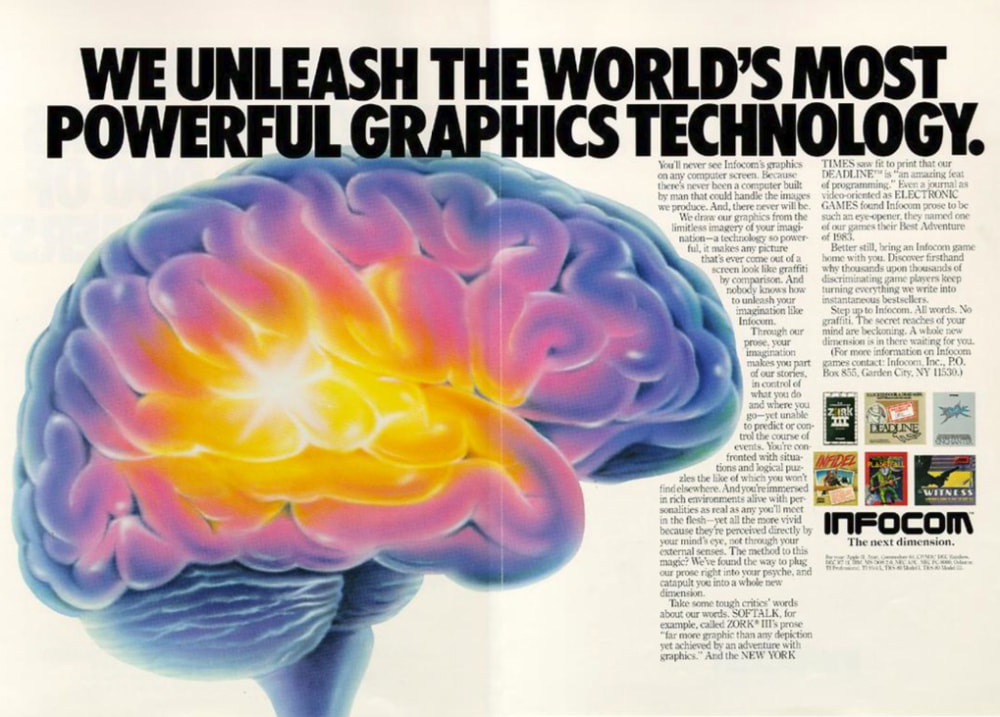
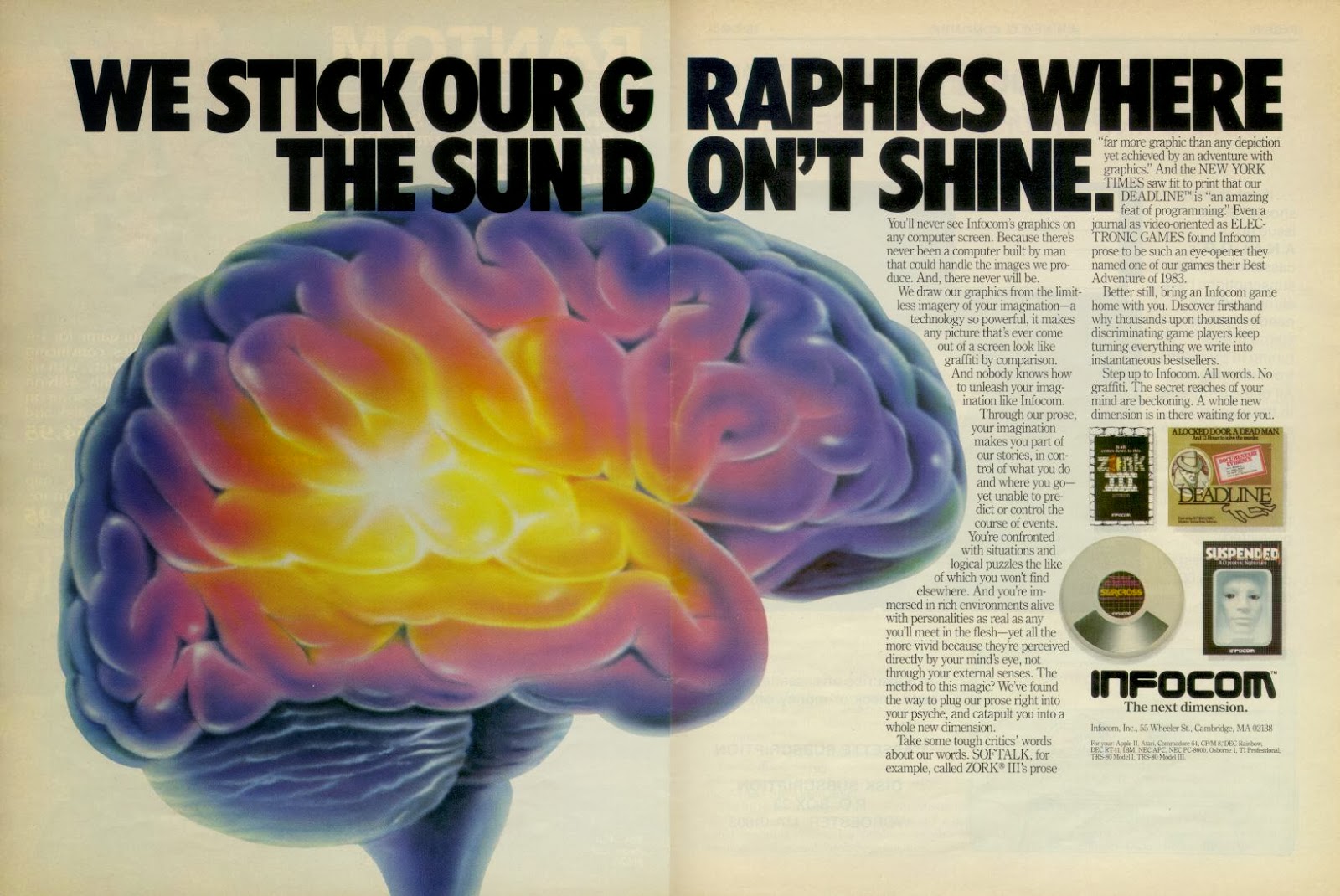
I always think that the brain is by far the best GPU.
Best regards from Italy,
dott. Piergiorgio.
2 Likes
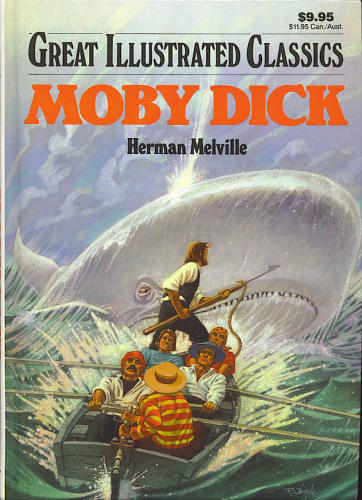
It’s a tricky one. I think that really good illustrations can enhance even a really good text; Tenniel’s illustrations for the Alice books, Mervyn Peake’s illustrations for the Gormenghast series, Tove Jansen’s illustrations for the Moomins, Quentin Blake’s illustrations for any of Roald Dahl’s books. Most of those are children’s books, of course, and they’re also works of fantasy. Would a Moomintroll be as appealing if we only had a written description? I’d say probably not.
Good illustrations can enhance a mediocre text. There’s nothing particularly scintillating about the writing in the Fighting Fantasy series, but the original illustrations gave vivid life to the rather lacklustre descriptions. The less said about the modern illustrations, the better, except that they make the books hardly worth buying.
I think it’s safe to say that bad illustrations would also detract from a great text, but it’s hard to think of examples because publishers are well aware of this. Most of the people who write IF are good writers, but not all of us are good illustrators. There are plenty of examples of IF authors who are both. Those who aren’t wouldn’t want to risk spoiling a good game with bad pictures, and I think it’s as simple as that.
2 Likes
I think the IF community remembers how things went with graphics in the past. Maybe, looking at these text-only games, graphics sound like a new and exciting addition to IF. In 1980 they were! Today, graphics are fine, but without any novelty, and with a long history of caveats.
First caveat: the graphics and text must relate to each other in some way, or else you’d be playing two separate games that just happen to be put together into one program. That would actually be pretty cool, but maybe a little experimental. Normally you expect graphics to depict things mentioned in the text, and vice versa. Experience shows that it’s not always clear to players what something in a picture is called, or that something in the text refers to something in a picture. Or which things in a picture are relevant to things in the text, and which are details that exist only to fill out the picture. In interactive fiction, that’s a problem. If you think it’s hard to write room descriptions without implying the presence of objects beyond what you’ve implemented, try it with pictures! A picture speaks a thousand words, which is not a good thing if you only wanted fifty. To make detailed artwork work in a game, you have to find some way to severely limit the player’s affordances, such as making it clear that this is more of a Choose Your Own Adventure than a game, only giving them the ability to run around and shoot things, or instituting some convention about what kinds of objects might be interactable (buttons, levers, and books, for instance).
Second caveat: if there are illustrations, and this is interactive fiction, doesn’t it make sense for the player to be able to interact with the illustrations directly? And if they can do that, it would just be confusing to present that same set of affordances in text. (Is it the same set? Or is clicking the picture subtly different from clicking the textual choice or typing a command? How does one know without trying both?) Most of many games can be presented graphically: if the player is generally attending to the graphics, how do they know when the text, or some textual affordance, is now important?
These are exactly the questions that adventure game developers were presented with, and the industry’s answer was point-and-click adventures. Maybe there are other answers too, but you can see that if your target is primarily a written work, there wouldn’t be any sense that the grass would be greener on the graphical side, and maybe a feeling that graphics have to be done right if they’re to be used at all.
That’s like saying that if a novel heavily features pictures, it’s a graphic novel. But there’s no amount of illustration that per se turns a novel into a graphic novel. See The Invention of Hugo Cabret or the Dinotopia series. Almost all games have text and heavily feature pictures, but not almost all games are visual novels. There are additional conventions involved.
7 Likes
I’m quoting this part, but I’m mostly answering to all your points. You seem to assume that the illustrations depict the location in a side panel, as if both were independant. That’s how it’s often done in parsers, but that needn’t be the case!
You could display a picture of an object inline, when examining the object, alongside its description. It then becomes a supplement to the description. With beautiful typography, and the text nicely flowing around it, it could be really nice.
Or you could display illustrations punctually, like at the start of chapters, or to illustrate cutscenes.
(Not to mention maps, diagrams and so on, but you have to make sure they are not needed for people using screen readers and such.)
My point is, there are lots of ways illustrations could be (mostly) strictly additive.
4 Likes