Trying out writing design focused posts. Let me know if this was helpful to you!
When writing interactive fiction, visual novels, or any interactive medium where player choice is a feature, the problem faced is scope. For a choice to be meaningful there must be a consequences. Consequences that, you might presume, dramatically increase your word count, scope of the project, etc. I thread the needle by changing the context of the story more often than I change the story.
In my interactive fiction, True RPG: Mercenary, the player will be hunting in the woods. During the hunt, they are attacked by a bear, always. There are several different results depending on their choices. The mama bear can live or die. The bear cub can live or die. The dog can live, get injured, or just die outright. The player can be injured or not.
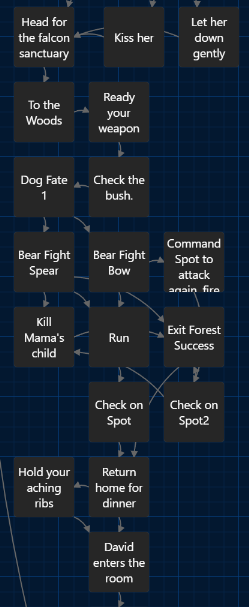
Some of these are directly corelated. If the dog dies, the bear will always will. If the dog is injured, the mama bear dies. If the mama bear is dead you can decide to kill her cub or not too. As you can see, there’s a lot of consequence for choices in this one scene. All of them only lead to maybe one future consequence, the dog living, dying, or being injured.
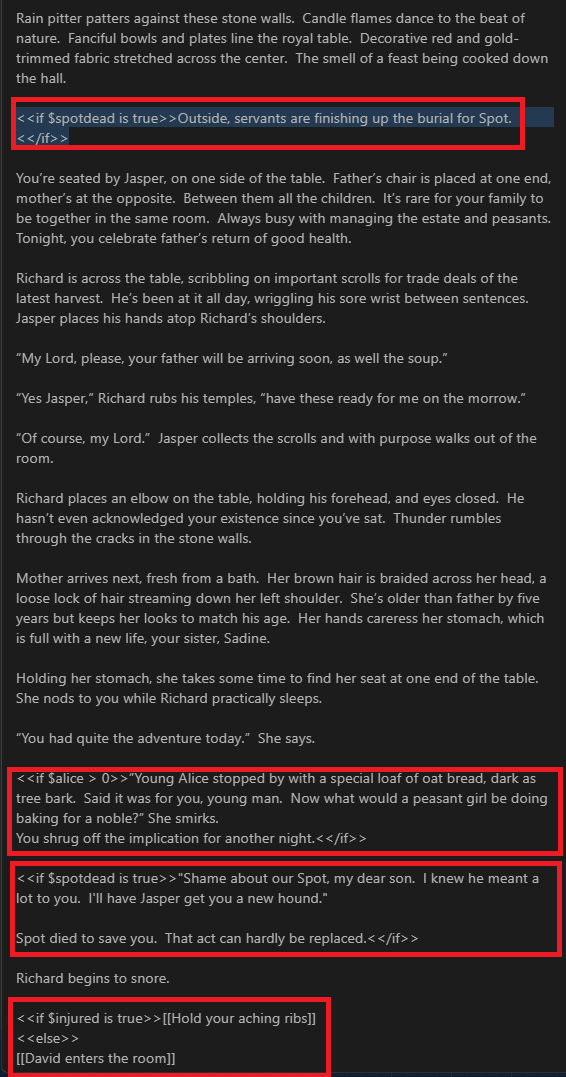
However, the game remembers all of those details. Extra or tweaked writing is added to further contextualize those consequences without them dramatically branching the story. For example, if the dog dies, a servant is mentioned burying him. The scene itself largely remains the same but now the context has changed. The emotional payoff for the player of their choice is upheld without a dramatic branch.
In this example I’ve highlighted all the changed text depending on if the dog died or not. Additionally, Alice is a character the player can romance earlier in the game. She too is contextually brought into the scene, without actually changing the scope of it. And finally, if the player was injured, it too creates a small diversion from the main path to change context.
Shortly after, further context is provided again if the dog died, if mama bear died, and/or if the cub was killed.
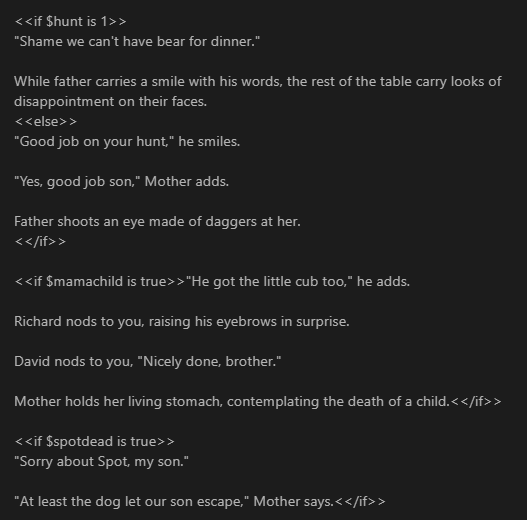
If you kill the cub, the scene characterizes your mother slightly differently, since she is pregnant herself. Small nods like this do not significantly increase the scope and basically end up writing two or more scenes for the price of one. Another quick example is in my interactive fiction, Kidnapped. You get a slightly different characterization of your kidnapper depending on completely optional choices.
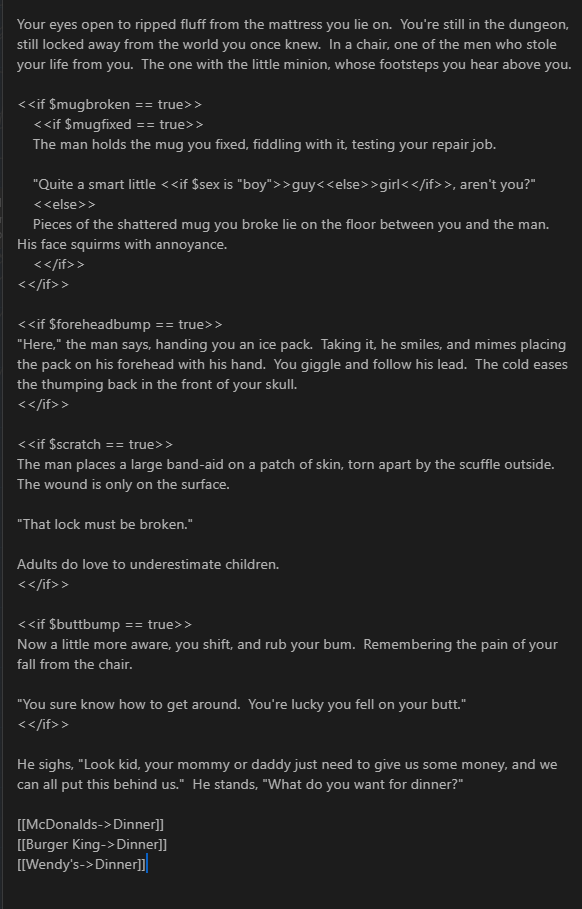
In this one scene a variety of independent choices the player can make contextualize the scene different. Five total different bits of writing that further characterize your kidnapper. When the kidnapper sighs, how exactly the player understands that sigh and subsequent dialogue will be based on the contextual bits before, thereby changing the experience.
You can even see that I give the player a false choice. No matter what dinner they pick I don’t actually care or track it. Why make it a choice? Because the player can pick their favorite childhood fast food they can better connect with the protagonist. No scope change, slight connection with the protagonist. It is the same reason why you can choose to be a boy or a girl in Kidnapped. It only changes the context, not the story.
In summary, when writing choice into your projects, you do not need to feature significant branching even for fairly significant choices. You can simply alter the writing and provide that player a contextually different story. That makes all the difference in their perception of the quality of the choice. You only need to make the player believe their choices matter.