Chronostates is a Worldbuilding Engine in a game format

Hi everyone! I’ve been lurking here for a while and wanted to share something I’ve been building.

ChronoStates is an AI-powered interactive fiction engine built around alternate history. The core idea: you step into a historical divergence point and make decisions that cascade forward through time. It’s not a visual novel and it’s not a parser game. It’s closer to a worldbuilding simulation that plays like a game.

How it works:

You pick a scenario like say, the fall of Constantinople goes differently, or the Reformation takes a different path. You’re placed as an advisor to a leader, and your choices trigger event cascades that ripple across politics, religion, economics, and culture. Trust matters. If the leader trusts you, they follow your counsel. Lose their trust, and you’re dismissed.

Behind the scenes, the engine tracks world state, character relationships, factions, and causal chains. It’s not just "pick A or B and get a canned response,” the AI generates outcomes based on the actual state of the world you’ve shaped.

What you can do right now:

  • Play 5 free alt-history scenarios — no account needed, just pick one and go

  • **Sandbox mode ($19.99/mo)**build your own worlds, your own divergence points, run longer simulations

    I’m particularly interested in feedback from this community because you all think about interactivity and narrative systems in ways that most people don’t. The engine handles things like trust mechanics, character voice profiles, faction dynamics, and tiered context management, and I’d love to hear how IF veterans think about those kinds of systems.

If you want to try it: FOUNDER1982 gets you 25% off for life.

Happy to answer questions about the tech, the design decisions, or the alt-history content itself.

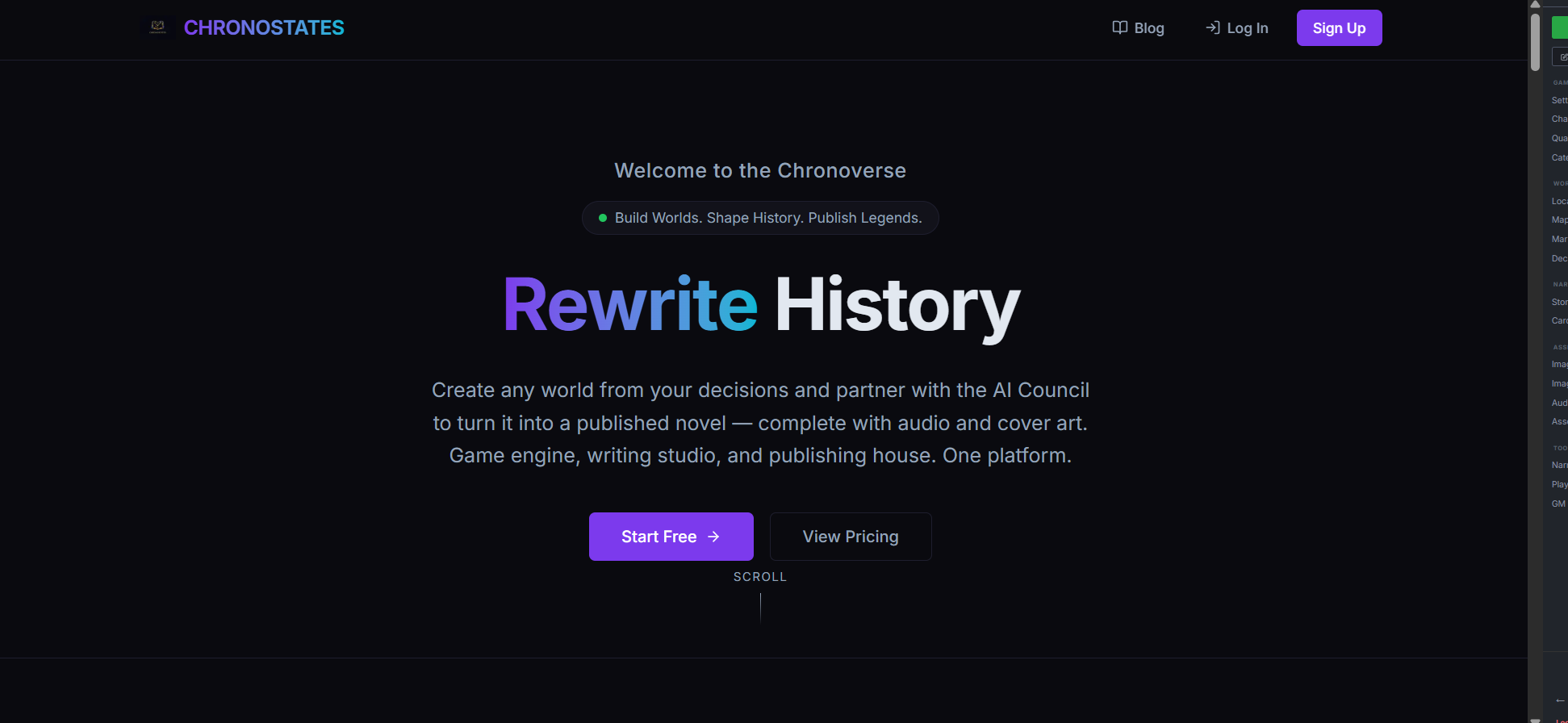
1 Like

“no account needed”

First prompt is the prompt to create an account

Looks like the URL is https://www.chronostates.io/

Your can play the sample scenarios for free, you just have to scroll down past the advertisements for some quite implausibly-priced subscription options first ($59.99/mo?)

Reminds me of A Better World (which has only humanly crafted prose)

3 Likes

If this thing runs 9 Opus models in the background, it’s bound to make some expensive API calls. But I feel aggressively marketed at for a premium service that looks cheaply made :sweat_smile:

$20 a month to read AI slop is a brave business proposition.

3 Likes

Ouch. I spent a lot of time working on this and perfecting it.

AI is not all “slop” as you say.

1 Like

I’m certain you did, and I just realised I ought to perhaps not post critique after having been woken up by my 1-year old. My apologies.

That aside, I have some experience with mostly building backends I am extremely proud of, and I happen to know how much getting AI to do different critique, generation and modification passes can feel like herding cats. The front-end just reminds me of something Google Gemini threw out on a first try, and the testimonials certainly don’t help me to get any confidence.

This may not be the case, but it feels like a cheap attempt at a very expensive SaaS, even though I know the struggle of getting LLMs to behave.

What would you do to improve the front end?

Gave one of the free scenarios a try. After the first choice it took 20 seconds to load the next bit of prose, made the 2nd choice and it took 30 seconds to load. Not a great experience so far.

2 Likes

Mobile or Web?

My initial thoughts, you have made a ‘product’ which has a very particular market. I think specifically history nerds and, possibly lazy-ish writers. I am very much one of those history nerds.

Now, what absolutely does not inspire me is the Dark IDE look that this gives me. When I think history, I am usually reminded of photographs, parchment, paintings, statues. Like Europa Universalis, what tickles me here is seeing moments in history, the highs and lows of humanity, that type of thing. Possibly just a ‘classy’ interface using serif fonts and a distinguished color palette, rather than a slick one.

Now, the second thing is that the price does not feel at all justified based on the initial offering. I think it’s important to highlight what the problem is your product solves: Generating alt history using LLMs, but in a way where it actually is coherent. Because I know from experience LLMs completely flounder at trying to write complex world states, which you seemingly attempted to solve with the different passes. This is expectation management.

Especially this example. I know why it takes so long, but this is invisible to anyone not as deep into LLM usage.

I think it’s good to be up front about why what you made has not been replicated elsewhere. Also, people are likely VERY hesistant to drop 60 bucks a month on something they don’t trust yet, except that’s the first offer thrown in their face.

You’ll want to have a softer opening bid. Try X amount for free on preset scenarios (perhaps even the full scenario), then you can either opt to drop a little money on tokens, or get a lot more or even unlimited usage with a subscription. This makes it easier to be ‘pulled in’.

You can even build in a little trick here in the backend. After X amount of times a scenario has been run, you are likely to already cover 90% of responses. So, store or cache them somewhere, and before even attempting to generate something, see if you can pull something from the database that would work with the user’s prompt already. You can even use a very lightweight or flash model for this.

Essentially, make the first thing a user sees “Just try it, click here” with some screenshots. Establish rapport before asking money.

Speaking of which, the testimonials feel fake. At least to me, they usually do on most websites.

I could go through it with a finer comb, but this is the best I can give you at a first glance. Right now I feel like I am looking at a vibe-coded SaaS, not a fellow history enthusiast’s labor of love.

6 Likes

Rather than reflexively dismiss this I thought I would give one of the scenarios a try. I went for Gettysburg.

It took about 30-40s to generate the world at the start which is fair enough. My game Fleet Commander spends about as long generating galactic history.

But selecting my first choice “March on Washington” I waited 70s for a response and then got a slow “typewriter” style entry. I was already pretty bored by seeing the same quotes carousel past me 3-4 times.

The result was a kind of dashboard of effects which are not presented narratively. I’m not quite sure what I was supposed to make of those.

Then I clicked “Continue” and in the time I’ve taken to write this it’s still doing its spinner thing.

Even if I thought this was a good idea it is essentially unplayable.

1 Like

Are you using Mobile or Web? Because i fixed this issue a few days ago and have not be able to replicate the time since.

Solid advice.

Regarding the other persons comments on timing, I don’t know where she is getting those numbers. When I first launched I was using a different AI for generation and it did take that much time but every time ive played through a scenario I get through 3 events and consequences.

I hear you on the tokens and the dark IDE.

testimonials are real - did you know its a literal crime to publish fake testimonials?

Part of why I can’t do the cache method beyond the free scenarios is because I was planning on adding a “Enter your own” option soon.

Well, that’s certainly a debateable point. But if I phrase my admittedly snarky comment more neutrally, as “$20 a month to read AI generated histories is a brave business proposition” then I struggle to imagine who that wouldn’t hold for. While I wouldn’t want to pay for a coding assistant myself, I can see why people would, and what they might get out of it. But why would I want to pay to read machine generated text? I cannot see how that would be a worthwhile experience for anyone, beyond being an amusing toy for a short while.

It’s always interesting to see people’s labours of love. But when you want to charge, you raise the bar on the quality expected very quickly. When you want to charge at least $20 a month, that bar is way high.

2 Likes

For $20 a month, you get to create your own world and expand it by playing through events like a choose your own adventure game. The world is your oyster. API costs on someone playing through 300 events are high.

Hello. I like your idea. No point for me to repeat what others have already said, so;

As this is a business idea, It’s not totally clear what i might be paying for. Am i paying my 20 bucks to play alt scenarios, or am i paying to create or curate scenarios, that i can also let other people play and possibly get some money back?

Because, if I’m paying $20 for me and me alone, that’s a bit expensive. There’s a lot of stuff out there i could get for that kind of spend. I’d immediately expect graphics, sound, spoken dialogue etc for this price range.

I realise you have API costs. And if this is the price you must charge, then i think it wont work unless you can find a cheaper AI provider, run locally or run on cheaper rented GPUs.

Nevertheless, i see you’ve put in a lot of effort which is highly commendable, and best of luck.

2 Likes

There are five free scenarios and then a sandbox builder where you can do whatever you want.

But - you’re right, I guess I did overprice the Voyager Plan.

I’m changing it to $8.99/m shortly after doing the math.