Ḫattušumna Laḫḫa, by Daniel Stelzer
As always, the start of the semester and an uptick in work have obliterated the time and energy I have to play everything I want, let alone review. I did want to make time to review this one, which is weird and special and a real oddball when compared to the rest of the IF Comp lineup.
First, my lingua bona fides: I took three years of Latin in high school (had fun, wasn’t very good at it). I took Spanish in HS (had fun, was decent but never got far). I took two or three courses of undergrad French and another year of French in grad school (had fun, got pretty good at reading comprehension).1 I enjoy learning languages, though I’ve never had raw genius, and I’d like to actually learn Spanish (it’s hard to learn languages as an adult, just time and opportunity-wise).
I was excited about HL as soon as I learned it existed. It was intimidating, and I needed to set aside time to really dig in. I played through the first tablet, looked at tablet two, and at that point I’d hit the 2-hour limit. I’m going to review it up to that point. I was uneasy about reviewing without finishing, but I think it’s an important part of my impressions and critique of HL as a comp entry.
What first struck (or maybe more accurately overwhelmed) me about this game was the UI, which was busy. I don’t mean it’s cluttered or poorly designed, but there is a lot going on. The conceit of a desk set up is both cute and quite smart. Marginal notes on the left disguise error messages as a translator’s textual commentary; commands and responses are broken up into simple line-drawn fragments that prevent an endless scroll of Hittite text; and discrete notes on the right-hand side remind you of generally important verbs, specifically-selected words and their cases, the map, and the available directions of the compass. It’s a lot to jump into, but it ultimately pays off. As I played and things got more complicated, the UI felt more natural and necessary, but at first it’s a lot to take in.
The story and puzzles of tablet 1 are simple, the real challenge being how to input the right commands to progress; the gameplay is basically split into a language puzzle that you need to solve to progress the parser game. This was the source of some humorous frustration (I had trouble dousing the fire because I kept putting my bucket down on the hearth instead of pouring water onto the fire) and some fun ancient linguistic shenanigans (sometimes no one bothers to describe a noun, and you just have to call it a doohickey and get on with the declensions).
So here’s my big criticism: I finished tablet 1 after about 1h 50m. The gameplay was pretty chunky, and I don’t see a lot of people finishing tablet one in less than an hour, absolute minimum. I took notes on paper to help me try to retain/learn, which maybe added some time. Still, peeking at tablet 2, there’s new grammar and notation: more learning, which I’m excited about, but if tablet one took basically two hours… A satisfying two hours, too. Tablet one felt like a complete thought, if not narratively than as an experience overall, a memorable introduction to Hittite language, culture, and linguistic scholarship. My impression is that HL would be a more graceful comp entry as a single tablet, maybe with one extra step or wrinkle added to the parser game. Three tablets don’t feel like a game so much as a project. This game, created by someone with a literal doctorate in Hittite, possibly suffers from an XKCD Average Familiarity issue; it’s just too chunky for anyone to engage with as a single experience, at least in the context of IF Comp.
But I don’t want to lose the rest of it. So, what, do I want a series of games, each building on the last? I think my conflict comes down to the fact that HL doesn’t feel like a game, it feels like an exciting learning tool. This is such a great way to solidify grammar and vocab learned out of a textbook, especially for dead languages. I wish I’d had a wax tablet to play through as part of each Latin unit. I genuinely think this would fit really well as part of an overall curriculum. Heck, it wouldn’t even be out of the question for an instructor to learn Dialogue and revise sections as needed.
Still, despite feeling like this isn’t a game so much as a neat bit of academic kit, I loved my two hours. It was fun to play; learning a language is basically a word puzzle. HL is totally unique and fresh and VERY on-brand. I will be finishing it. So maybe forget all that stuff I said above? I’m glad this was here, regardless of how bulky it was, and I’m excited to go back and get through the next tablets.
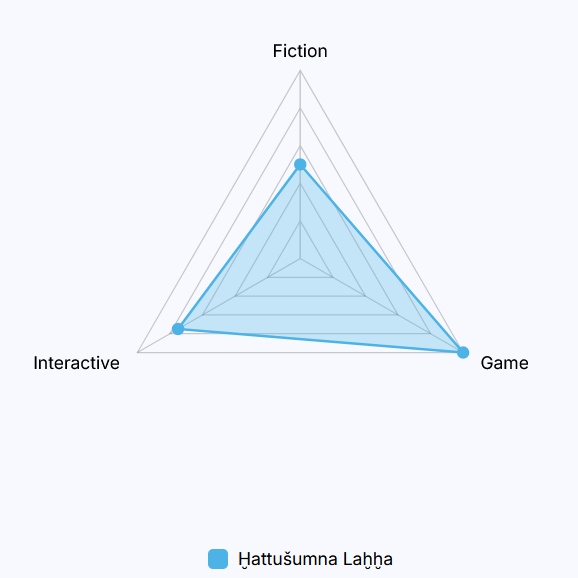
HL was a tricky stress test for The Chart!
Interactivity - To refresh, interactivity “measures” the extent to which you can affect the game state or the world. None of the language learning is really interactive in that sense, but all of your input DOES progress a parser; there are objects to manipulate in different ways. It’s a simple parser, but parsers are highly interactive inherently.
Fiction - all the parser input progresses a story, but that narrative gets a little lost in the meta-puzzle. A lot of what you’re actually doing learning a language that you then use to progress the story that demands you learn more language. So… middling fiction?
Game - There’s two levels of gameplay here, the language puzzle and and the parser game. Both have a clear, set goals with right and wrong answers. You can fail by using the wrong word or the wrong case, or by failing to solve the parser puzzle. Very high game, according to this chart’s definition of game.
___________________________
1. (As a grad student, I had to co-write & perform a short skit in French. My team’s sketch was about Barak Obama and Mitt Romney who, having overcome their political differences, were now living as elderly lovers in a nursing home. The main humor came from Old French Romney’s repeated use of the phrase “mon petit Barack” and Old French Obama saying “laissez moi etre claire", which is graceless French for “let me be clear”, a phrase that Obama said sometimes. The year was 2013, the place was Edmonton, Canada, I played Old French Romney, and the sketch killed in the room. Truly, it was a different time.)