baezil's IF comp '26 reviews (latest: Ḫattušumna Laḫḫa)

Assorted shorter/simpler thoughts below.

When You Were Shot by Elephants, by Ellie G. - This was the first game I booted up for the comp. Quite a choice by me! Intertextuality is all well and good if you’re in the know. With no experience with the referenced games, though, I was nonplussed. If this game is saying much about the games it’s referencing, I’d be curious to know what. If it’s trying to say anything that stands on its own, I missed or failed to appreciate it. Either way, this could be a me problem. I’ll note that I don’t love a fake CW, and I don’t get this game’s. A reference? A commentary? A joke? A perplexing game overall.

Live and Get Pie!, by Tame Spond/ee

Huh. Cute!

Demonstration, by Marion Zhuravlev

With games that lean more poetic or experimental, I find that a good way in is to ask why it isn’t simply written on a page. What does the interactivity do for/in this work? For me, the interactivity broke up the meaningful passages with a lot of “?”s and “you see nothing special about”s & obscured the substance. The final action needed to conclude is uncued, and I think that’s the most interesting part of the work, but it’s bad parser form, and the frustration failed to make me receptive to what the work was doing. This bills itself as an experiment, so like a good datum, let me report that overall, the procedure of the game distracted from the meaning.

IF Derby, by Hedda Deadline

I spent maybe ten minutes with this, felt pretty confident there were secrets to be seen, and waited for smarter, luckier, more patient players to discover them. Cheers to them, because I liked what they found. I’ve seen a reviews question whether a game really “belongs in IF Comp” a few times, which seems like such a silly thing to say. Do we really want the same kind of thing, predictable winners with the right pedigree of influences? Isn’t opening something new and being surprised or provoked or baffled part of the joy of the hobby? If that means we sometimes bet our time on a knobble-kneed pony I think we’ll survive.

New Captain, by Joshua Kaden

Crew/ship management and dialog-based relationship mechanics are very much my jam, but this one didn’t quite work for me. I’ll start by saying that I thing all the right pieces are here, but they didn’t quite fit together. The UI/structure makes navigating the game unclear or unpleasant, with a lot of clicking and repeated text, a lot of options that mostly return basically blank responses (the crew convos, e.g.), a lot of basically unneeded info siloed away. There are relatively few story choices. How the time mechanic, the crew opinion score, and mission success affected one another wasn’t clear during play, and I never felt sure of the extent to which I could affect things; not very captainly! The tone confused me: the names are kid’s cartoon goofy (Yuk Yuk, Crunchisnax), but this isn’t really a comedy game. It’s also too vague to successfully play it straight (we find choice-significant kompromat, but it’s kept irritatingly abstract; the crew have long dossiers but little personality shows in the few conversations you have with them). I think this needs to be sillier or more grounded to work. If the author had ideas that didn’t make it into the comp version, I’d love to see a post-comp New New Captain release with more substance and styling. It this is it, I think this only works as a streamlined experience. (No one asked, but I think the current version would work better as a parser.)
12 Likes

Pegasus Crew, by Dildemma

Pegasus Crew is an amiable little game that I wanted to really like. It’s competently styled, has an interesting setting, doesn’t try to do more than it needs to, and it has some funny moments. This review, though, will read as largely negative. I’m disappointed in myself; I’ve written a few “this isn’t working” reviews, and I’m torn on whether those are really worth sharing. Maybe I should spend more effort on what works, y’know? My experience of this game, though, was largely characterized by confusion that affected what this story was trying to do. So warning, I guess: spoilers and critique below!

This game is both confused and confusing. Here’s the first sentence you read in-game:

Once upon a time, I believed that the universe was made from ones and zeroes: Those who live to serve a purpose, and those who ordain too much chaos to be allowed one.

That’s not what ordain means, and worse, the basic metaphor is doesn’t work. A few sentences later we’re told, “My comrades and I served our creators well, terminating zeroes before they disturbed the binary.” You can disturb a binary by declaring yourself to be a third thing, and you can disturb it by eliminating half of it and turning it into a unary, but being a loser and not a chad is, if anything, reinforcing the chad/loser – sorry, the one/zero binary. This passage suggests that binaries will be some coherent conceptual motif… Are Locke and Chicken a binary, the grump and the happy naif? Is captain/crew a binary? Are we a binary, past/present? I don’t see the game meaningfully engaging with the concept of “us and them,” not in a consistent way. Also, all I can think of is that “listen up, fives, a ten is speaking” line from 30 Rock, or the Meow Meow Beans ep of Community.

Not a great start, then, and the confusion continues. This games says, here’s a plucky crew of oddballs resolving the captains’ backstory after a series of adventures, don’t worry about what those adventures are or what your relationships look like! It does this so it can justify a range of choices we’re given in-game, but it means that the significance of things we do or learn in game is often unclear. We learn that Chicken used to work on Endaimon, and very soon after get a flashback to our our first meeting, back when Chicken was a sex worker. This flashback’s pupose is to complicate our relationship with Chicken (which is already hazy), but reading it I had questions about the plot. Is the implication that we met her here on Endaimon? I thought we, the captain, were here for the first time? No big deal, maybe, but the next big thing that happens after this scene is a trip through a zoo of functionally extinct beings. We see a earth exhibit with humans, and you recognize the woman who was your handler when you were an assassin. So, wait, are WE from the zoo? Is that why the collector has your memories? Was the collector using you as an assassin, or were we hunting other humans within the zoo enclosure? Did we break out with Chicken? Or was earth just destroyed recently? Are humans rare, now? The PC’s reaction is kept fairly vague, so we as the player don’t know the significance to the plot or to our character. This isn’t artistic or productive ambiguity, it’s just frustrating. It makes us feel very disconnected from the character we’re meant to play and the world we’re meant to inhabit.

This haziness of the captain’s past and personality makes the gameplay choices feel weightless, including the climactic moment when we can choose to trade a crewmember for our memories. We aren’t told much about our relationship with Chicken & Locke, and the game is too short (and choices too varied) to establish one. Sure, you can win Chicken a cute plushie, choose not to force her to produce sex spores, but is that enough to buy loyalty so deep she’d go willingly? Have we bonded with Locke to the extent that he’d call us family and feel horribly betrayed if we swap him? If we’ve been cold and inconsiderate, why are they working with me at all? Without more concrete history and characterization of the PC, it all feels unearned. Playing PC feels like watching a season finale ep for a show you’ve never seen: it looks fun, the vibe is cute, but the plot is kind of hard to follow, and you don’t have the context to understand the significance of any of the big story beats.

Okay, some things I liked: this one has a colorful setting that was fun to explore. I liked the weird aliens with rice paper skin, and though the “companions awkwardly enter a sexy situation, learn about each other” isn’t exactly untrod ground, it’s pretty fun and handled fairly well. I think this game deftly avoids the all-too-easy “good choice/bad choice” setup by focusing instead on how different choices will please/displease your companions. That’s really smart!

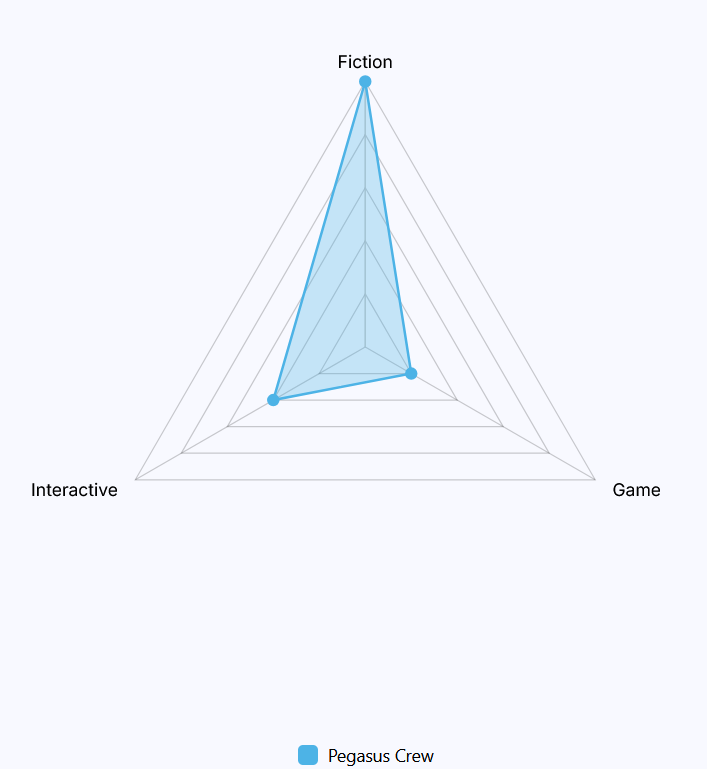
Chart

Interactivity - Fairly limited. Choices influence relationships and the tone of your progression, and this has an effect on what endings you can get, but that’s the only real way you can affect the world. As always, this isn’t a bad thing! This roughly measures what this work emphasizes, not how well it does so.

Fiction - Max; the story prompts all the gameplay; everything you do is in service of the fiction.

Game - There’s technically a goal (get memories), but I don’t think it’s possible to fail, and there’s very little friction. As above, everything is in service of the fiction, and you’ll get to that final scene no matter what you click (well, unless you exit a browser tab, I guess).

9 Likes

Ḫattušumna Laḫḫa, by Daniel Stelzer

As always, the start of the semester and an uptick in work have obliterated the time and energy I have to play everything I want, let alone review. I did want to make time to review this one, which is weird and special and a real oddball when compared to the rest of the IF Comp lineup.

First, my lingua bona fides: I took three years of Latin in high school (had fun, wasn’t very good at it). I took Spanish in HS (had fun, was decent but never got far). I took two or three courses of undergrad French and another year of French in grad school (had fun, got pretty good at reading comprehension).1 I enjoy learning languages, though I’ve never had raw genius, and I’d like to actually learn Spanish (it’s hard to learn languages as an adult, just time and opportunity-wise).

I was excited about HL as soon as I learned it existed. It was intimidating, and I needed to set aside time to really dig in. I played through the first tablet, looked at tablet two, and at that point I’d hit the 2-hour limit. I’m going to review it up to that point. I was uneasy about reviewing without finishing, but I think it’s an important part of my impressions and critique of HL as a comp entry.

What first struck (or maybe more accurately overwhelmed) me about this game was the UI, which was busy. I don’t mean it’s cluttered or poorly designed, but there is a lot going on. The conceit of a desk set up is both cute and quite smart. Marginal notes on the left disguise error messages as a translator’s textual commentary; commands and responses are broken up into simple line-drawn fragments that prevent an endless scroll of Hittite text; and discrete notes on the right-hand side remind you of generally important verbs, specifically-selected words and their cases, the map, and the available directions of the compass. It’s a lot to jump into, but it ultimately pays off. As I played and things got more complicated, the UI felt more natural and necessary, but at first it’s a lot to take in.

The story and puzzles of tablet 1 are simple, the real challenge being how to input the right commands to progress; the gameplay is basically split into a language puzzle that you need to solve to progress the parser game. This was the source of some humorous frustration (I had trouble dousing the fire because I kept putting my bucket down on the hearth instead of pouring water onto the fire) and some fun ancient linguistic shenanigans (sometimes no one bothers to describe a noun, and you just have to call it a doohickey and get on with the declensions).

So here’s my big criticism: I finished tablet 1 after about 1h 50m. The gameplay was pretty chunky, and I don’t see a lot of people finishing tablet one in less than an hour, absolute minimum. I took notes on paper to help me try to retain/learn, which maybe added some time. Still, peeking at tablet 2, there’s new grammar and notation: more learning, which I’m excited about, but if tablet one took basically two hours… A satisfying two hours, too. Tablet one felt like a complete thought, if not narratively than as an experience overall, a memorable introduction to Hittite language, culture, and linguistic scholarship. My impression is that HL would be a more graceful comp entry as a single tablet, maybe with one extra step or wrinkle added to the parser game. Three tablets don’t feel like a game so much as a project. This game, created by someone with a literal doctorate in Hittite, possibly suffers from an XKCD Average Familiarity issue; it’s just too chunky for anyone to engage with as a single experience, at least in the context of IF Comp.

But I don’t want to lose the rest of it. So, what, do I want a series of games, each building on the last? I think my conflict comes down to the fact that HL doesn’t feel like a game, it feels like an exciting learning tool. This is such a great way to solidify grammar and vocab learned out of a textbook, especially for dead languages. I wish I’d had a wax tablet to play through as part of each Latin unit. I genuinely think this would fit really well as part of an overall curriculum. Heck, it wouldn’t even be out of the question for an instructor to learn Dialogue and revise sections as needed.

Still, despite feeling like this isn’t a game so much as a neat bit of academic kit, I loved my two hours. It was fun to play; learning a language is basically a word puzzle. HL is totally unique and fresh and VERY on-brand. I will be finishing it. So maybe forget all that stuff I said above? I’m glad this was here, regardless of how bulky it was, and I’m excited to go back and get through the next tablets.

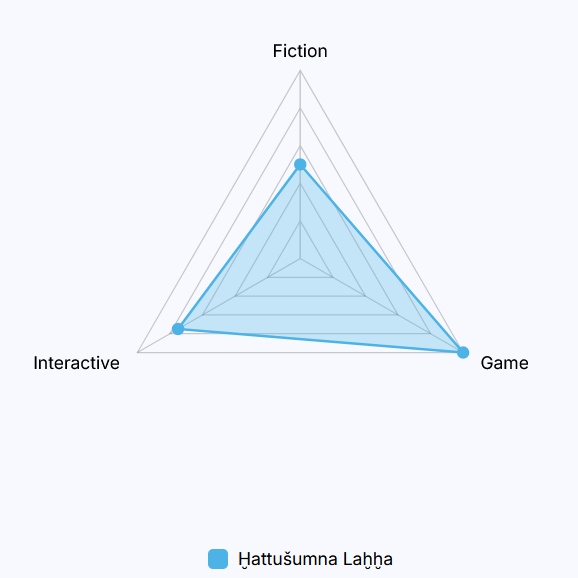
HL was a tricky stress test for The Chart!

Interactivity - To refresh, interactivity “measures” the extent to which you can affect the game state or the world. None of the language learning is really interactive in that sense, but all of your input DOES progress a parser; there are objects to manipulate in different ways. It’s a simple parser, but parsers are highly interactive inherently.

Fiction - all the parser input progresses a story, but that narrative gets a little lost in the meta-puzzle. A lot of what you’re actually doing learning a language that you then use to progress the story that demands you learn more language. So… middling fiction?

Game - There’s two levels of gameplay here, the language puzzle and and the parser game. Both have a clear, set goals with right and wrong answers. You can fail by using the wrong word or the wrong case, or by failing to solve the parser puzzle. Very high game, according to this chart’s definition of game.

___________________________

1. (As a grad student, I had to co-write & perform a short skit in French. My team’s sketch was about Barak Obama and Mitt Romney who, having overcome their political differences, were now living as elderly lovers in a nursing home. The main humor came from Old French Romney’s repeated use of the phrase “mon petit Barack” and Old French Obama saying “laissez moi etre claire", which is graceless French for “let me be clear”, a phrase that Obama said sometimes. The year was 2013, the place was Edmonton, Canada, I played Old French Romney, and the sketch killed in the room. Truly, it was a different time.)

13 Likes

Thank you so much for the review!

2 Likes

It’s me again hi! To be honest I replied so fast originally because I thought that I somehow broke the game and like, if you can’t starve your neopet- I mean duck why even bother /j

I’m so glad you enjoyed the game so much! I think you’re part of the exact audience I wanted to reach: the people who experienced the death of these online communities young enough for it to be so emotionally affective. The teen years are weird and the internet only makes it weirder, especially back then when there weren’t as many centralized messaging sites like Skype or Discord (y’all remember Skype?).

Thank you for playing!