a link is a kind of value.
the links are defined by the table of linking.

table of linking
link	priority	reflexive	printed	input
take-link	9	false	"take it"	"take [frob]"
place-link	10	false	"place it"	"place [frob] on"
in my program, I am cycling through a list of things. Right now, there is some pretty laborious code for running through a table to determine the valid links for each thing in the list:
	let placeholder be a list of links;
	repeat with E running from 1 to the number of filled rows in table of linking:
		choose row E from table of linking;
		if link entry is take-link and frob is takeable, add link entry to placeholder, if absent;
		if link entry is drop-link and frob is droppable, add link entry to placeholder, if absent;
	truncate placeholder to four entries;
	decide on placeholder;
what I’d like to do is associate each link with its relevant property and push to an if link entry is valid, add link entry to placeholder to avoid a long string of if link entry is... add link code to this project.
However, if there is a way to do it, I haven’t arrived at it yet. I don’t think a table will accept a calculated property, ie something like takeability of frob .
A table can accept named phrases, but I don’t think you can (or at least I don’t know how to) do that with a table also used for definitions. I don’t know how you’ve defined “takeability” but this is what I came up with based on what you’ve posted so far:
This is kind of a hack, but you can store text in a table, and text can do anything a phrase can do!
"[if takability of frob is true]1"
This will be empty if the condition is false, and non-empty if it’s true. Texts can’t quite do everything closures can do (since they don’t capture their scope), but they can do a lot of it!
OK! Both of these suggestions are great. I don’t think I ever knew that I could name a phrase in this way.
With regard to the text, I spent a lot of time trying to wedge a number in there, but I never thought about just putting a condition text in a field. I’ll experiment a bit and come back.
This isn’t what you asked for, but I might also recommend using a rulebook instead of a table, because then you can control the order of the rules and put arbitrarily complex code in them. (“Link rule for a portable thing…”)
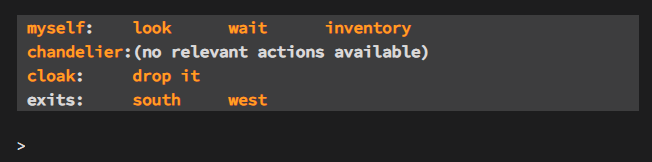
Would the rule be generating output? Right now (this is for a command bar), I’m printing up to four links (based on relevance (takeability, etc) and the author’s prioritization) with spacing between.
The rule could print things, or it could append them to a list (a rulebook variable), as desired. If you only want four links per object, appending is probably better.
Like @BadParser said, but dispense with placeholding and use only one table. Untested…
Table of linkable actions
condition     label      command
[...]

To generate command bar:
repeat with t running through things enclosed by the location begin;
  let count be 0;
  say "[t]: ";
  repeat though the table of linkable actions begin;
    if the condition entry applied to t is true begin;
      hyperlink "[label entry]" as "[command entry] [t]";
      increment count;
      if count is link-limit, break;
    end if;
  end repeat;
  if count is 0, say "(no relevant actions available)";
end repeat;
In the course of working on this, I had an idea that I might make an extension for people to use. I’ve been working with that in mind, hoping to help authors configure things as they go.
One concern that I had was that, in a game with several valid actions, the author needed control over which links appeared in the command bar. I saw this working two ways:
Global Priority. When iterating through links, it should print them based on both relevance (what we are discussing) and a configurable priority.
Noun-specific priority override. An author should be able to override the global table for specific nouns. Take the squeeze bottle in Plundered Hearts, for instance. Squeeze might be a low priority link globally, but it may become high priority for the bottle once its function is discovered.
I could shift gears away from values (links) and toward named phrases, but I feel like I’d need to add some complexity somewhere else. It’s too bad named phrases aren’t allowed in a definition table. That was what exactly what I was looking for. I have already thought of another use for named phrases in tables, though, so that was a bit of an ah-ha moment!
I just want to get this cloak of darkness port out the door, but I will revisit all of this before I release the extension.
That’s part of why I think a rulebook might be fitting. If you want SQUEEZE BOTTLE to be a high priority, you can write one rule for squeezing things in general, and a separate rule for squeezing the bottle; the latter can be a higher priority because it’s more specific or because it has “first” attached.
I’m definitely going to have a look at using a rulebook, or a bigger rulebook. I’d obviously learn more that way, but I also want to come up with something a beginning author can use without needing to understand how everything works.
If the single priority value on a per-action basis is good enough for the normal case and needs overriding only for particular thing/action combinations (perhaps under specific circumstances) then a rulebook on things producing a number is probably in order. You’ll need a global to “pass” an identifier for the action to the rulebook since rulebooks can only have 0 or 1 parameters. That identifier could be an action name (you’d probably want to add a column for this to the table of linking) or it could just be the value of the link column itself.
A fairly easy way to store results for consideration would be to add another column for score to the table of linking. At the beginning of considering a thing, set score to 0 for all rows. Then loop through the table, leaving score at 0 if the condition doesn’t pass. If it passes, set it to priority but then check the scoring rulebook, and set the result if it produces one. Then reorder the table by descending score and make hyperlinks for up to the first 4 rows with non-zero scores. You could keep restoring the table order to a consistent known order, but it wouldn’t really matter.
It sounds goofy, but if you compare it to creating a list of 2-element lists so you could sort that by score it starts to look better.
This (and Daniels’s suggestion, too) have me interested in a rulebook approach. I haven’t made a rulebook producing a result before, but I’ve looked at the docs and it makes sense. So I’ll try that and report back. Thanks everyone for the help!