Very excited for your project! 
Statistically, it probably is. A lot of spiders are very hesitant to bite and even more hesitant to unleash venom. Attacking has a large cost involved, so a spider often wants a good trade. That said, spiders should still be given a respectful amount of personal space, just to be on the safe side! No reason to go unnecessarily poking and grabbing spiders!
- The chelicerae are a pair of thick digits, which hang over the mouth. Each carry a fang at the tip. Some spiders use their chelicerae for chewing.
- Pedipalps are the small, finger-like mini-legs, found on either side of the mouth’s chelicerae. They’re technically like a fifth pair of legs, and their shape can help identify what kind of reproductive organs a spider has.
- The prosoma is the forward body segment, where the eyes and legs connect.
- The opisthosoma is the rear body segment, where the spinnerets, heart, and lungs are found.
- A spider usually has a visible stripe or streak going over the top of the opisthosoma; this is called a “heart mark”. What you are seeing is literally the pumping heart of the spider, partially visible under the blurry surface of carapace material.
Orb weaver update! And I used my dad’s camera this time!
She can tell what direction I am, relative to her web, and I noticed she’s a lot more nervous when I’m standing in front of it, versus standing to either side of it. So I got a pic of her in the middle of her web, but I couldn’t get close enough because I would risk walking into some fibers. Meanwhile, I couldn’t get too close in front of her web, because that visibly terrifies her, so she starts running for fallback safety spots.
However, these pictures offer a bit more clarity!
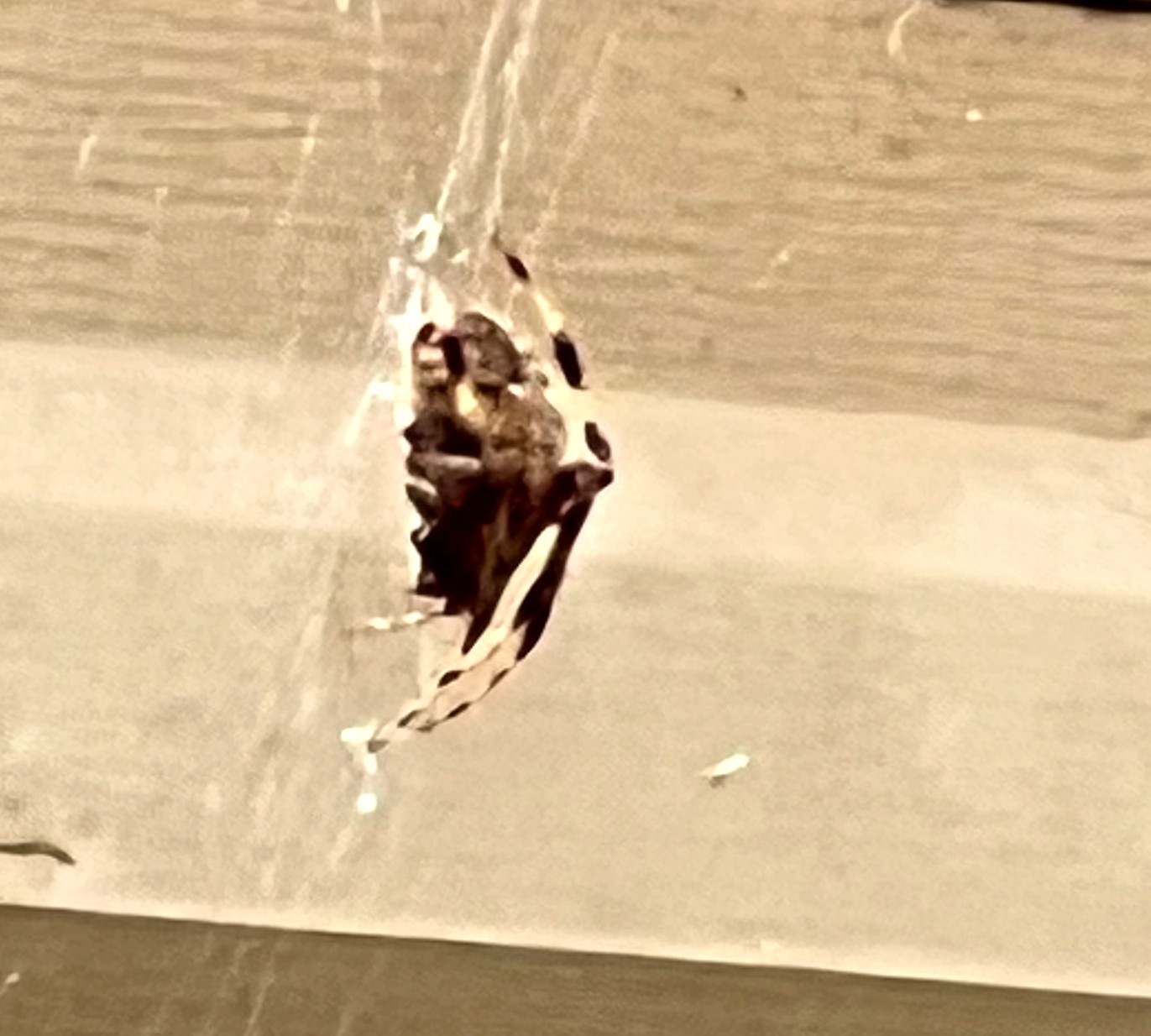
Image description: The orb weaver is visible in higher resolution, now. This image offers a sideways view of her at the center of her new web. She is facing downward. Her body seems to be dark-grayish-brown, with orange stripes and rings, which catch the sunlight. The silhouette seems to roughly approximate a semicircle. Half of her legs are held forward, and the other half are held backward.
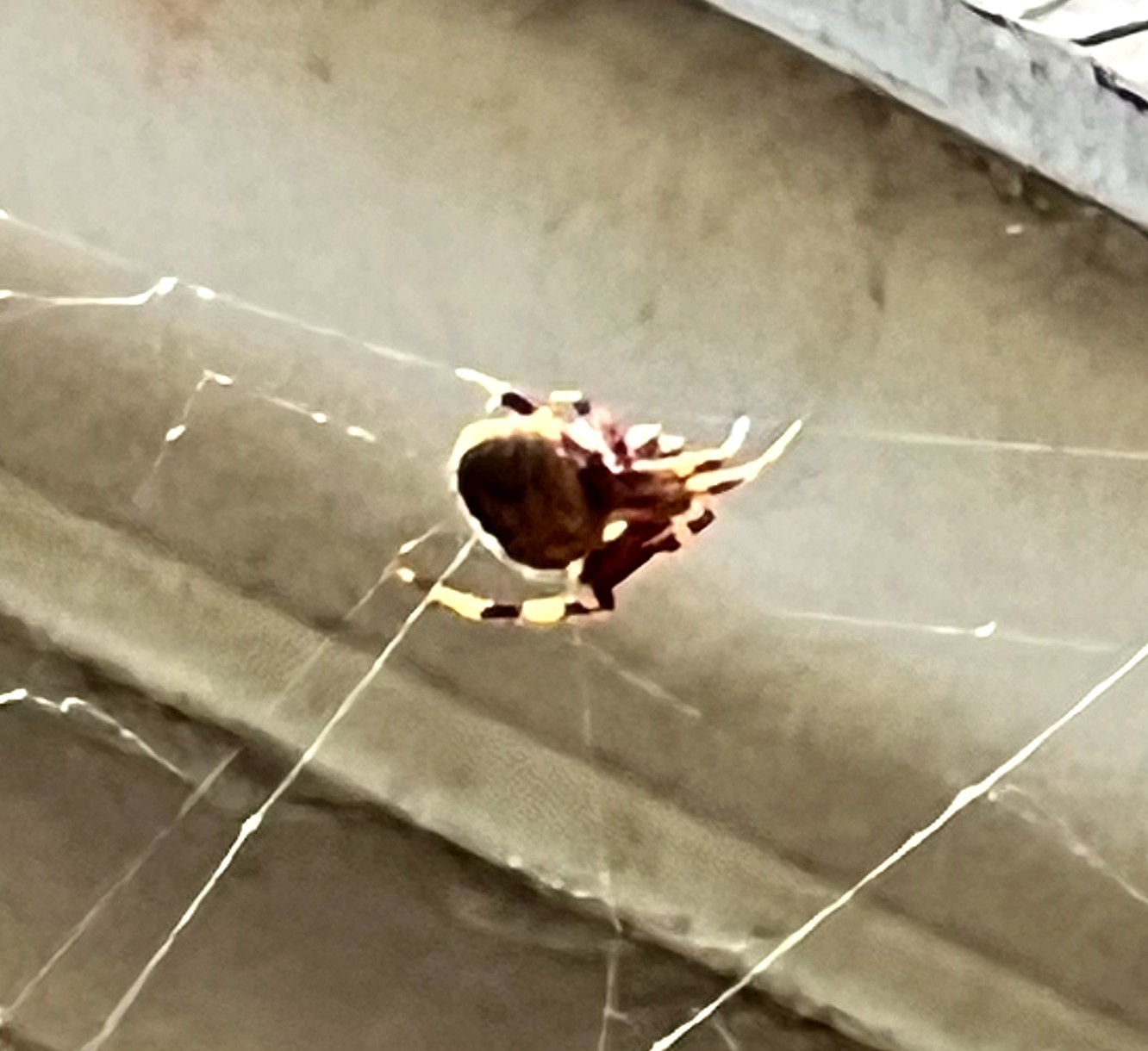
Image description: This photo offers more of a top-down view of the orb weaver, though after she has escaped to the top of her massive web out of panic. The shape of her two body segments are much more clear here. Her opisthosoma is about twice the size of her prosoma, and looks fairly spherical from this angle. Hints of dark rings seem to decorate her body, in contrast with the orange rings of her legs.