But only after reminding you to nibble on a madeleine or two, right? The best literary legacy. 
6 Likes
I’m trying American Gods. It’s very good. Interesting, and kind of weird, but good.
8 Likes
I’m reading Charlotte Bronte’s Villette about an inwardly-despairing-for-lack-of-drive Englishwoman who becomes a teacher in France. Which I’m loving. Have read zero of any Brontes before and maybe only one Jane Austen. Without experience, I vaguely lumped all these together in my head.
I say I maybe read Austen because I had to do Austen’s Persuasion in two unit English for the HSC thirty years ago (Australian final exams). It’s the only book I ever wrote about in an exam where I hadn’t really read the book. I think I’d tried, and gone back and forth, but I just couldn’t.
My Villette experience will potentially get me to try Austen again. Though Villette has an unexpected morbid streak and occasional fancyfulness, much to my taste, that I assume I’m not going to get in Austen.
-Wade
5 Likes
I haven’t read Villette, it sounds like a novel that I might like very much. I read only Jane Eyre from that particular Brontë sister. I liked it but maybe because I have read Emily Brontë’s Wuthering Heights just before that, I haven’t been much impressed by it.
I would recommend Wuthering Heights without reservation if you are on a Brontë binge. It’s a very bleak novel, about unending revenge, cruelty and abuse. It feels like every chapter of the book has been carefully designed to crush the hope for happiness for the characters in the reader. Even if you don’t like it in the end(quite possible), it is one of the most referenced novels in literature, therefore worth reading. Also it is the inspiration for the Kate Bush song with the same name of the book.
5 Likes
Currently reading The Marbled Swarm by Dennis Cooper, but I wouldn’t recommend anything of his unless you have a truly iron stomach. Just finished Manhunt by Gretchen Felker-Martin, and enjoyed it a lot!
3 Likes
OOOH I loved that one. And the follow-up one Anansi’s Boys is great!
3 Likes
I like Cooper, but hated The Marbled Swarm… I’m not really sure why, I just vibe a lot more with his other stuff. If you end up wanting more in the same vein of the two gnarly, intense books you mentioned, you might like The Doloriad and/or Lapvona 
3 Likes
Interesting! I think it’s one of my favorites of his, specifically because the gnarly stuff feels in service of something.
These are going on my reading list expeditiously!
3 Likes
I have to mention one thing about Villette. It actually has a fair bit of untranslated French dialogue in it. Not so much you’d say to someone ‘You have to know French to be able to read this,’ but a bit above that level of, ‘Okay, it doesn’t matter if I don’t exactly know what was said in that blob.’
I can’t see it from the perspective of not knowing French at all, as my first-in-class schoolboy French is carrying me. But it’s the most French I’ve had to try to pick at in my head at length for, well, decades.
-Wade
4 Likes
Huh. I’ve read both and it never occured to me that they were connected. The fact that I read Anansi’s Boys several years before American Gods probably has something to do with that.
I’m now reading Aravind Adiga’s The White Tiger. One-way epistolary account of an Indian Entrepreneur. Juxtaposing the fast-growing Indian economy in the cities with the underdeveloped country the protagonist comes from.
A picaresque social critique on the double standards and moral vagaries of the economic class and social caste system, in the form of a series of emails to the General Secretary of the Chinese Communist Party, who, according to the media, is planning to visit India shortly.
6 Likes
I hadn’t read The Secret Garden in about 40 years, and it came up in conversations with friends a couple of times recently, so I reread it. It’s a product of its time so it’s got some problematic stuff in it, largely (but not totally) because of being set partially in India during the British Raj (It was written in 1911).
But for all that it’s still a hell of a book. It starts off with a bang (cholera!) and goes to charming, weird, goofily hyperspiritual-religious places. I remember at age 10 or so desperately seeking a secret garden of my own, and being absolutely crushed that there wasn’t a single ivy-covered stone-walled mystery garden filled with English flowers anywhere in my central Texas neighborhood.
8 Likes
I FINISHED THE NAME OF THE ROSE!!
Some random stuff:
- I jokingly called who was the murderer super early on (as like "If it is him, wouldn’t that be dumb) then ended up accusing all the characters as I read through (and has a surprised pikachu face when they would drop dead).
- the method for the murder is actually pretty cool! It really is smart!
- I wanted to punch Adso so many times
 I don’t think I’ve hated a character this much for a while…
 - I may have skipped the “interesting/good” parts because they super bored me

- It’s literally the Burning of Alexandria all over again, and honestly that was the saddest moment in the book.
I get why people enjoy it. But also eh…
I’m off picking some sci-fi pulp instead to cleanse my brain…
9 Likes
Current main reading end of May 2024. I have some more books on the go more sporadically. But the ones below are my current main reads. All read on my Kindle. With an utterly gargantuan font! 
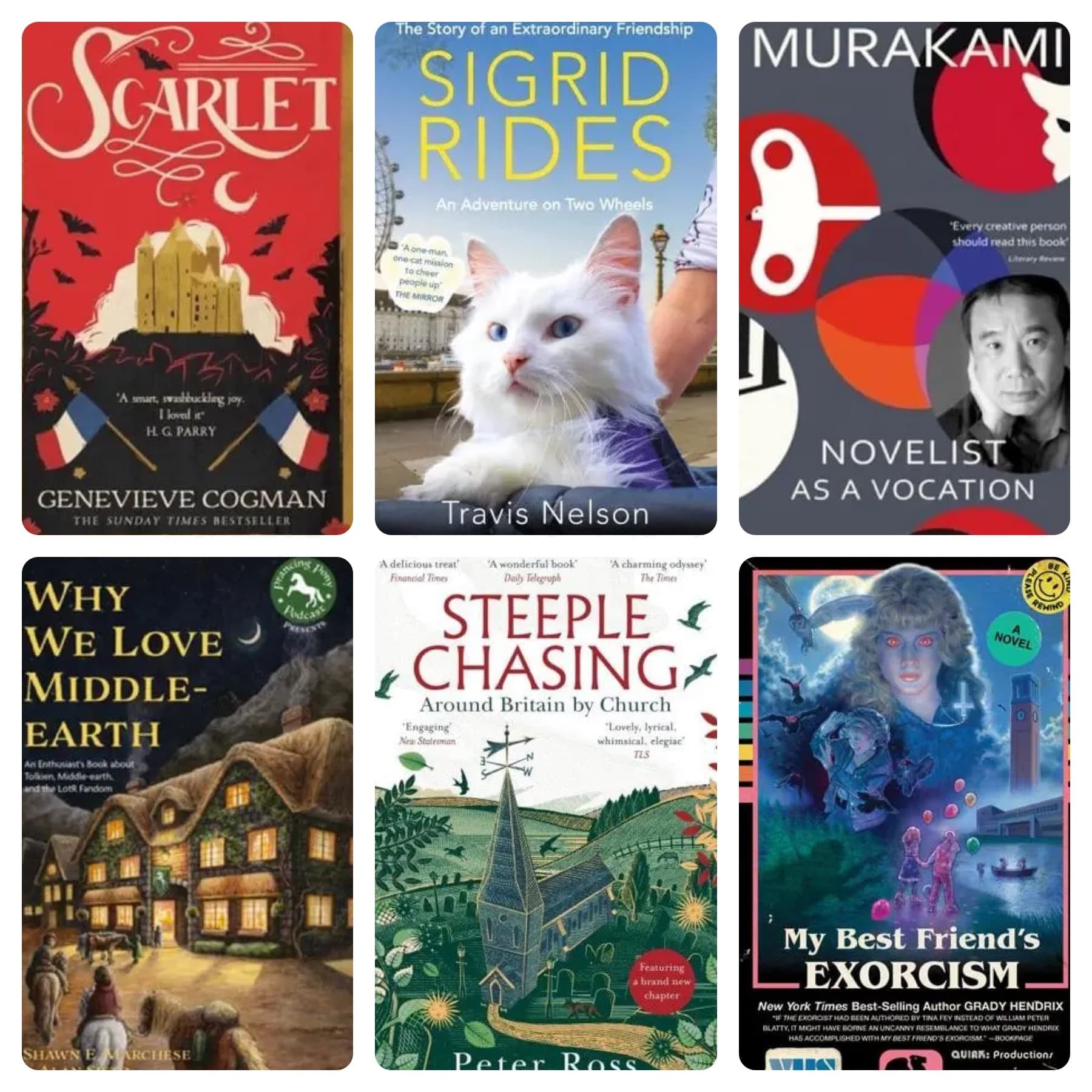
Alt text for above picture
Picture showing 6 book covers. On the top row Scarlet by Genevieve Cogman, Sigrid Rides by Travis Nelson, Novelist as a Vocation by Haruki Murakami, then below that Why We Love Middle-Earth by Marchese and Sisto, Steeple Chasing by Peter Ross, and My Best Friend’s Exorcism by Grady Hendrix. Many varied cover designs.
4 Likes
Finished The City of Thieves least night. It was pretty bleak, with some really touching moments and very funny lines (Russian humour can be dark, but it tickles the funny bone)!
Also a very easy and quick read after The Name of the Rose!
4 Likes
Currently reading: German translation of a criminal novel by Felix Francis (who continues his father’s series of horse related criminal novels).
On my staple [edit: pile], to be read soon: German translation of Waris Dirie “Desert Flower”.
2 Likes
I loved this book. Considering how badly Benioff screwed up the last season of GOT, I hope he decides to write more books and stay away from TV.
3 Likes
Just finished Less by Andrew Sean Greer. I highly recommend it—it’s a madcap comedic chronicle of a globe-trotting midlife crisis. I’m now just starting 11/22/63 by Stephen King. I figured with all the shorter books I’ve been reading lately, it was time to tackle a real door-stopper.
5 Likes
Oh I loved that too! I’ve actually got the sequel on my to-read pile, though a friend told me he didn’t think it was as good, alas.
4 Likes
Thomas Coraghessan Boyle: World’s End
None of the characters are particularly likeable, and the ending is quite the bummer. I loved it. Or rather, I was engrossed, captivated, spellbound.
The novel switches back and forth between characters in 17th century Nieuw Amsterdam/New York and their descendants in the 20th century. The different threads laid out in the first 300 pages or so come together in a gripping mesh in the finale.
5 Likes
I read Horowitz; A Biography of Vladimir Horowitz by Glenn Plaskin. I know next to nothing about classical music. Some names of composers and compositions sound familiar to me from a general cultural knowledge, but I have no specific or detailed knowledge.
What drew me to read the book was the fact that it’s about a Russian Jew, born in 1904 into an upper-middle class family (if such a category makes sense in that context), who has lived through the greatest societal upheavals of the 20th century. A series of anti-tsarist rebellions in his early childhood leading to the Communist revolution, almost simultaneously WWI and the collapse of Central and Eastern Europe as the cultural focal point of the continent, Hitler’s rise, his Endlösung, his tyrannical ambitions culminating in WWII, and the consequent rise of American power after the war.
None of these factors are deeply or explicitly analysed in the biography, but they simmer in the background, and it’s impossible to read about this man without acknowledging the waves of history that influenced him.
The book does explicitly, deeply, exhaustively shine a light upon the technique, studies, repertoire,… of the pianist, and on the sometimes crippling self-doubt and social anxiety of the person Horowitz.
I learned a lot.
Vladimir Horowitz - Wikipedia
(There’s a link to a limited preview of the biography at the Internet Archive in the bibliography).
Now I’m halfway through The Eye of the World, part 1 of The Wheel of Time-cycle by Robert Jordan. I would have loved this book when I was thirteen, but now it has me torn.
On the one hand, I love straight-up fantasy, the wide landscapes, the discoveries and exploration, the looming Evil,… On the other hand, this novel sometimes feels like it was pressed out of a mould. The story-beats are almost one-to-one Tolkien.
Maybe what I think of as hopelessly cliché now wasn’t already overdone in 1990, when the book was published. Maybe I’ve read so much fantasy and adventure novels that my brain is saturated with the associated tropes, especially when played straight.
Although I can’t help but sigh at the predictability at the start of each new chapter, I am still enjoying it when I manage to tap into my childhood enthusiasm,
7 Likes