Because then Inform will use “it” for the third-person pronoun.
2 Likes
It’ll work just fine in Inform, I think.
All this talk of multiple PCs is making me think of Suspended. Ah, sweet Suspended…
1 Like
Fun fact: all the different (playable) Mikes and (nonplayable) Lizes in Sting are entirely different people, which is how I managed to jumpscare myself by not precisely specifying which kitchen I wanted to move one of them into, which led to a mute 3-year-old version of my sister suddenly popping up in a timeline where she would have been 16 years old.
5 Likes
What if you also set them to be plural-named?
Experimenting a bit in third person singular:
>pronouns
At the moment, “it” means Brian, “him” is unset, “her” is unset and “them” is unset.
>x me
He sees nothing special about himself.
Okay, it’s a little messed up.
The Questions extension allows a person to set their gender at the beginning, but only M or F.
I am having trouble understanding. I thought the player was the object and yourself was a pointer to it. I created a female person named FemaleTpl. Later, after the actual player entered ‘female’ into the question of gender, I tried now the player is FemaleTpl. I also tried now yourself is FemaleTpl.
I didn’t expect the former to work but I did expect the latter to work. The parser barfed on both of these.What is the difference between “the player” and “yourself”?
I used Item 5 The Viewpoint Character in the Recipe Book to help. It didn’t.
Other way around: “yourself” is the object, “player” is the pointer. I’m not sure why this isn’t working, though.
1 Like
Here is a screenshot of the SHOWME SELF dump. The female Character Corey is created with inventory and lots of other stuff, but note that the player internal values say male, but the gender says Feminine.
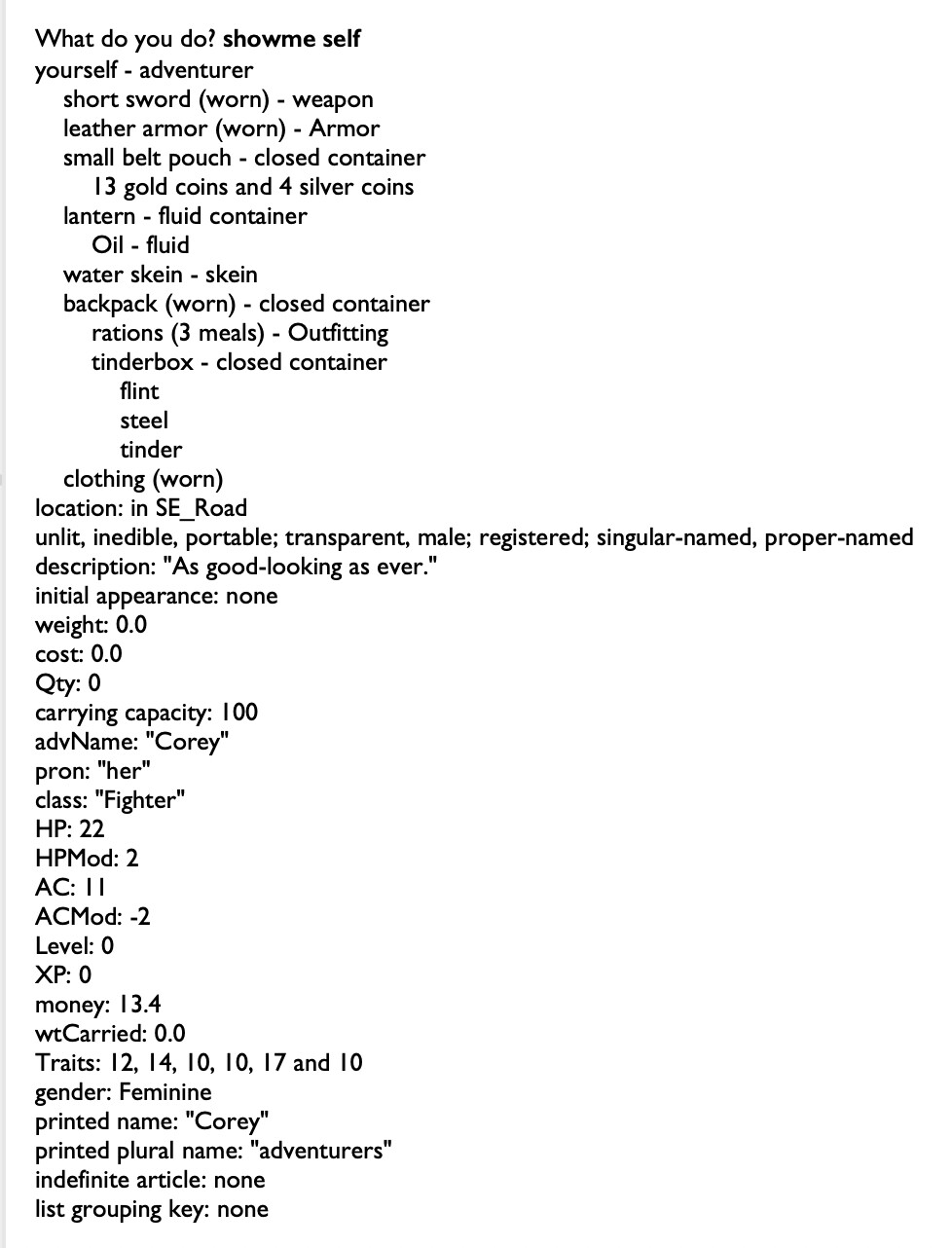
I’m going to try revising the code slightly with your correction in mind.
I am now convinced that there is a bug in IF regarding this issue. I use the statement
The gender of the player is feminine., which compiles. Then when I create a character, male or female, the SHOWME dump still says “male” in that list of properties (that start with unlit, inedible…) but the gender of the character (near the bottom of the dump) say the appropriate gender, Masculine or Feminine, depending on which I created.
Is there a way to see that the names of those properties are? Or are they just treated as properties without names? The index doesn’t even give the properties.
I don’t know what the “gender” property is? It’s not a built-in property in Inform 7. The built-in gender in Inform 7 is just the male/female binary and the neuter/not neuter binary (which, confusingly, actually gives 4 total options). If you have a custom plugin that provides a “gender” property, it probably makes sense to just ignore the built-in binary gender system. However, if you really want them to be aligned, I think a line like the following might do the trick:
Someone feminine is usually female.
Someone masculine is usually male.
The built-in gender property doesn’t have a name, since it’s an either/or property (which can’t have names per se). It is shown in the index though – in the Kinds section, find the details on “person”, and you’ll see “Usually male not female” and “Usually not neuter”.
Yes, I can find person in the Index, but you can also see “yourself” at the bottom of the index, without any further properties given.
I made gender a value in accordance with the suggestion in the Recipe book section 5. So the question is, how can one change the built-in property male/female of yourself?
Enumerated properties and either/or properties can both be set the same way, but enumerated properties have an additional way you can set them, which is what you just posted above.
The gender of yourself is feminine.
That works, but you can also write this instead:
Yourself is feminine.
And that method also works for either-or properties.
Yourself is female.
When I say Yourself is female outside of a rule, the internal property says female in the showme dump. However, if I try to assign the player to a gender, it compiles, but it doesn’t change it either.
A gender question rule when stage is stSex:
	now the gender of the player is the gender understood;
	if the gender understood is feminine:
		now pron of player is "her";
		now yourself is female;
	otherwise:
		now pron of player is "his";
		now yourself is male;
	now stage is stClass;
	exit;
My gender as a value works but not the player properties: the gender properties and adjectives all work fine.
now yourself is male or now yourself is female works for me even if I have a statement that Yourself is a man or Yourself is a woman, so it definitely works. My guess is that yourself in your game is not the player, so try changing it to now the player is female and now the player is male.
1 Like
OK, perhaps there is something else going on here. I get exactly the same result: For a female input, SHOWME SELF gives a male property but gender is Feminine and pronoun is “her” (as shown above) in the dump example.
A gender question rule when stage is stSex:
	now the gender of the player is the gender understood;
	if the gender understood is feminine:
		now pron of player is "her";
		now the player is feminine;
	otherwise:
		now pron of player is "his";
		now the player is masculine;
	now stage is stClass;
	exit;
The gender assignment is being done inside the Questions extension, and perhaps it is not handled properly. I’ve ignored the male property and proceeded (successfully) with the gender value I defined.
You didn’t say now the player is female, so they’re not.
2 Likes
I had that before, but I changed it again for the test. now the player is female still gives the gender property male in the SHOWME SELF dump. I think there is a bug.
Celtic Minstrel: my apologies. With a few debugging statements, I found that the gender assignment was being bypassed as part of an AUTOFLAG I have. Once I used your statement in the RIGHT PLACE, then all worked. Thanks.
1 Like