Agreed, OOPS (and O as an abbreviation for it) is the wrong solution to the problem of typos.
The up arrow key is a good answer for devices with keyboards. For touch-screen devices, I think interpreters need some way to edit the recent command.
Hadean Lands for iOS has a little “book” icon you can tap on that shows a few recent commands; you can tap on them to edit them. iOS Frotz has a book icon, too, in the parser line, but it just shows common verbs (not game specific). I don’t think it provides any way to edit a recent command. Parchment has nothing at all like this.
I’ve also long thought that parser games should have tab-complete. I use that constantly in any other command-line environment.
Of course with the Inform ecosystem my impression is that would involve major major reworking so I don’t know how we’d get there from here but ugh, it would be so nice and it’s such a huge omission.
+1 to tab completion should be on the feature check list for any parser engine being built from scratch in 2025. I don’t mind even multi word commands lacking a short hand if I can just type the first few letters then tab complete.
Of course, with parser games, you have the extra challenge that you might not want to tab complete things the player can do, but hasn’t done before, especially if doing so would give away the solution to a puzzle…
And speaking of different directional systems, I’m now imagining a space faring adventure where you jump between compass navigation on planets and other roughly spherical bodies, shipboard directions while traveling on a starship, and turnwise/Widdershins/rimward/hubward aboard spoke wheel-shaped space stations… and whatever directional system would be used for the surface of a torus as you encounter a ring world… with the available navigation commands changing on location(e.g. s is south or staboard depending on context, w is west or Widdershins depending on context.
Part of me feels like it would also be useful for some parsers to be supplemented with menus or keyboard shortcuts like those found in most modern apps. like alt+i doesn’t just print your inventory, but opens and inventory menu where you can rearrange tems, select one and get a menu of actions you can perform with that item, etc. ctrl+s quick saves your game, alt+g brings up a list of places you can fast travel to, etc.
I think Starcross equated: N=F, S=AFT, E=P, W=SB. Makes sense to me!
Tab completion should maybe be implemented by the interpreter rather than the game. Then it’s available in all games, and it also avoids giving away the secrets of a particular game. You could implement it by including a default dictionary of very common words, plus completing from the output printed by the game so far (like Emacs’s dynamic abbrev expansion, which is very handy).
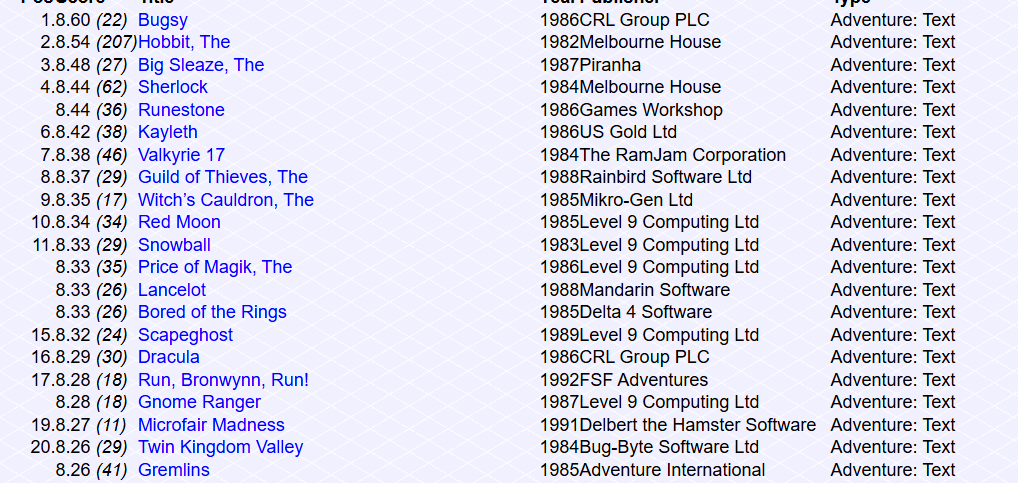
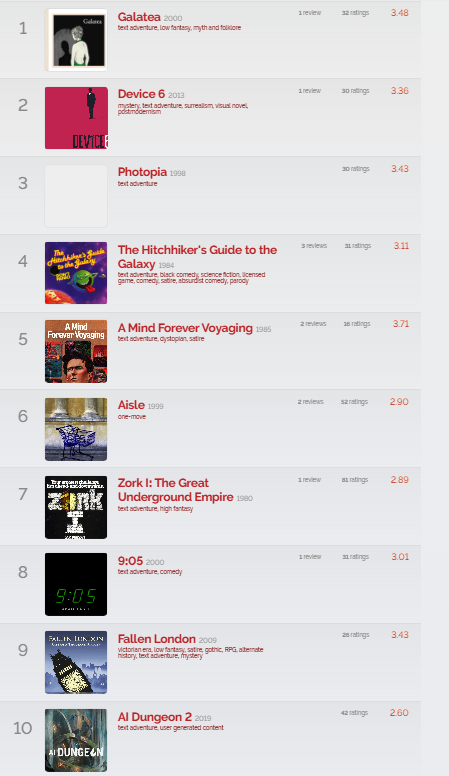
This discussion made me wonder about how many of the best-selling text adventures of all time used different abbreviations (from the commercial era). I tried googling it but instead found some lists of ‘best adventures of all times’ that had almost no crossover at all:
It really drives home how, globally, fans of text adventures and interactive fiction are fragmented into different communities that don’t really communicate with each other or even know of each other’s existence or appreciate each others’ games.
That’s why I’m glad for IFComp and for the people on this forum who take time to interact with each other, learn about what others like and enjoy and broaden their horizons; I think it’s the main thing that brings us together and helps break down those walls.
Historically, the trends followed the hardware, which shaped tastes by geography and availability, and also the capabilities of that hardware. In the 8-bit era, different platforms reigned in different areas. The Apple II dominated the USA (and here in Australia) but it was considered too expensive in the UK, which had homegrown cheaper, lower-RAM computers like the ZX series and BBC, and where tapes and not disk drives remained the dominant storage medium for longer. The C64 was the only platform that presented strongly everywhere, and its disk drive was appalling (30 times slower than the Apple’s). So that World of Spectrum list is representative of the UK and European experience, including single-load tape games like Twin Kingdom Valley, and then for more advanced games, the list is big on Level 9. Infocom didn’t release games on the Spectrum.
Scott Adams’s first games were designed for absolutely minimum RAM on the TRS-80, so they were rare in being American games that suited the early UK environment, and he had distributors over there. (That last bit I learned on The Retro Adventurers podcast, which shored up pretty much all I’m talking about here, in my brain.) Infocom were already off and running in the USA starting with Zork I on the Apple II. So the first seeds planted in each region were different and there were whole areas of no overlap. Today, there are no technical reasons for non-overlap, just historical ones plus the fact IF is niche
A few games including Swiss Family Robinson were doing it 40+ years ago and it didn’t catch on because ???
This is the crossover killer more than anything. Because for yeaaaaars after, many of the UK developers who want to make a “big game” are actually breaking that game up into 3-4 independently loaded chunks so they can still be sold on tape, with “enter the password to begin” or “load your saved game to begin” the later parts of the adventure.
>examine door
The front door is closed.

>x door
The word 'x' isn't in your vocabulary.

>version
DEADLINE: An INTERLOGIC Mystery
Copyright 1982 by Infocom, Inc. All rights reserved.
DEADLINE and INTERLOGIC are trademarks of Infocom, Inc.
Release 27 / Serial number 831005
Bocfel (the Z-machine interpreter in Gargoyle) specifically replaces X with EXAMINE at the start of a command if and only if X is not a word in the game’s dictionary. Which is sometimes nice, and sometimes trips me up when X MAP THEN X BOOK fails on the second one!