The post-comp release of Tableaux Vivants is now available to play!
Many thanks to all who played, wrote reviews, and submitted ratings for Tableaux Vivants! I’ve been blown away by the positive reception, and to have received second place in IFComp is a huge honor.
Thanks to my beta testers, @Ally, @John_Ayliff, @DemonApologist, @aschultz, and @alyshkalia, who guided my refinements to this game over the course of about five weeks; and to @jeresig, my alpha tester and brainstorm buddy, whose unfailing support and thoughtful suggestions were critical to this game seeing the light of day.
In this essay I’ll discuss the origins of Tableaux Vivants, its development, and some reflections after the comp.
MAJOR SPOILERS AHEAD: If you haven’t played Tableaux Vivants and think you might in the future, please read this essay after you play. It will be spoiler-filled, and it will discuss puzzle solutions and late-game plot points!
Contents:
- Planting the Seeds: Where it Started
- Hanging Wallpaper: The Setting
- Finding Books: The Game Design
- Casting Spells: Coding with Inform
- Writing Letters: What’s Next
Planting the Seeds: Where it Started
This past spring was, by most any measure, a productive time for my IF writing. My choice-based deduction game Fantasy Opera: The Theater of Memory appeared in Spring Thing; and my first parser game, The Gnomish Treasury, was voted first place in TALJ soon after.
Behind the scenes, however, I was hitting impasses with several works-in-progress. These ranged from the barest stubs of an idea to substantial, half-finished drafts of tens of thousands of words. In retrospect, this period of practice was fantastic for developing my writing craft; but at the time, I was incredibly frustrated with continually churning through unfinished projects.
The first embers of Tableaux Vivants were salvaged from the ashes of a few of the smaller discards from this period. The chimera-feeding puzzle originated with an outline about a magical contest. A scene in which characters from a Dante Gabriel Rossetti painting came to life was part of a quest narrative.
There was a loose concept I’d been developing through two different WIPs: a protagonist who is “rewarded” for overcoming challenges by gaining (or re-gaining) some core part of their identity, or even their humanity itself, only to find that gift may be too heavy a burden for them to bear. Ultimately, they come to see this suffering as inherent to becoming whole; and either learn to accept that, or try to reject it.
I’d also been feeling drawn to explore themes of queerness, femininity, social isolation, alienation, and mid-life disappointment.
But I wanted to write a story that would be self-aware about its own angst, in which the protagonist was constantly taking action, and propelling the story forward, rather than getting stuck in self-reflection. Channeling the above themes through the character of Theodora Violet, with her blend of Sturm und Drang emotionality and intensely cerebral introspection, was that crucial missing piece.
A first-person narrative inspired by 19th century Romanticism was the language I’d been searching for. But these abstract beginnings of the story needed grounding in a detailed setting, and engaging gameplay.
Hanging Wallpaper: The Setting
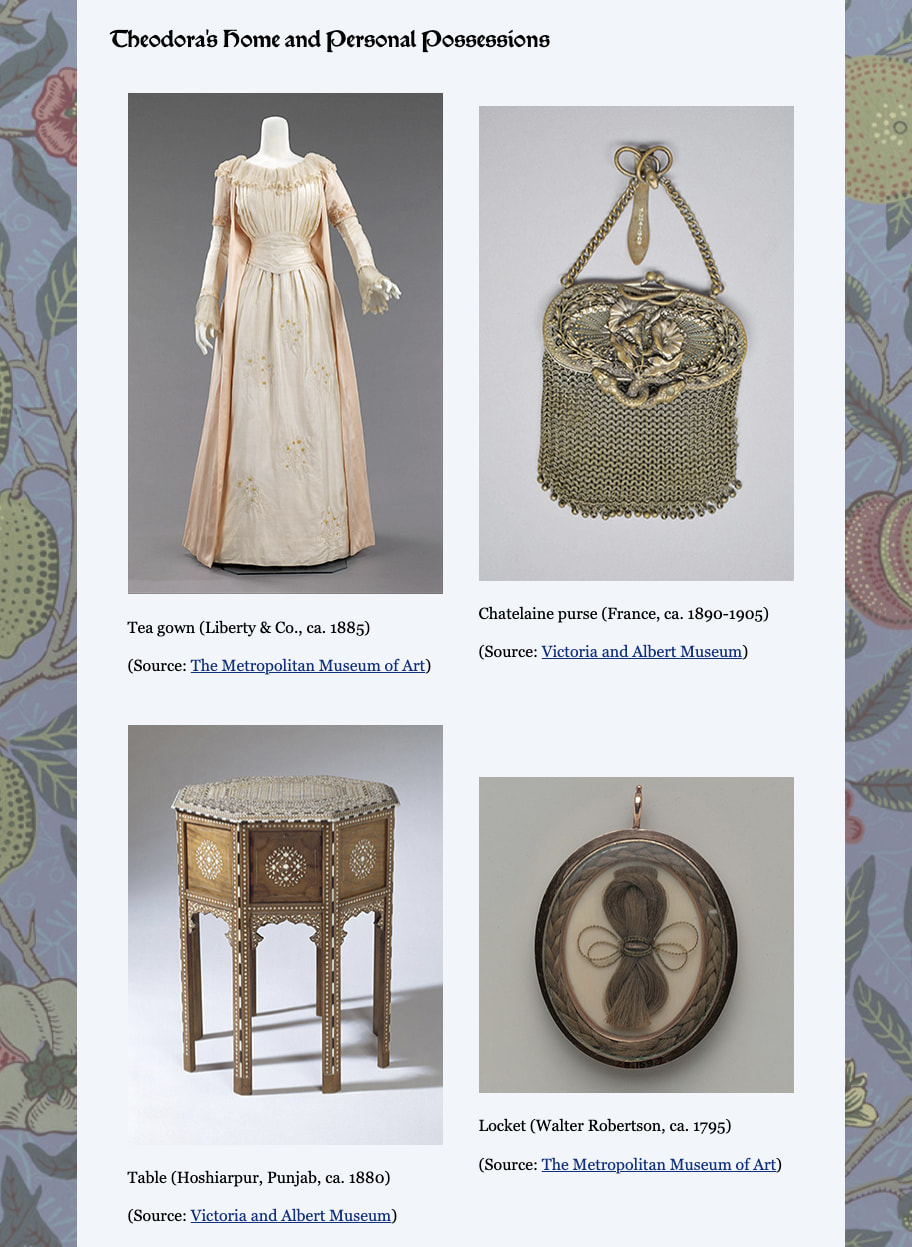
The guide to historical references on the game’s companion website.
“Have nothing in your houses that you do not know to be useful or believe to be beautiful.”
-William Morris, 1880
For as long as I can remember, I’ve been drawn to creative projects that serve as a vehicle for exploring subject matter like art history or literature. Several years ago, I composed a choral cycle, Transform the World with Beauty, on texts from the Arts & Crafts and Pre-Raphaelite movements. These included the same Christina Rossetti poem that appears in this game, and a collage of quotations from William Morris and titles of his designs. In making Tableaux Vivants, I found I wasn’t finished with that font of inspiration.
Historical context was central to the game’s story and setting. The four artworks that spawned each of the tableaux; the titles of the magical books; many of the entries in the “research” command; and the William Morris designs throughout the interior decor. And I had to incorporate the Rossetti poem, too, once I decided that a portion of this game would revolve around a painting by the poet’s brother. (This specific poem has been interpreted as commentary on Dante Gabriel Rossetti’s objectification of his subjects.)
There were other, smaller details that played a role in my process, but which won’t be readily apparent to the player. Charlie (Theodora’s brother) was very loosely inspired by elements of John Lockwood Kipling’s biography (Rudyard’s father); photographs of Beatrix Potter’s historic home informed some descriptions of the interior spaces; and so on.
While I took some inspiration from early 19th century Gothic literature in the form of Frankenstein, the setting is very late Victorian. Much of the art and design in the house is just slightly out of date, its Morris wallpaper faded by the sun; and the protagonist’s psychological awareness and fixation on the nature of the “self” contains echoes turn-of-the-century thought.[1]
All of these historical elements gave me a sense of direction while writing, and helped me to establish context for my fictional setting. But I also included them with the hope that my game might spark some curiosity and intellectual engagement in players, by alluding to a larger world of ideas outside the frame of this story.
Finding Books: The Game Design

An early outline in which I began to organize the progression of story and puzzles.
Tableaux Vivants really started to click into place once I found the ways in which the themes of my story could suit the affordances and conventions of parser games.
This game is an affectionate tip of the hat to the parser tradition. TV plays with tropes throughout; and while I didn’t set out to subvert these tropes, exactly, I tried to present them with a kind of freshness and specificity that I hoped would make players smile, or think about them differently. There’s a torch, but it’s a lamplighter’s torch. There’s a key, but it magically emerges from a novella by Louisa May Alcott. The holdall isn’t a backpack, but instead a niche bit of Victorian fashion in the form of a chatelaine purse. And the protagonist’s amnesia is not merely a plot device, but an expression of her particular struggles and aspirations.
I wanted to take on the challenge of creating a game that would resonate with longtime fans of parser IF; but above all, I was drawn to making the kind of parser that I myself would want to play, as a newcomer to the genre myself, and that I would’ve enjoyed in the not-so-distant past when parsers seemed incredibly intimidating to me. This thoroughly informed the game’s design, of course, but its presentation was also intrinsic to my goals. The inclusion of in-game hints and a companion website with a detailed walkthrough, a reference for parser commands, a map, an example transcript, and a guide to the game’s historical references, are all meant to invite the player in, to support and enrich their experience as much as possible, and to signal to that they’re welcome in the world of TV.
While my creative work is never motivated by the need to please others (I would be making some very different life choices, if so!), I always view it as a form of communication; and what I want to communicate to the player, and the kind of experience I want to provide them with, is often at the forefront of my consideration.
Another major goal (and challenge) for the game design was to integrate it as holistically as possible into the narrative, and to convey that the player’s actions are directly motivated by the protagonist’s needs through thematically meaningful game mechanics.
The most novel mechanic in TV is probably the “research” command, in which you find books in the library. I knew from an early outline that I was going to have a magical transformation of at least one book into another object, based on a noun in its title. And I knew that the player character would have an extensive library in her home (it’s just who she is). I realized that if I’m setting up a world in which 1) objects can be magically transformed from books, and 2) there is a large library of books in the setting, I ought to follow the idea to its natural conclusion: there may be many magic books, and searching for them on these shelves ought to be a major theme.
I made certain books “free” to the player by placing them directly into the environment (books for the key, Wardian case, food, and wine) in order to avoid gating too many puzzles behind a repetitive pattern of library-based solutions. Although there are eight important books to be found, only four require using the research command (three, if you were sneaky enough to look up the Rossetti poem outside the game).
But there are over 30 unique responses to “research (topic),” grouping together synonyms or related terms (including, perhaps absurdly, three totally distinct responses related to the chimera). Most of these are there for world-building or narrative flavor, as well as subtle hints for puzzles. I needed the research command to serve a secondary purpose as a true reference tool: if this is a library, surely it should also hold interesting, setting-relevant information.
Most of my games have featured not-terribly-difficult puzzles, and I’d aimed to nudge this one just slightly in the direction of challenging gameplay (while keeping to my generally non-punishing philosophy). If everything is too obvious, the puzzles will feel trivial; and if everything is obscure, the puzzles become frustrating. But designing towards that “not trivial but not frustrating” sweet spot often feels like a moving target, because each individual player has their own preferences around the level of friction they prefer — and puzzles seem to land very differently depending on the player’s experience level with similar games, or (perhaps most importantly) how their mind works. I think one core challenge in all of this is finding the balance between encouraging lateral thinking and expecting the player to make logical leaps. Especially when there’s an element of “guess the verb”; or, in the case of TV, “guess the noun.”
Reviews and transcripts of TV have indicated to me that most players manage to solve most of the puzzles in this game with a comfortable degree of experimentation, and some puzzles sent many players to the hints or walkthrough. Although it wasn’t universally problematic, one sticking point I’ve seen come up often in reviews and transcripts was the key step in Napoleon’s puzzle. After early beta testers snagged on that, I made a major revision that appeared at the time to address the underlying issue (subsequent testers sailed through their saddle-gathering with ease). Seeing this crop up during the comp now has demonstrated something I’ve experienced before: some patterns may not become obvious until one hears from a large sample size of players. I’ve aimed to improve the cuing for this puzzle in the post-comp release, with several new clues seeded through setting descriptions, the “research” responses, and the hints themselves.
On the whole, though, it’s been very rewarding to see that players have found Tableaux Vivants to be a coherent and viable entry into the genre of “parser games with puzzles.” That might seem obvious now, but I’m sure some other authors can relate to the experience of making something, being deep in your subjective creative process, and wondering whether other people will find your collection of ideas legible as a “thing.”
Casting Spells: Coding with Inform
After my first (finished) parser game, The Gnomish Treasury, I found myself oscillating between two extremes: “Never, ever again will I ever write another Inform game. That was way too frustrating!” and “I want to start writing another Inform game. Right. This. Second!”
After TV, I still feel some of that. But now I’m more resigned to the fact that I’m not done with this thing. Which means you can probably expect another Inform game from me at some point, and I can probably expect to gain some gray hairs in the process.
I think this internal conflict happens in part because I’ve learned so much during the process of writing each of my Inform projects (included the unfinished experiments that never saw the light of day). This gives me the illusion each time that maybe I’m actually starting to get the hang of it, and that’s a very satisfying feeling. But every game, with its unique combination of elements, presents fresh technical problems. Especially as my ambitions grow.
There’s a lot I could write about my experience with coding TV, and most of it is uninteresting and frankly embarrassing. But here are a couple details that might be interesting to some:
Custom responses
One goal I had for TV was to write custom responses for all parser errors (including basic mechanical things, like disambiguation responses), and quite nearly all blocked actions or defaults. I didn’t manage to strip away every single word of Graham Nelson’s voice, but default responses should be very rare.
I don’t feel that every game necessarily ought to aspire to this (I didn’t even consider this level of customization for The Gnomish Treasury), but it was important to me with TV because I wanted the entire text to be thoroughly and consistently in the protagonist’s voice. In the handful of spots where that didn’t make sense to include, I put the text in brackets and/or italics to indicate that text takes place outside of the narrative.
Something that surprised me during the writing process was the pleasure of getting to spend more time with Theodora as I added more custom responses throughout testing and revisions. After finishing the main draft of the story, there was a sense of possibility in the process of continuing to develop its world in nonlinear ways. “The End” wasn’t the end!
The purse
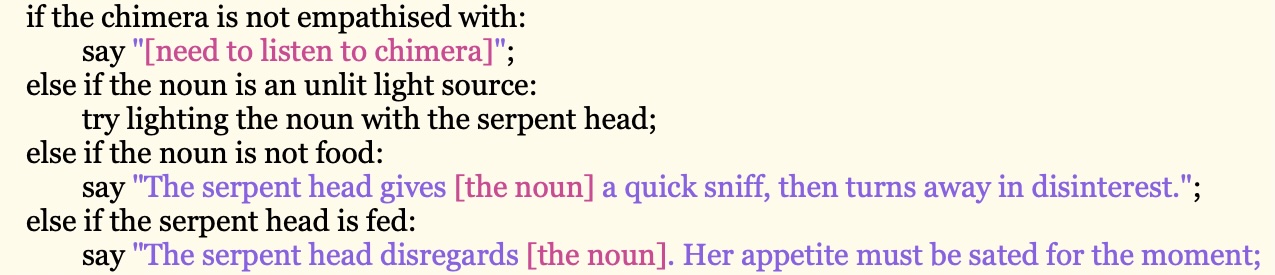
One of the fiddliest aspects of my code was managing the purse. Inform’s default rules for holdalls took care of some of it, but I had to layer in custom behaviors to ensure that everything worked smoothly and automatically. Objects that are moved to the player via custom actions (e.g., through book transformations) are put directly into the purse, where sensible, to avoid triggering carrying capacity errors. Actions are scripted to include taking objects implicitly from the purse when they’ll need to be used (e.g., getting a key to unlock a door, or getting food to feed the chimera). Lit light sources are moved automatically in/out of the purse, despite Inform’s default rules insisting on realistic physics that are not applicable to my magical world.
Getting all this to function seamlessly, especially as a fairly new Inform author, involved more debugging and head-scratching than I expected. It was a lot of effort for something that ended up being largely for narrative flavor. But it seems that the final result does, in fact, work!
* * *
I’ve come to understand Inform through an artistic metaphor (very on-brand). Michelangelo famously spoke of sculpting marble as revealing a figure that was always hidden within. His process was subtractive (removing the excess material that didn’t belong to the inner artwork), rather than additive (making something from nothing). That’s how I feel about working with Inform’s Standard Rules. They’re like the marble that the author chisels away, in order to give shape to their own story.
Writing Letters: What’s Next
I have a new choice-based game coming up in ECTOCOMP called Undead Identities. It’s very, very silly. I hope folks enjoy it!
Meanwhile I’ve started writing traditional fiction, and exploring some (extremely preliminary) ideas for a visual novel/RPG with a possible commercial release. All of this might slow me down a bit on the IF authoring side, but I don’t plan to stop.
My partner and I have been mulling over a collaborative IF project for a long while now (a sci-fi game that is also, somehow, about art). Will 2027 be the year for it? Stay tuned. And if you enjoyed Beatrix in TV, know that I might be making a parser game that is entirely cat-themed…
If you’d like to stay up to date with my projects, I post periodically to my Patreon (which is free) and Tumblr, and release my games on itch.
Thank you so much for reading this essay, for playing Tableaux Vivants, and for participating in IFComp! It’s an honor and a pleasure to share this virtual space with you.
-Nell
P.S. There are numerous “Easter Eggs” in TV: custom responses to a variety of rare commands and actions. Shout-out again to my testers (especially @Ally), whose transcripts gave me a lot of fun ideas for these! Just to throw a few examples out there: Have you triggered the two different XYZZY responses? Have you found a way to water the potted plants? Have you tried smelling yourself?
In particular, the American psychologist and philosopher William James. ↩︎
