Mathbrush reviews IFComp 2025 (Latest: Monkeys and Car Keys, done for now)

Errand Run

This is the third and last Sophia Zhao game I’m playing this competition. The other two were fantastic, and this is now an author I’ll keep an eye out for in the future.

This is the shortest game, and while it has a great gut-punch ending, it’s the weakest of the group to me (but it has some very strong competition, so that’s not saying much).

You play as someone grabbing some groceries in a store. Money’s tight; I thought this was a reference to recent tariffs in the US at first, what with poor quality onions for $2.

Things descend a bit from there, and there’s a lot of strong profanity (which matches the strong, bitter taste of the onion, I suppose). It’s when we got to dairy that I started getting what was going on (despite strong hints earlier).

The ending was a really creative take on the event it described, I’d never seen anyone describe something like it before, so I thought that part was really neat.

The reason I think the other games are stronger is that this game was fairly one-note, while the other two Sophia Zhao games were a great study in using contrasting tones and evoking a variety of emotions.

1 Like

A winter morning on the beach

Well, it was fun to load up this game and see the font adjust itself slightly. “Bisquixe does that too,” I thought. And it turns out this game uses Bisquixe! And a lot of the features, too, like hyperlinks and CSS adjustments. So it was fun to see someone use my extension, it made my day.

The coding of the hyperlinks lets you examine different objects and try out various interactions with them (some of it reminds me of some sample code Drew Cook posted a while back with a list of sense you could use; that example crashed in one interpreter but that interpreter bug has been fixed since then). There are also some more tricky hyperlinks where the linked text is very different from the action that you end up doing.

So overall I’m very happy with the technical side of this game. On the other hand, the story is pretty thin; most of the game is either a sudden bird poop-induced ending or walking past several almost-identical rooms. There are some kind family moments near the end but there’s not a big build up. So I’d see (from my obviously biased perspective) this game as a successful tech demo that could be the foundation of an even stronger future story, but it would likely take a while to develop such a story.

3 Likes

Fascism: Off Topic

I remember the Fascism: Off Topic intfiction thread from earlier this year and I had heard about this game cooking up for a long time so I somehow imagined that it would be a twine game with a fake model of intficiton where you participate in a thread but you have to argue with increasingly irrational people. I had such a strong imagination of what I thought this game was that I thought it was real.

Instead, I was shocked to open it and find a well-implemented (well, that part wasn’t surprising) parser game set in a grungy subway with graffiti on the wall and an arguing couple. Where was the thread? What was the reference?

Playing around and examining things, seeing some well-written descriptions, I tried talking to people, and that’s when I discovered the mechanic:

You can talk, but if you do, the game ends. You only have one thing to say, a one-note parrot’s catchphrase. It might be relevant to the current conversation; it might not. It doesn’t matter.

It reminds me of the Introcomp game Gallery Gal, where you have the superpower to turn into an art gallery, but only once, and permanently. You go through a normal game and choose to end it whenever you want to, crushing all those around you as you assume your true art gallery form.

Similarly, you can at any time interrupt the conversation of those around you with your irrelevant comment.

Because of my pre-conceived notions, it’s taking me a bit to suss out the message. I had imagined (in my fake mental version) that the game was originally pro-discussion of fascism, and that we would be playing the role of someone who was pointing out the rise of nationalism in the world and that others would poo-poo our notions and shut us down. This game seems to be the opposite, where it paints out the discussion of fascism as an obnoxious interruption to others’ conversation.

Whatever the true meaning of the game, it’s well-put-together. My apologies to the author for fabricating a fake game from whole cloth and spending half of my review discussing it, and thanks for entering!

3 Likes

The Olive Tree

I thought this was a touching game. I have listened with anxiety to news reports of famine and destruction of homes in Palestine over the summer, and fervently hope and pray for peace.

In this game, you are an olive tree that needs to be nourished in order to produce. You add more water and leaves to balance your growth, and then use it up to produce. Expending some energy to survive, and more to create the next ‘generation’.

Simultaneously, outside of your control, a story plays out of a Palestinian farmer helping you grow and passing you on to his daughter. Like him, you experience hard times and lack of the resources you need to live. Each ‘season’ is actually a large amount of years.

Like the olive tree in the name, being a symbol of peace, I hope for peace for both Palestinians and Israelis.

There is a curious coincidence (although it’s likely due to a specific common source) between this game and something in my own religion. Since it’s not relevant to most players, I’ll put it in a details tab here and not include it on my IFDB review.

Summary

The Bible compares Israel to an olive tree on numerous occasions, especially in Romans 11.

The Book of Mormon has a much more extended version of this same analogy in Jacob 5, by far the longest chapter in the Book of Mormon. It’s also one of the most unusual; I used some Python data analysis to try to determine authorship of the Book of Mormon a few years ago. I took every chapter of the Book of Mormon along with some bible chapters, the writings of Joseph Smith, some of my own writings, Charles Dickens, some random creepypastas, and a couple choicescript games and SCPs and used some cosine distances of wordprints to cluster them into groups.

My findings were not publishable because the model couldn’t distinguish between me and Charles Dickens, so it was not a workable model. But, it split the Book of Mormon into different clusters based on similarity, and Jacob 5 was by far the most unusual chapter, very distant from the others.

In it, it describes the House of Israel as an olive tree that is wilting and begin to rot. The owner takes a lot of care of it (fertilizing it, pruning it, watering it, etc.). This step is repeated so much that, since I’ve read the Book of Mormon in multiple languages, I have a lot of these terms memorized (like German ‘ringsum hacken’). Basically the tree is going bad, so they take pieces of it and graft it all around the vineyard. Then those go bad, and they go against praxis and graft their pieces back to the main one and back and forth. In the end, the tree only has a little good, so they carefully water it, dung it, feed it, and ringsum hacken, taking off the most evil branches one at a time so that they don’t kill it by removing it all at once, and adding in the other branches.

The message is supposed to be that there is great evil now in the world but it can be overcome by feeding the good and removing the worst of the very bad, and that the greatest strength is in unifying disparate branches. So this game, with its emphasis on repeatedly watering and growing the olive tree and looking for peace in the world and especially between Israelis and Palestinians was directly relevant to one of the most memorable pieces of religious literature that I believe in.

3 Likes

My creation

This game reminds me of a more HD version of Baby Tree, one of the games I most frequently show to people to tell them what interactive fiction is. It’s also a minimalist game prominently featuring a bed and a child and some agonizing decisions.

In this game you play a single parent, on a bed, with your child interminably crying. All you can do is crawl around your bed, not enough energy to do more. It’s a multiple-location bed, something I haven’t seen much before. After finding some appropriate reading material (which is coincidentally something I’ve been discussing with my students a lot recently since it’s assigned reading), you have some parent-to-baby discourse on your hopes and dreams and fears.

It was easy for me to vividly imagine this game because in some non-zero measure I was there. The day we took my son home from the hospital, I helped my exhausted and injured wife into bed in a dark bedroom, took a look at my son, and panicked.

For the first time, I realized that our life as we knew it was over. We couldn’t just stroll out of the house to get Taco Bell or whatever. I couldn’t just hop into the car to go see parents without planning. There was a helpless human being in our car and from now until the (it felt like) rest of our lives, one of us will have to be with that person at all times.

It was daunting, especially after the painful c-section. It didn’t help that I both forgot the baby in the car when stopping at CVS that day (for five minutes, and panicked that I would get arrested) and that I let him roll off the bed and hit the ground after rushing outside to grab a credit card for my wife when an aggressive and convincing scammer called.

So this game really hit home. Our protagonist has to deal with all of that, but also alone. There are also concerns about whether they can relate to each other in terms of gender and orientation. I hope that all parents out there know that things can work out well, that there can be many good times mixed in with the bad (although for some people it really is hard all the time so take that with a grain of salt!)

Presentation-wise, the game has a lot of rough-edges. Here is a sample:

Top of the bed
You have dragged yourself up, digging your nails into the bedcovers, to the top of the bed. Here you can reach what is on your bedside table.

You can see your phone and a glass of water here.

The baby looks tired. You are tired too.

>x table
You can’t see any such thing.

>drink water
There’s nothing suitable to drink here.

The baby takes a quick and wheezing breath, only to continue crying.

>take water
Taken.

The baby’s high pitched crying turns even more high pitched.

>drink it
There’s nothing suitable to drink here.

You feel your own vocal cords contracting and stinging, asif you are the one who has been crying all this time.

>x it
You take a sip of water from your glass.

Your baby’s cries become even louder.

So the implementation could definitely use some work, but the message resonates.

3 Likes

Thanks so much for the gameplay and the review!

2 Likes

Thanks so much for playing!

2 Likes

Monkey and Car Keys

I beta tested this game so I saved it for last.

This is a puzzle-filled comedic parser game about recovering your car keys from a bunch of monkeys in the jungle.

Notably, this is one of many games in this competition that involve translating a language. In this case, the language is: monkey language!

By searching around the compact starting area, you can find ways to understand that language better. Once you do, you can get involved with some shenanigans in order to get back your stuff.

I’d say this is one of the harder games in the competition. Even having tested it a couple of times I couldn’t remember how to solve one especially complex puzzle. Examining everything and exploring everywhere are important, and it’s good to save if you think you’re near the end, as the endgame has a few ‘bad’ endings.

I know there are some old-school parser fans who hope for a puzzle-filled traditional parser game in each year’s competition. I think this one will please those fans.

5 Likes

You did it! :clap: :tada:

81 reviews in less than a month is extremely impressive.

10 Likes

I’ve now reviewed all the IFComp games I plan to! The other three all seem high-quality and interesting but have content warnings for things that I’ve decided to avoid playing at this time.

I had a lot of fun with this competition! Unlike past years I didn’t see one specific stand-out winner (although I have my guesses) but I saw a ton of high-quality games, so I think the top 10 and even top 20 rankings are going to be wide open, and people shouldn’t feel bad for placing lower; there’s just so many good games. I hope to do a ‘pseudo-awards’ post later.

Thanks, Hidnook!

16 Likes

Thank you for the kind review!

How embarrassing that the forklift bug is still there, even though you already pointed it out in the German version… I’ll fix it right away, but the new version most likely won’t be released until after IFComp is over.

4 Likes

Thank you for taking the time to play WATT! I’m so sorry that I only managed to get to this review after ballots have closed TT

OH! Do you mean the question itself contains an error or is it the answers? This was taken from an A Levels paper from 2010, and I had adapted the MCQ to include the right answer in one of the choice (or at least, the right answer according to the answer booklet). I have to say, I’d take advice from a math PhD candidate over an outdated marking scheme any day.

And you’re absolutely right! We did get our inspiration from Deltarune :smiley:

You’re so incredibly kind :” I feel like for us IF writers, it means a lot to hear that the writing is good and that it resonated :heart:

4 Likes

One of them is wrong. Whether it’s the question or the answer depends on what you want to change! If you send the question I can solve it, or Mathbrush can.

1 Like

That’ll be great! We’re currently on the post-comp release of the game so this would be very helpful .If it isn’t too much trouble,feel free to recommend other bizarrely difficult mathematic problems as well.

Thanks so much for pointing this out, both!

cc. @mathbrush

2 Likes

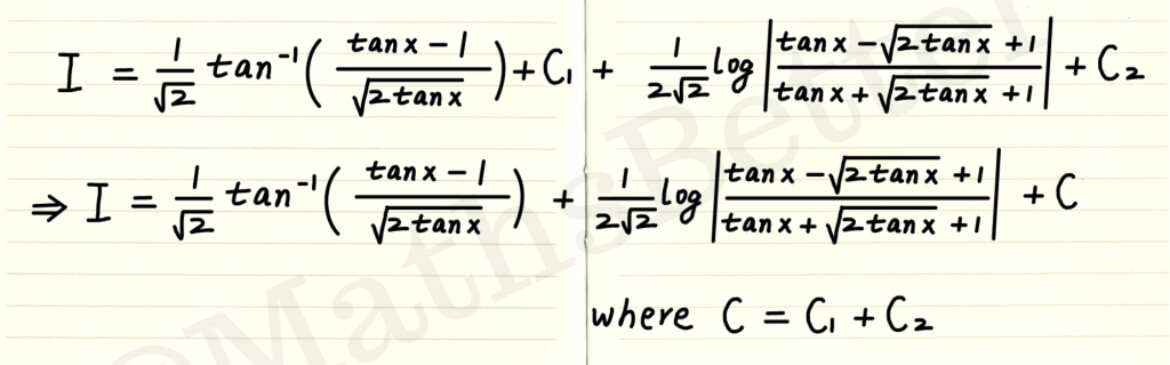
If you want bizarrely difficult, one of my students recently asked me to integrate the square root of tangent. It took me forever so I thought I messed up, but it turns out it’s just a notoriously hard problem. (Here’s one solution I found online just now):

1 Like

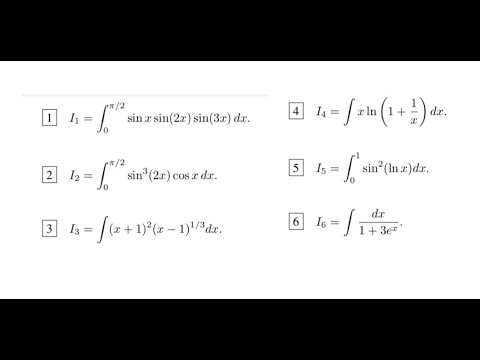
MIT also apparently holds an Integration Bee. Here are the ones from the qualifying round in 2010:

4 Likes

I’m looking through old math problems I liked, relatively ones that made me say “no way” until I got them, then they felt cool. And I wanted to lean in with maybe making the questions easier with multiple choice so people don’t have to calculate too much.

If it’s not what’s required, I hope it’s entertaining for non-math-o-philes.

Find the next triplets in the sequence
0, 1, 1
3, 4, 5
20, 21, 29
119, 120, 169

The answer

696 697 985
4059 4060 5741
23660 23661 33461

The reason

If x(n) is the 3rd number then x(n) = 6x(n-1) - x(n-2). The numbers in the middle are a bit trickier. Their average or sum follows the same formula as well.

y(n) = 6y(n-1) - y(n-2) + 2 for the left
z(n) = 6z(n-1) - z(n-2) - 2 for the center

Since this is multiple choice, we might allow the observant test-taker to guess #3 right and not worry about the other 2 digits.

An alternate question would have the series
0,1
2,3
12,17
70,99

next 3

408 577
2378 3363
13860 19601

But I like the first a bit more since it has Pythagorean triples that may make non-math-o-philes say “Whoah, really?”

A 3rd alternate might add 1,1 5,7 29,41 169,239 … so the reader has a chance to make a connection since the numbers are closer together. (x squared is 1 different from y squared) and the formula is x(n) = 2x(n-1) + x(n-2)

1 Like