This is a tiny game, written by a Slovakian student. It describes itself well, as it’s one room in a Twine game where all exits lead either to the same room or an identical place. The only choice is when to stop.
It’s a funny idea, but the title kind of gives away the big twist, and the game itself is small, so I would have hoped for something a bit more. That doesn’t mean it’s bad, though; it feels similar to games like Uninteractive Fiction 1 and 2, made by a skilled author who wanted to convey a specific message/feeling etc. through a tiny or unfulfilling work. Experimentation like this is a great sign (to me) in a young author.
The opening of this one stumped me so badly I had to resort to hints, due to it not working with my pronunciation at all. I got the second part of the command quickly but was stuck on the first.
This is the last of the Slovakian student games, I believe, and a good one to end on, with a larger structure than many of the others.
You are a player in a cruel game run by a wizard, and you have to pass through three mini-games. You have a couple of options each time, some of which lead to death, but you can always retry each world.
There are some typos and I feel like the narrative plot arc could be structured better (with more rising action and a little bit longer denouement) but otherwise this seems pretty good.
This was a choice-based mostly linear game that was longer than most of the Petite Mort games. It builds up background and has one choice at the end. I didn’t encounter any bugs and the style/polish looked good.
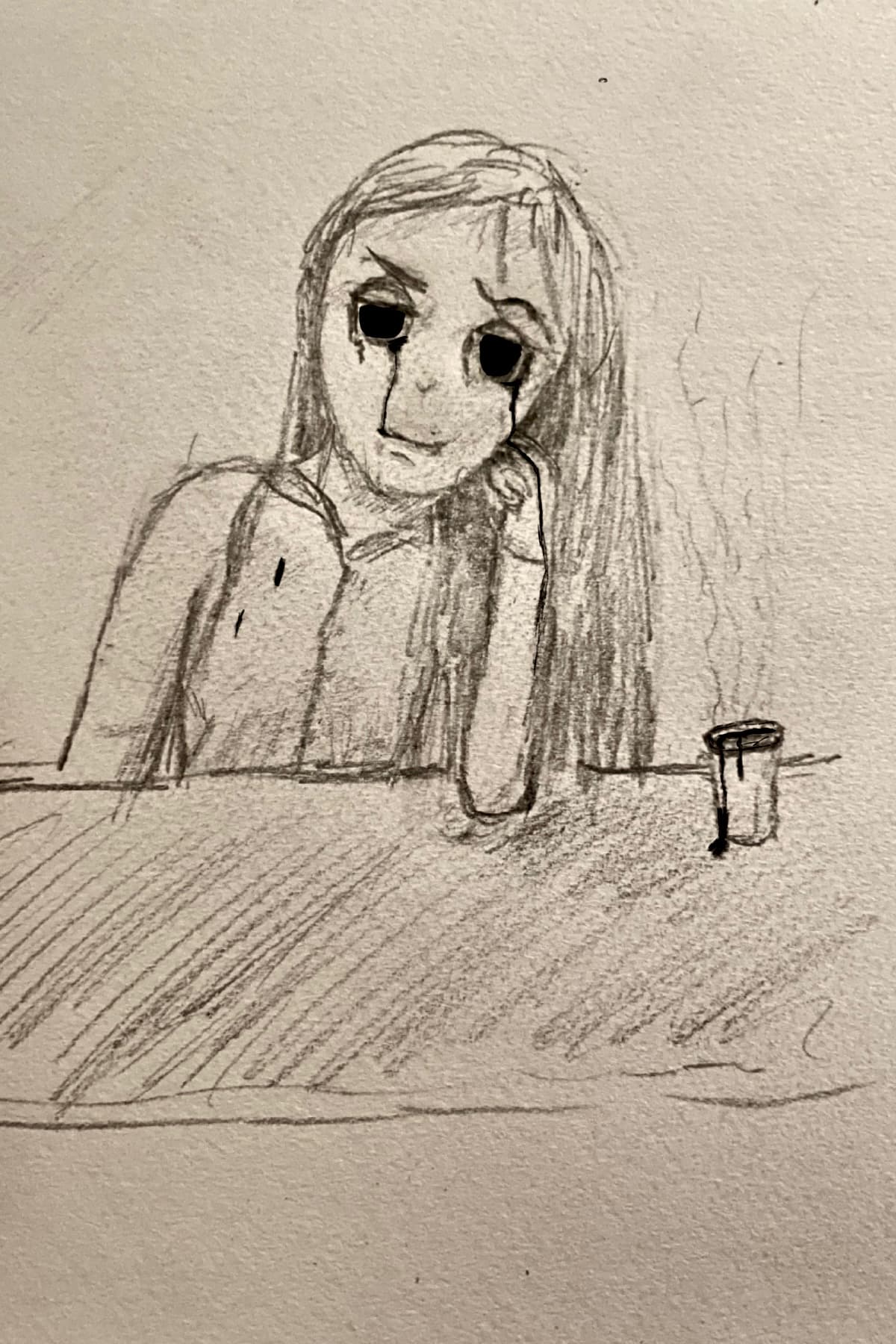
The story is about a girl in your college class with eyes like black pools. She unsettles you, and seems to be aware of that fact. Soon, you end up meeting with her, and learning more about her.
To avoid spoiling the game’s twists, I’ll put the rest of my impressions in spoilers:
I thought the woman at first was Jesus. Many of the miracles model those in the temptation of Jesus, but the temptations there were mostly for Jesus to use his own power: for he himself to turn rocks into bread; to prove God’s love for him by letting angels catch him after jumping off. The only thing Satan ever actually offered was rulership over the world. The other miracles here (parting water, water to wine) were also Christ’s miracles. So I really expected a ‘dark Jesus’ moment. But having it be Satan makes sense, too. It reminds me of a speculative fiction anthology from the 70s my dad had around the house where a guy goes to shoot Satan to save the world but Satan and Jesus are twins hanging out at a Cafe and he can’t tell which one is which.
Overall, pretty thought-provoking. I even sketched a doodle of the main NPC. The prose was the highlight.
This game is really ambitious for a Petite Mort game: many superhero characters, an expansive map, and actual game mechanics rather than individual parser rules. This is pretty hard to do!
And it manages to mostly pull it off. There are a few rough edges here and there (mostly with necessarily repeated text due to the short time frame and difficulty finding a path forward sometimes that several reviewers noted), so I would look forward to a post-comp release, because this already-good game deserves even more imo).
The game itself is about carrying concepts around as physical objects and gaining them and losing them in various situations. You have to carefully manipulate the order you get the concepts and learn the map to get it all to work. This reminded me of Delightful Wallpaper, a two part game where the second part involves taking concepts from people and placing them in others.
The writing is enthusiastic and creative, and the mechanic was enjoyable.
This game’s text would have fit well in Season 5 of the Magnus Archives, probably with the Stranger or the Spiral.
Someone is contacting an Ai support system, but they are in turmoil. The game repeatedly mentions a desire to hollow onself out, or the state of already being hollow. I mentioned social alienation in another game; this feels like self-alienation, like depression and other neurodivergence, where you feel barely attached to the flesh and to your own identity.
The game contrasts this with the multitudinous non-sentient existence of AI. The two are able to connect with each other and try to help each other.
The text is written in a intense way, and the physical display uses a variety of effects to augment that effect, including mimicking online help systems, using color, overlapping text, etc.
Overall this one was one of the strongest entrants in the comp, for my tastes.
Same, this reminded me of Magnus ep 65, “Binary”, not in a “derivative of” way but in a “I love spooky computer horror and there’s not a ton of it out there” way. I’m glad this one seems to be getting a decent amount of attention (18 ratings at this point).
I’ve always liked self-referential media, like the opera Capriccio about writing opera. That extends to interactive fiction; Creatures Such as We is in my top 10 favorite IF of all time, and it’s full of discussions about game writing.
This short ectocomp game is about writing a short ectocomp game. I had to laugh at the end when I read that it was ‘based on a true story’. The author goes through a very similar process to me when needing to write: procrastinating, researching, hanging out online, and then having inspiration strike.
It’s fun to see ‘the process’ from someone else’s viewpoint, like reading someone’s written remembrances of your deceased grandfather and realizing that they knew the same person as you but in a different way.
This also made me think of how the process must work as this author (with her co-author) has 2 of the top 100 most-rated games of the 2020s and 3 of the highest-rated games of the 2020s on IFDB, so there’s a good chance anyone who’s been around the last five years has experienced and enjoyed the team’s work.
This game is a speed-IF parser game. Like many parser authors have done before, this author has chosen to write a ‘my apartment’ game, spending a lot of time on a familiar setting. Appliances are the most common item to be implemented, each with at least something to do. It’s hard to implement a whole apartment in 4 hours, but the scope has been narrowed to just two rooms.
Other than that, there’s not much to talk about.
Besides, of course, the corpse on the couch. But that’s another story for another day.
This was a compact but complex puzzle game, impressive for being written in 4 hours.
You are a ghost, only able to interact with the world once each year. The house you are in is being used for a vacation by guests. Your goal is to interact with them to guide them to the truth.
Unfortunately, you are very weak, and time is short. I found myself struggling (in character) to do almost anything, like opening windows and doors. But after replaying several times and exploring, I discovered the pattern needed to win.
Dialog and presentation were good and the puzzles were engaging and not too hard or too easy. Great work.
This is a DendryNexus game written in 4 hours. It looks great, with pixel art on the drawn cards containing the storylets. It’s also a pretty tricky game!
You play as some sort of being, either a kind of human not well-regarded or something human adjacent. Falling under the earth, you are left to wander alone, seeking food and comfort and combing through memories.
You draw from two decks: the present, and, later, the past. These can vary different attributes, like your hunger or more obscure things like ‘void’.
There are many endings. I found bad endings: hunger, and drowning. I also found a positive and hopeful ending. I was impressed with how complex the game could be and how rich the text in such a small timeframe.
This is a polished-looking Ink game with a great story arc, solid writing and interesting characters. It has frequent strong profanity that seems natural to the characters.
You play as someone who is currently presenting as a man during a date. Your best friend Tom is coaching you, Cyrano de Bergerac style, on how best to romance your date. As things go on, facts come out. Gender identity is a central component of the story.
There are a variety of ways it can end, some shorter than others. It took me a few replays to see how the author cleverly handled the scope of the game without letting it get out of hand (by funneling several types of choices to the same results).
The horror here is the horror of self-hatred (in my interpretation). Pretty much every path leads to some kind of self-loathing. The other narrative thread I identified is toxic friendship.
I think that most people on the forum will find something rewarding in playing this game.
This is the last game I’m playing/reviewing in Ectocomp, and is the most-rated one in the comp so far. Having played it, it’s easy to see why.
You play as an employee in a firm that seems to specialize in educational software. For some reason, you constantly get emails intended for people that aren’t you.
The game was trickier than I expected, and I wasn’t paying attention at first, so I didn’t know who to forward emails to for a while (which is part of the gameplay). This enhanced the experience, as it got several people mildly annoyed at me and made me feel like we were all playing the same game in multiplayer.
Then, things begin to change. The workload gets harder in ways that shouldn’t be possible, and a greater burden has to be shouldered. The ending is ambiguous, which I liked.
Unlike most petite mort games (which tend to be quick sketches of games due to the time constraints), it seemed to completely polished and fully fleshed-out, which makes sense as it seems to be scoped well (with a system that doesn’t require much branching, if any, but still rewards interaction by having you guess who to forward an email to).
That’s it for my comp-playing! The remaining three games (Velatorio, Slop, and the Final Stew) have content warnings or content indicating material that I usually avoid.
This has been a fun competition and I deeply enjoyed seeing the creativity on display!
I had watched a video about the universe maybe being symmetric and had the idea: what if time flowed backward in an IF game? But it ended up being way too ambitious and I had to cut it short. It was also a little maddening to try advancing a narrative in reverse. So I’m happy to hear A Life Rewinding described as ambiguous rather than nonsensical
Thanks for taking the time to review–for this whole thread of game reviews really.
Writing the code is half the fun I had two frameworks I had been hacking on in my spare time, and used them for my two entries.
The fun part of the parser system (called Subtext) has been implementing some ideas from the 1991 book The Art of Metaobject Protocol to make a rule system.
The fun part of the choice base system (called Nine Lives) was experimenting with the question: do you really need to make a heavy DSL for choice-based games? JavaScript goes a long way if you just invert code and text. So the *.9l file-type consists of ink-like nodes. Each node is essentially a function that treats the block of text under it as a JavaScript template literal to print, so you get the familiar escaping of JavaScript’s ${foo} syntax. Lines that start with | will run javascript code, and lines at the end of the node starting with > are choices that call other nodes as functions.