[bump] ?
6 Likes
Great timing! I’ve been horribly busy the past few weeks rehearsing (Lucia di Lammermoor opens next weekend), and upgrading Ubuntu broke my Gargoyle installation, and then I broke something else trying to build from source…it’s been a frustrating comedy of errors.
But last night I got back into this and it’s time to EXPLORE THE MOON!
7 Likes
As a reminder, we’re starting at…
A Magnificent Desolation
As Buzz Aldrin put it. A ridged, furrowed plain of unraked powdery soil, dotted with pebbles and boulders of subdued grey and brown which gleam here and there with splashes of glass. Mountains rise like sand dunes from the overcurved horizon.You have landed in the southeast corner of the Taurus-Littrow Valley, an embayment between two-kilometer high Massifs to north and south, which runs eight kilometers wide to the west until it climbs foothills bordering the Mare Serenitas. The valley floor ends suddenly with Bear Mountain to the southeast.
A ladder rises through the shade into the airlock of the squat and beautiful Lunar Module “Othello”.
The Lunar Rover, a stripped-down jeep, rests neatly here.
Exploring this area is really annoying, because the second time you get a “you can’t go that way” message, it takes you back to the start. This means I spend a lot of time brute-forcing every exit, finding nothing, making my way back, continuing brute-forcing, and so on. But I think I’ve found all the rooms that are currently available. (At least the random messages as you walk around add a nice flavor to it all; you can see them all in the transcript, but I’ll include a few samples.)
To the southeast is…
The lunar soil is slippery underfoot, like walking on clay made of tiny marbles.
Bear Mountain
The mountains are deceptive: no smooth and rolling foothill this, for Bear Mountain suddenly rises at a thirty-degree angle, littered with jagged landslide debris fit to puncture the suit of a careless astronaut.This is the farthermost finger of the Vitruvius mountain.
A gnomon stands upright here, beside a boulder.
A gnomon, you say? I know where this is going!
>x gnomon
A geologists’ gnomon, an accurately-made tripod of measuring rods used to provide colour and length scales for photographs.
Oh, so it’s not the Trinity type of gnomon. Never mind, I don’t know where this is going. Maybe we’ll get to take some lunar photographs with it?
We can also pick it up, triggering a quote:
Gnomon is an island.
– Astronaut Jack Schmitt
(on every possible occasion)
Ha.
It’s curious: although gravity here is one-sixth that of Earth, objects feel even lighter, only weighing a tenth or so of their normal weight. Perhaps the lack of air resistance accounts for it.
Interesting! I’m guessing this is something the Apollo astronauts reported? I wonder if the bulk of the spacesuits contributed to it too.
Going many other directions from either the beginning or Bear Mountain takes us to:
You can kick the soil loosely with your toes, like powdered charcoal. Each time your foot falls, dust spins away with machine-like precision.
Regolith
Walking on the surface regolith, the cement-grey rock dust which fills lunar valleys several meters deep, you leave perfect 1/8th-inch deep footprints. The ground bears weight like freshly ploughed soil, or wet beach sand.The blue crescent of Earth hangs in a starless and Bible black sky. This is an unforgettable place.
And further north:
You have settled onto a loping tiptoe walk, as if on a trampoline: but it is exhausting to stop and start, because although you weigh very little your momentum is the same as it would be on Earth.
Emory Crater
One of the dozen or so big impact craters in the valley, five hundred meters wide and too steep to comfortably descend. The regolith is scattered with flat boulders like stepping stones. Everywhere is crater upon crater, the piled debris of one meteor strike after another, uneroded by wind or water. In the centre of the brightest craters are little glass-lined pits.The Green Clod, a fine paperweight-sized rock, nestles beside a boulder here.
The capitalization and “the” makes me think this is some important artifact, but Google is coming up empty: there’s some interesting discussion of green vitreous rocks from earlier Apollo missions, but nothing specifically from 17. So hopefully we’re not going to break history if we take it with us—which nets us a point!
Further north:
Apollo 17 Landing Site
Just about the exact centre of the Taurus-Littrow plain, ringed about chaotically with footprints and Lunar Rover tracks which will, perhaps, remain for millions of years. Some way off to the west, scientific instruments gleam.A sun-white ladder rises to the airlock of the lion-faced Lunar Module “Challenger”, which is over three times your height. It has one leg in a small crater, and is tilting gently backwards. On another leg is a ceremonial plaque.
The American flag stands here, held out by a wire frame.
>x plaque
“Here man completed his first explorations of the moon December 1972, AD. May the spirit of peace in which we came be reflected in the lives of all mankind.”It is signed by the Apollo 17 astronauts, Eugene Cernan, Harrison Schmitt and Ronald Evans, and by President Richard Nixon.
>x flag
The same $5 flag which flew in Mission Control throughout the Apollo years.>take flag
Don’t be a fool. The real astronauts will surely notice if you steal the flag - it could hardly have blown away in the breeze.>u
Too risky by far! Think of the damage to history you could do just by disturbing the tiniest thing inside.
And also the astronauts might be in there, since we don’t see them out here! Hopefully we’re not going to get spotted—that’s going to be pretty difficult to explain.
I wonder if they’ll accept “my frenemy brought me here to help them research, and I honestly have no idea where they got the spare Saturn V from”?
While the crater extends in all directions, only north and west take us anywhere new: the others just send us back to our lander.
You trip over, but fall so slowly that you have time to turn and catch your footing again.
Silver Cairns
A clear patch of regolith, two hundred meters west of the “Challenger”. To the north is an extraordinary view: dead flat plain, then the North Massif rising like a cliff. The trails of rover prints lead roughly southwest.It is home to the ALSEP scientific station, five weird-shaped instruments laid out on the lunar soil and cabled together to a nuclear reactor and a skyward antenna.
A stiff cable snakes away, ready to be hooked up to some experiment or other.Some kind of two-foot long rod is propped up next to the ALSEP. There’s a hairline crack around part of its midriff.
[Your score has just gone up by one point.]
Ooh, shiny!
>x rod
A couple of inches in diameter, two feet long and bearing a triangle. Inside the (red) triangle is the symbol Pu238. The rod seems to be fragile: perhaps it has been dropped, because there’s a crack around the middle. Surely, an accident waiting to happen!
My roommate is a nuclear engineer, so I asked her what the dangers of this would be. She says it gets very warm (which is the point of taking it into space as a power source) but isn’t imminently dangerous: in that shape it won’t be able to go critical, and the main danger is inhalation. Plutonium is an alpha emitter, and alpha particles are big and charged: even jeans are enough material to stop them, so in a spacesuit there should be no issue. (And even if inhaled, it’s more a “kidney cancer twenty years later” risk than a “die immediately” risk.)
Thus reassured, we can…
>get rod
The hairline crack opens just a fraction as you take the rod. The rod doesn’t break, but you feel dizzy, overcome, rather nauseous (no joke in a space-suit) and then blisteringly hot…*** You have died ***
Oops.
At least we’ve got UNDO on our side.
>x cable
The cable is insulated and almost inflexible, anchored firmly to the ALSEP reactor door-front at one end and ending in a plug at the other.>take cable
You pull at the cable, which pulls the reactor door open slightly, but as soon as you release it again the door closes on a spring.>x antenna
Dead cairns like these, scattered across the trackless lunar mountains, will reflect Earthlight forever. Eventually the solar radiation will tarnish them; but perhaps there will be life of a kind before then, if the ALSEP can be activated.
A beautiful description. Clearly we need to “activate” this, but I’m not sure how. It doesn’t seem to be a power issue:
>plug cable into alsep
There’s nowhere suitable on the ALSEP scientific station to plug the cable into.
At the north side of the crater is a different experiment:
North Massif
Perhaps thrown by a moonquake, perhaps by long-extinct volcanic action, perhaps even smashed by meteorite strikes: boulders have tumbled down the slopes of the North Massif and left spectacular tracks down the dusty soil. The big one to the east, for instance, could have fallen and shattered any time from yesterday to four billion years ago.The sunshade experiment, a strip of gold foil a foot or so long, is deployed here.
>x sunshade
The gold foil is meant to stop the solar radiation, and so provide a sample of the solar wind for scientists back on Earth to analyse.
For once I’m resisting the urge to take the shiny thing. Scientific progress is more important.
What else can we do? Well, we’ve got that lunar rover to check out:
>get in rover
You get into the lunar rover.In the lunar rover you can see a joystick.
>push joystick north
Is that the best you can think of?
: (
Yeah, it kinda was.
>n
(The lunar rover is deactivated at present.)
You’ll have to get out of the lunar rover first.>turn on rover
That’s not something you can switch.>push joystick
It is fixed in place.
So we need to activate this somehow too.
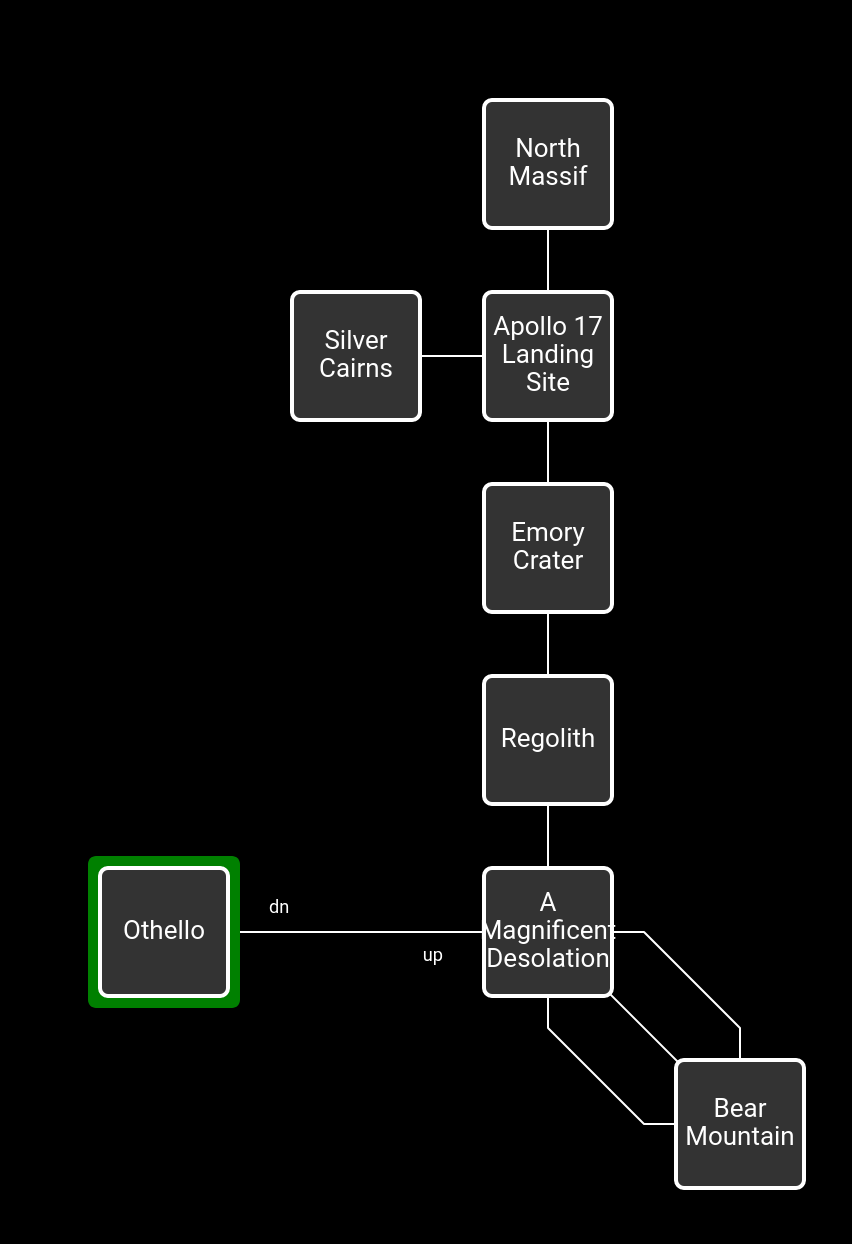
At the moment, we have a lot of truly beautiful scenery and not a lot that we can interact with. I think I’ve found all the exits: any that aren’t marked on this map either take you to Regolith or the Magnificent Desolation, possibly at random. Which means we’re going to have to work with what we’ve got, for now.
What should we do next? Thoughts, suggestions, and ideas welcome!
6 Likes
Yaaaay! Very excited this is back (break a leg).
This… actually doesn’t seem that sudden of a rise? 30 degrees is a pretty modest angle of repose even on earth (Wikipedia says you can get 34 degrees with dry sand) and even steeper angles should be possible under lower gravity. All of which is to say, have you tried climbing the mountain?
If the Apollo astronauts were capable of distinguishing stuff that felt like it was 10% of its regular weight rather than 17%, more power to 'em.
What happens if we X it?
Oh man, this reminds me of how my group’s playthrough of the Call of Cthulhu campaign Masks of Nyarlathotep ended: so after raiding the baddies’ volcano base and foiling their plan to shoot a nuclear warhead into space to summon the Great Old Ones (I think? It’s been quite a while), we decided that the best way to dispose of this dangerous stuff was to throw the warhead into the lava – I think we had three different Caltech physics majors in the group agree that this would be safe? Then the GM – another Caltech physics major – told us that unfortunately, per the campaign’s authors, everything had nonetheless just blown up. We would have pushed back harder, except by Call of Cthulhu standards “TPK in an inferno of nuclear fire” counts as a pretty positive campaign ending).
Hey, the ALSEP is real!
From the description, it sounds like the cable is providing power from the reactor – can we examine the individual experiments, or try to plug the ALSEP into them individually or collectively? Alternately, can we drag the cable across locations to plug into the sunshade?
Blarg, this is tough. Can we examine the rover for any hints? Failing that, can we push the joystick up, down, left or right? Or just DRIVE ROVER?
…stepping back, Black implied we’re here to keep the Apollo astronauts from dying, which from what we’ve seen of their landing site, would likely be due to the crack in the fuel rod. So I’m guessing we need to somehow fix and/or safely dispose of it, though given our current kit and the possibilities before us I’m not seeing an easy way to do that.
4 Likes
I’ll guess you havn’t tried this…
>x joystick
There’s a switch on the joystick.
The joystick is currently switched off.
2 Likes
Aha! No I had not. So that’s a new thing to work with!
2 Likes
I think you also forgot to examine the lander “Othello”.
2 Likes
Good to see this thread returning! I was starting to wonder how the story worked out.
The Taurus-Littrow segment does show the author a bit determined to show off his researches, doesn’t it?
But something I still like about this is that it’s trying to give the part of the experience you don’t get from film footage: the tactile quality of the lunar surface, the feel of moving about. Almost all of this came from a NASA history project called the Apollo Lunar Surface Journal, whose editor, Eric Jones, let me see drafts of the A17 sections before they were officially released. Eric had the noble idea of putting together the kind of expedition log which somebody like Sir Joseph Banks, or Merriwether Lewis, might have kept in the age of exploration. Of course, the total time actually spent on the Moon by all six landing crews combined is still less than a fortnight, so the ALSJ achieves its bulk by being just minutely detailed. If you want to know what they were doing between 3:01 and 3:03 on day 2, and why, the Journal can tell you. Once in a while the astronauts, who were extensively debriefed for the project, clearly have their memories jogged and say something enlivening. More often, they’re just plodding along, collecting rocks, and setting switch XLS/DTENT to AUX, and that sort of thing. But in the mid-90s, when Apollo seemed an impossibly distant venture - distant both in time and in cultural presence - that tiny amount of time spent on the Moon seemed precious (to those few romantics who still thought about it), if only for its scarcity.
Assuming Artemis 3 successfully lands in, oh, let’s be generous and say 2026, Jigsaw will turn out to have been written only 23 years into a 54-year stretch of the Moon going unvisited. But I suspect that scarcity is coming to an end. Nobody set foot on the South Pole between 1911 and 1956, but there’s been an outpost maintained there more or less ever since. Maybe the Moon will become a location again, and not just a disc in the sky.
12 Likes
We now have a bunch of good suggestions for what to do next! After grappling with some frustrating interpreter-update issues, we can start on those:
A four-legged platform supporting a mis-shapen, four-meter diameter golf ball. The upper half looks like a box of mirrors bolted together along the edges.
You can’t help noticing a Cyrillic letter K where the American flag ought to be.
K as in Kaldecki, perhaps? So this wasn’t even a hijacked American or Soviet lunar module, it was built in secret…the questions just keep mounting!
A paperweight-sized rock of emerald green, shot through with calcium-rich spherules of glass. A beautiful find for any geologist.
Or selenologist, as the case may be. (Do we actually call them selenologists?)
Fun fact: the -ne in selene (Greek for “moon”) and the -na in luna (Latin for “moon”) probably come from the same source. The first part of luna is a Proto-Indo-European root for “white” (also seen in “lux”, “leukocyte”, and “light”), while the first part of selene is a mysterious borrowing into Greek (selas, “shine”). Other dialects give us forms like selanna, which I always thought sounded prettier than selene.
Back to the game!
The ground is too dangerously uneven: the Lunar Module stands to the northwest.
But perhaps the rover could help?
>x joystick
There’s a switch on the joystick.
The joystick is currently switched off.>turn on joystick
You switch the joystick on.
Aha! Now we’re getting somewhere!
>push joystick north
Is that the best you can think of?
: (
> n
The lunar rover comes to life, sturdily driving as it bounces around a little on scattered rocks.
Ah, so we can just use direction commands. Makes sense, it’s an Inform vehicle after all.
You’re getting the hang of this now. Anyway maximum speed is only about 10 miles an hour, so not much can go wrong.
We’re on the moon! I think quite a lot can go wrong!
It is oddly fascinating how the wheels kick up dust to a height of two or three feet, which then falls so slowly back to the ground that it makes almost a continuous fountain.
I do really appreciate the random messages as we navigate around.
It definitely makes it feel different from just the quotidian walking around we’ve been doing back on earth.
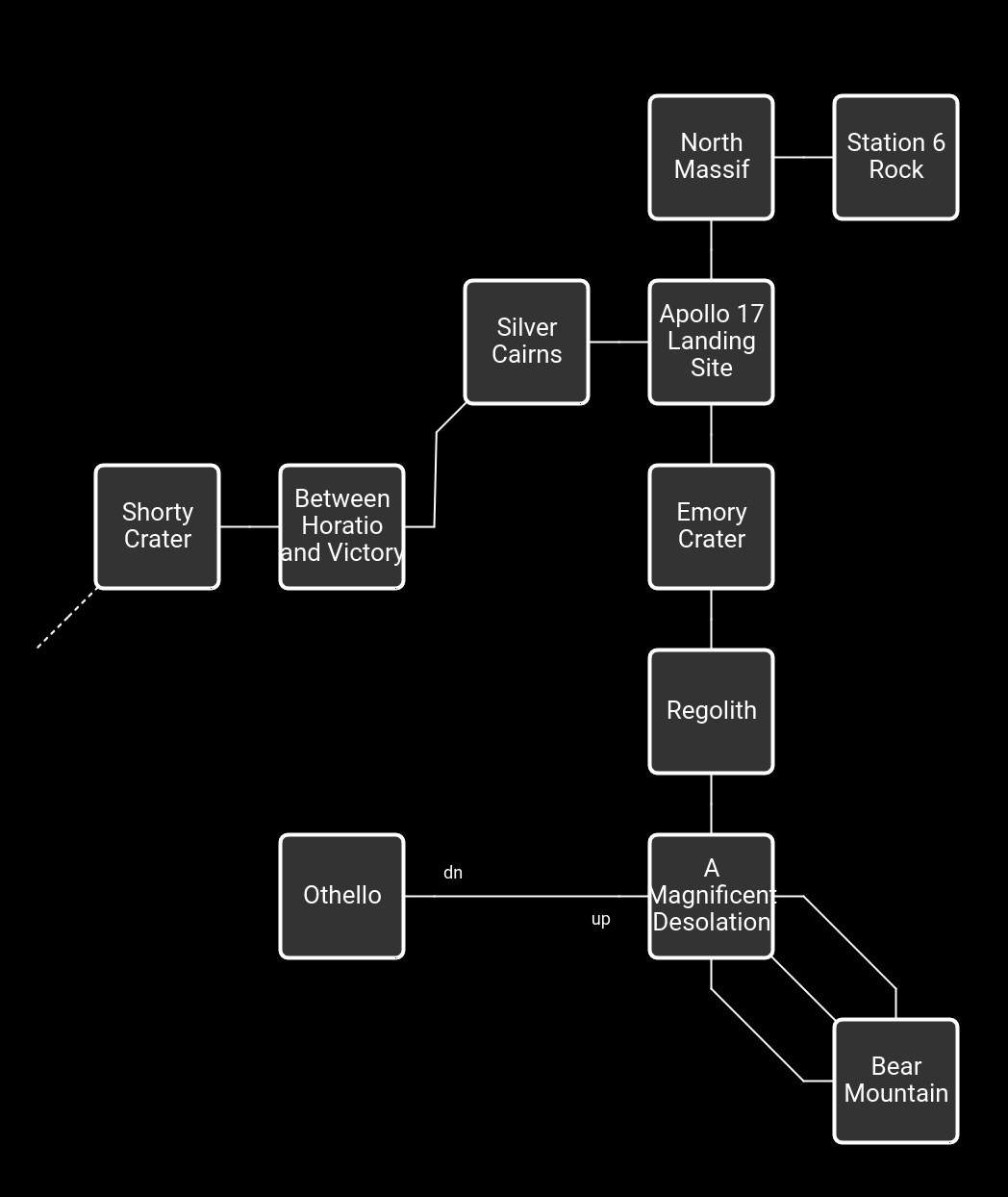
Sadly, even the lunar rover can’t go up Bear Mountain: “the ground is too dangerously uneven”. But it has one very valuable property: instead of nonexistent exits taking us to a random room, we now get a straightforward rejection every time! This makes exploration a lot easier, and leads us to a new place east of North Massif:
Station 6 Rock (in the lunar rover)
This boulder, the size of a house, is sliced into five like an irregularly-cut farmhouse loaf. There’s nothing like it across the whole plain. The North Massif, Wessex Cleft and the Sculptured Hills lie across the magnificent north panorama, but the slopes are far too gruelling for any rover.>x boulder
The house-sized boulder is sliced into five like an irregularly-cut farmhouse loaf. You feel quite dwarfed by it. Actually, you’re the first to see it: the only rover tracks here are your own. But the astronauts are bound to come and take a look at something like this.
Hopefully they won’t question these tracks.
We can also go southwest of the ALSEP now:
Between Horatio and Victory (in the lunar rover)
The valley is getting smoother as you head roughly west from the “Challenger”. Boulders mark the rims of the craters either side, and the soil is deep and clinging, fresh soil that’s been thrown up by the wire-rimmed wheels of a Rover.
And further!
Shorty Crater (in the lunar rover)
A dark-rimmed minor crater the size of a football field, whose inner wall and central mound is scattered with blocks. Lunar Rover tracks turn from southwest to east, and footprints are stamped about, scuffing the soil to reveal vivid, bright orange earth, the most spectacular colour-burst you have seen on the Moon.
Orange? Huh! I didn’t expect that, but apparently they did find bright orange soil on Apollo 17; the color comes from volcanic glass beads.
> x soil
The soil is rich in titanium, and unfortunately not volcanic (as some astronauts might be led to believe).
Or maybe not. I suspect this is a reference to a scholarly controversy of some sort.
We can’t go anywhere else from here (“In the distance you can just make out the other lunar rover. It seems unwise to drive further southwest.”), so let’s head back to the ALSEP and mess with the cable a bit.
We can’t take the cable with us (“You pull at the cable, which pulls the reactor door open slightly, but as soon as you release it again the door closes on a spring.”), and the reactor, door, and all the equipment redirects to the ALSEP object. Which is going to make it harder to figure out what to do with this reactor and cable, but also tells us none of the other experiments are important.
Well, important for this puzzle at least. They’re very important for science!
We can bring the sunshade over to it, but it’s just a strip of foil, with nowhere to plug in. Nor can we plug into the rover. But I suspect there will be something we can plug into, because PLUG CABLE INTO ANYTHING has a custom refusal message (“There’s nowhere suitable on the [whatever] to plug the cable into.”).
Examining the rover gives us a bit more detail:
There are two webbed seats, a great gossamer-thin dish antenna, a joystick to steer with, an electric motor mounted on the back and four big black rubber tyres.
Searching it says it’s empty, which is not the response I expected. Maybe we need to PUT something IN it? Or maybe it’s just a container as a side effect of how the Inform library handles vehicles.
Not a very satisfying update, but I’m not sure what else to try here—so I’m turning it back over to you, the audience. What should we do next? Let me know here and I’ll try them…probably Monday!
New map:
Save and transcript:
15b.txt (20.9 KB)
tmp2.sav (6.5 KB)
4 Likes
I have started playing Jigsaw by now. It is a pitty I had notime to play it when the thread started.
This is a great, big, rather difficult awesome game. Thanks Graham.
1 Like
The Moon chapter was one of my favourites - and it was also one where I needed relatively little help from the walkthrough, which was good. (There was one item that I didn’t think to examine, and another point where I couldn’t figure out how to use the game commands and had to look them up.) Really enjoying this playthrough!
Oh, so that’s where the name “Adam Selene” came from in Robert Heinlein’s The Moon Is A Harsh Mistress. I never even thought about that!
1 Like
Oh, something I should have put in that last update:
I think Mike’s right that we need to do something about the broken rod. We’re supposed to prevent the Apollo 17 astronauts from dying on the moon, and that’s something that’s clearly dangerous and also something we can interact with. We don’t have the skills or equipment to e.g. replace a stirring fan with faulty wiring so it doesn’t blow up the oxygen tank, but if there’s one thing White is good at, it’s moving medium-sized objects around!
The problem is, of course, we can’t pick it up without dying. We can open the door of the reactor by pulling the cable, so maybe we can find a way to open the door via the cable, shove the rod in, and close it again. The cable implies we might be able to do this from a distance (out of radiation range?), but we can’t carry the cable into another room. We’ll need to plug it into something that pulls it at the right time.
I suspect that, once again, there’s some simple interaction I’m missing that will give us new capabilities (like missing the switch on the joystick). In the meantime, I’m reading up on the equipment they had on the actual Apollo 17 mission. Did they have some sort of automatic winch that could pull the cable, for example?
1 Like
Hmm… “unwise to drive”… How about walking?
2 Likes
Reading up on Apollo 17, it seems they did three EVAs. During the first one, they set up the ALSEP, which took longer than they’d expected—so they had to cancel their planned trip to Emory Crater. Instead they went south to Steno Crater and gathered a lot of samples there. The second one was the longest lunar EVA ever; they went west to Shorty Crater and found volcanic orange soil. And the third one went northeast to Split Rock (station 6).
I’m not sure which one is currently happening in the game (probably the second, but Split Rock already has its name). But the purpose of going to Emory Crater (and then Steno) was for Schmitt to look for interesting geology, so we might be able to distract them with the Green Clod while we “borrow” the equipment we need to fix the ALSEP.
2 Likes
True, a person in a spacesuit is probably a lot stealthier than a lunar rover!
>sw
In the distance you can just make out the other lunar rover. It seems unwise to drive further southwest.>exit
You get out of the lunar rover.Shorty Crater
A dark-rimmed minor crater the size of a football field, whose inner wall and central mound is scattered with blocks. Lunar Rover tracks turn from southwest to east, and footprints are stamped about, scuffing the soil to reveal vivid, bright orange earth, the most spectacular colour-burst you have seen on the Moon.The Lunar Rover, a stripped-down jeep, rests neatly here.
>sw
The lunar soil is slippery underfoot, like walking on clay made of tiny marbles.Tortilla Flat
The Tortilla Flat (these names, you will have gathered by now, were not the work of the International Astronomical Union, who got more and more pompously annoyed with NASA as Apollo went on) is a long swathe northeast to southwest, rising towards the South Massif. Travel west is balked by a rill.You’re about at the northeast corner of the small, squarish Lara crater, crouched behind its low rim. The crouch is because the real Apollo 17 astronauts are raking a detailed geological sample at the far corner, beside their repaired lunar rover, and you don’t think it wise to be seen by them. Not wise at all.
“Repaired” because Schmitt accidentally took off one of the fenders with an incautiously-swung hammer and they had to fix it with maps and duct tape. Though in this game, I wonder…
> x rover
The repaired LRV is too far away to make out much. The repairs are to its fender, which was supposed to keep dust from being thrown up over the drivers, but must have broken off in flight. The fender is now a crudely improvised squarish grey board.
Aha! I feel inordinately proud of predicting that one, even if the knowledge just came from reading Wikipedia earlier today.
We’re at the northeast corner, and the astronauts at the southwest. We can’t move around much:
You can’t go that way, for fear of the astronauts noticing you. The crater rim is really very low.
Over the radio, you hear astronaut Schmitt telling Houston that “It looks like a finely vesicular version of our clinopyroxene gabbro.”
Oh, we have a radio? I suppose that makes sense, it would be built into the suit. Maybe we need to wait for the right moment when they’re most distracted.
Schmitt was a geologist by trade, and basically ended up leading the Apollo 17 mission from the moon, telling mission control what to tell them to do (now there’s a hard-to-parse sentence!). Whatever rock he’s found apparently looks like gabbro:
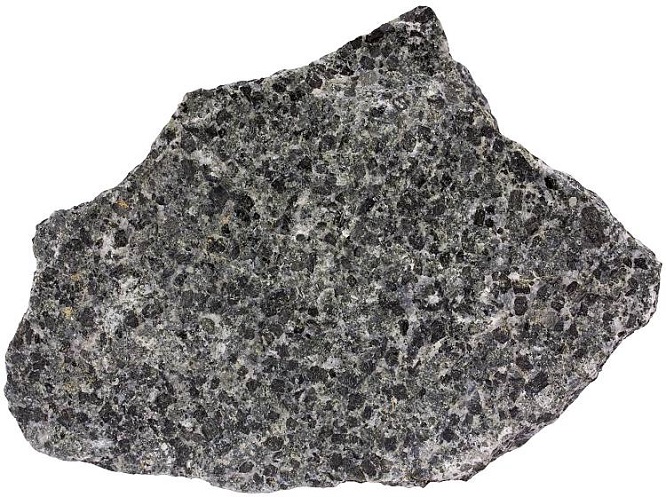
Which is probably very significant to a geologist. Maybe this green clod will be even more significant.
> throw clod
You lob the green clod stone somewhere over by the astronauts. Shortly after, they discover it, and clearly become very excited, turning their attention mainly away from the crater rim as they carefully photograph its exact location and geological context (you feel a little guilty about this).
First try! I was worried the low gravity would mess up our throwing instincts—there’s an Asimov short story (Archive.org link) where this becomes very important—but it seems we got very lucky here. (I thought the astronauts might notice it landing, but of course, they wouldn’t hear it without the air.)
Unfortunately, this still doesn’t let us move around.
You can’t go that way, for fear of the astronauts noticing you. The crater rim is really very low.
At first I thought they abandoned their study of the clod unfortunately quickly and got back to business:
Astronaut Cernan is cleaning the TV camera lens, while Schmitt takes a panoramic photograph, causing you to duck hurriedly.
But this is just an atmospheric message. LOOK tells us they’re still thoroughly distracted.
The real Apollo 17 astronauts are examining the green clod, but still far too close to risk approaching their LRV.
There are a few more fun messages like that:
“Oh, hey!” says Schmitt, having apparently spotted something. Your heart stands still. “This is orange soil!” he eventually says.
“Don’t move it until I see it!” Cernan replies, excitedly, moving over to join him.
“Is it the same colour as cheese?” asks the capsule communicator (the physicist and fellow astronaut Bob Parker) back in Houston. He contrives to do this with a perfectly dead-pan voice.
Schmitt replies that it’s nearly the colour of the decal on his camera. You have no idea what colour that is, but luckily Bob Parker does, as he copies that.
Cernan is still dusting instruments, but is quite excited. This is as nothing to Schmitt, who is animated indeed. “Okay, sports fans, a trench!” he declares.
But it seems the clod will keep their attention for a while. The question is, how can we get over there? Most of our inventory is back in the lander, leaving us with only a gnomon, the sunshade foil (I gave in to the temptation to grab the shiny thing), and our spacesuit.
Exploring the other parts of the lunar surface gets us this nice little message:
Really, there’s no way further north without a one-man flyer (which the Apollo designers reluctantly abandoned work on).
And then something notable.
>climb boulder
As you clamber onto the rock, you can’t help noticing something much more interesting…Behind the Rock
The broad, flat plain runs all around the rock, of course, and back southwest to its approaches.An extremely modern, not to say futuristic-looking, cargo pod sits here where it softlanded (perilously close to the Rock, but saved perhaps by its radar).
What is this?
> x pod
This isn’t 70s technology at all: it looks new even to you, and military at that, but bears no flag or insignia. Unmanned, of course (since it’s only a two-foot barrel) it must be designed for storage of some kind.
…aliens?
> open pod
A good trick if you can do it. It’s entirely unclear how the barrel opens: in fact, about the only markings on it are three small recesses, in each of which is a button.
Well that seems like the obvious way to open it!
> x buttons
The recessed buttons are indistinguishable, and about a foot apart.> press button
You push one, then another, then two together. Nothing happens.
Hm. Maybe Black will know?
>ask black about pod
“Questions, questions.”>show pod to black
But you have so little to offer Black.
We have alien technology! That’s not so little!
Well, our inventory is pretty limited, so let’s try…
>put gnomon on pod
Happily, the gnomon’s three legs end in three points making a triangle one foot on a side too: and you press all three buttons at once, making the pod slide smoothly open. In the cargo capsule are Waldo and a checklist.[Your score has just gone up by one point.]
In the IF world, “Waldo” is famously the name of a robot in Suspended, but it’s actually a general term for any device that lets you manipulate objects remotely. I think it comes from a Heinlein story, though I’ve never read it.
>x waldo
This Waldo is a robot designed for exploring such hostile environments as the Moon with minimum risk to the lives of human scientists. Unfortunately, it’s very clumsy and not very clever. Waldo has one great big pink hexagonal button on its “head”, a swivelling socket mounting and a rather neat little keyboard and LCD screen arrangement below (though the keys are rather small). Its one manipulator arm looks less than dextrous.
But perhaps dextrous enough to grab a puzzle piece? Or pull a cable?
>x checklist
An embossed-plastic checklist strip of instructions for Waldo, published by FMWC Inc:Type “comm cycles”
Comms FORWARD, RTURN, LTURN, SAMPLE
64 bit, 8 line technology TM
Comm cycles?
>comm cycles
That’s not a verb I recognise.
Hm.
>type comm cycles
You’re unable to type at the delicate keyboard with such thickly gloved hands.
Well, that makes sense.
Black is amusingly taken with Waldo, and crouches down to rub its head. “Hello, Waldo!”, says your bete noire, “What a clever robot you are! One day we’ll have lots more like you and never need to go into space ourselves at all… Wonder how Kaldecki got you back from our time?”
You were trying hard not to smirk, never having been the kind of person to name a car or a fridge, but it’s a losing battle. Black glares, piqued.
“Our time”, huh? So Kaldecki has been sending things back, not just people? Interesting…
>type comm cycles
Waldo beeps with unease, and the screen momentarily displays * ERROR * before clearing the program and returning to the * READY * prompt.>type “comm cycles”
Typing quoted text makes no sense here.
Yeah, I’ve got no idea what that part of the instructions wants us to do. That seemed like a very straightforward command.
>type forward
Waldo beeps with unease, and the screen momentarily displays * ERROR * before clearing the program and returning to the * READY * prompt.
Hm. So there’s something else we have to do first before we can use these commands.
>press button
Which do you mean, the curious device, Waldo’s hexagonal button or the recessed buttons?>waldo
Which do you mean, the curious device, Waldo’s hexagonal button or the recessed buttons?>press waldo button
Which do you mean, the curious device, Waldo’s hexagonal button or the recessed buttons?>press waldo’s hexagonal button
Waldo has no program at present, and activating it does nothing.
Not that.
>waldo, forward
You can’t talk to Waldo.
Or that.
Well, the closest we can get to the astronauts is the northeast corner of the crater. If it has a northeast corner, I’m guessing the crater is laid out like a 3×3 grid, so W. W. S. S. will get to the astronauts. Or, in Waldo’s vocabulary, FORWARD. FORWARD. LTURN. FORWARD. FORWARD. SAMPLE. Then reverse that to get back, hopefully with a puzzle piece in tow.
What do you all think? How should I be communicating with our new robot friend, and does this sound like a good program to use?
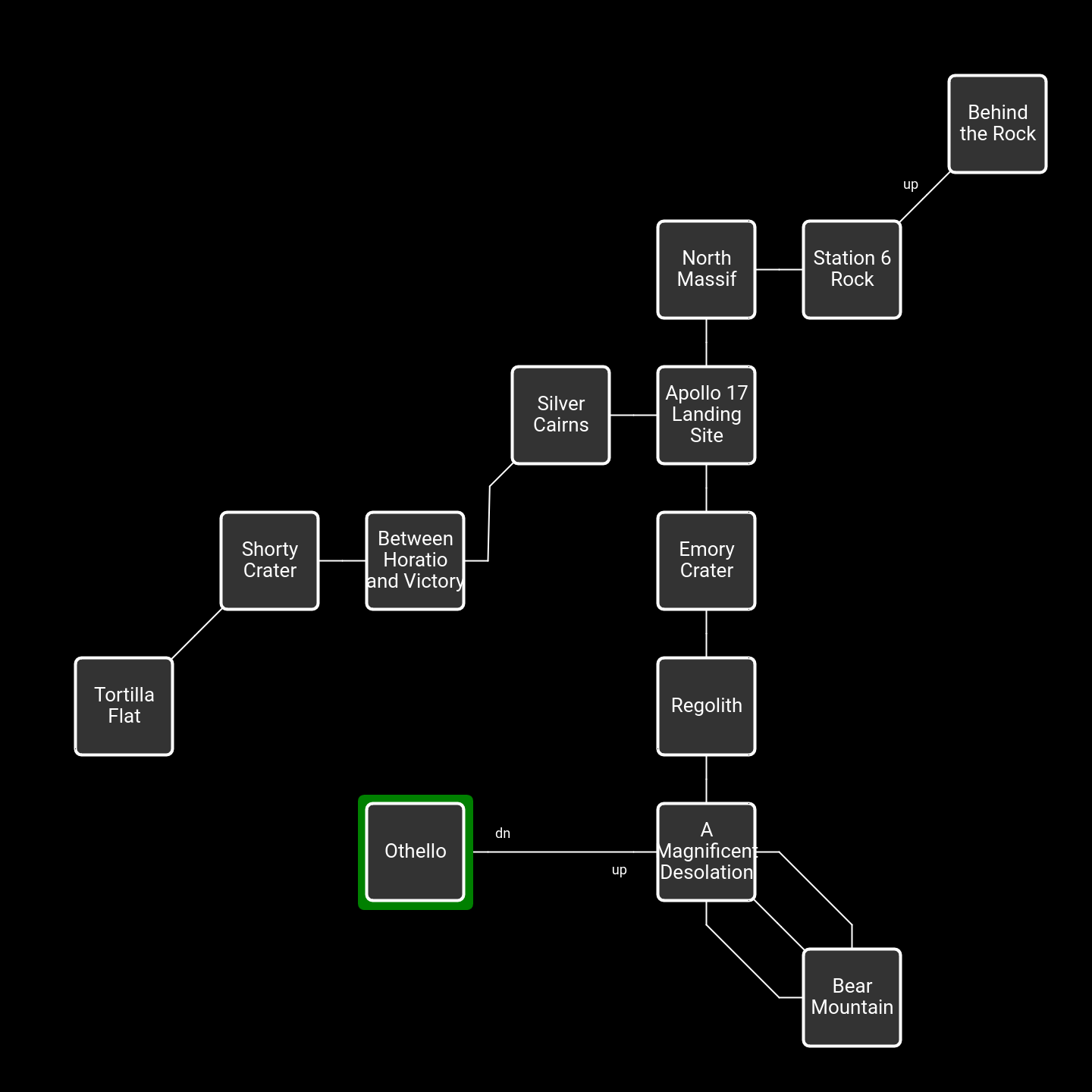
Save file, transcript, and map:
15c.txt (29.3 KB)
tmp2.sav (6.6 KB)
4 Likes
I think “comm cycles” might be “command” followed by “duration in cycles”
So like “forward 8”
2 Likes
Aha, and it has “64 bit, 8 line technology”. I’m guessing that means 8 instructions, each 8 bits long—two bits for the command itself, six bits for the number of cycles.
Can we get the puzzle piece in only eight instructions? If it takes X cycles to go from one side of the crater to the other, then:
- FORWARD X
- RTURN 1
- FORWARD X
- SAMPLE 1
- RTURN 1
- FORWARD X
- RTURN 1
- FORWARD X
Eight commands exactly. Or swap in LTURNs and face it the opposite direction.
The question is, how do we figure out X without losing Waldo to a bad guess? Maybe we can first try a program like…
- FORWARD 1
- RTURN 2
- FORWARD 1
And see how far out it goes. I’m guessing FORWARD 1 means exactly the distance between two rooms on the map, but that’s something only the player knows, not White themself.
3 Likes
FMWC = Frobozz Magic Waldo Company?
2 Likes
Oh dear. This section seems to have taken a sharp turn into “Zork II”-land. I’d forgotten the Waldo completely.
I looked back at the ALSJ today, just out of curiosity. I dare say it’s right that the plutonium canister wasn’t all that hazardous, but it does serve as a symbol of just what a huge level of risk the astronauts accepted on this mission. To begin with the obvious, they’re on the Moon, without a hope of rescue if anything goes wrong with their ascent engine, or they can’t make rendezvous. They sleep in what’s more or less a two-man tent made of aluminium foil, surrounded by hard vacuum. Outdoors, they have oxygen canisters pressurised to 6000psi on their backs. If the cooling system fails, they die. If the electrics fail, they die. If the oxygen leaks, they probably die. If the rover wrecks itself, they maybe die (could they really have walked five miles to safety in those suits?), and they’re driving in very bumpy terrain, which throws their rover around so violently that sometimes all four wheels are off the ground. They drill rocks, they smash them with a geological hammer. On one drive, Schmitt has seismic explosive charges balanced on his lap.
I think it’s genuinely possible to imagine a what-if history in which there was a serious accident, and Apollo came to be seen as a reckless overreach. I forget the details, but somebody at NASA was once asked what he really thought about Nixon cutting the budget so that Apollo 18 to 20 were cancelled, and he said words to the effect that he was kind of relieved, because 17 is plenty.
6 Likes