I used the reap skill a bunch of times in conjunction with that temple that gives you a bonus for attacking at a particular moment. If I correctly recall, the tactic works even better if you use the axe as that’s a favoured weapon of that god. Unfortunately, that’s the only useful way of using it that I’ve found.
Reaping allows you to retreat from a fight without getting any attacks of opportunity against you, and what’s more, it allows you to do this as a reaction to an attack which is thus guaranteed not to hit. I have always found it one of the best abilities in the game.
Here is a use case: the two monsters left alive are Malygris and the blood ape. You trade some blows with Malygris, but he manages to get 3 concentration and attacks you – so you reap the blood ape. Running away from the blood ape is no problem, because by now your defence is very high; you can therefore return to Malygris without getting any damage except the possible damage that reaping did to you (which is not much). You have thus entirely avoided his blow. Repeat as necessary. If your health gets low, reaping the blood ape also allows you a free retreat to a place where you can heal up (by killing the blood ape). (As an added bonus, reaping Malygris after he teleports ensures that he cannot summon his demon.)
What about a new main menu item, “Release notes”?
Erik – thanks for ideas about Bodmall, I’m going to think about all of it!
These facts definitely make it more useful. But I’m not sure that it would occur to most players to try the power in combat, and certainly not as a reaction. It had never occurred to me, and it doesn’t sound like it’s occurred to Dannii and Joey either. Maybe make this more explicit in the power description?
Ah, if that’s the case, then I will indeed change the description.
I usually feel like by the time I get to Malygris either it’s an easy win or a easy lose. But I should try reaping away, it sounds like it might take the edge off him.
Contextual hints for reaping would help too.
Bodmall
Minor comment: I guess it’s a good idea to have Bodmall’s power grant the player immunity to smoke. That fits thematically with her fog power, and gives the player a reason to save smoke-related encounters or items for after she has defeated Bodmall.
Real stuff: Here is an idea. The “thorns” command summons bushes, which hinder anyone who tries to make a non-ranged attack. The player is of course immune. This hindrance no longer involves actually dealing damage.
After one turn, the bushes grow a small number of thorns. Every subsequent turn, the bushes either grow more thorns, or the bushes grow weird fruits (some of them have the power to turn metal to wood; some act like smoke grenades; and there should be other kinds of fruit as well). This happens in an indeterministic way. As the bushes become stronger, the probability of having a negative rather than a positive change increases (thorns may fall off, fruits can whither and die), so that after a while a kind of equilibrium is achieved. (Although perhaps some really powerful fruits will become more likely as the turns go by.)
No matter how many thorns and fruits the bushes have, they still only hinder the attackers, until the player uses the “volley” or “barrage” command. At that moment, everyone in the room except the player will be sprayed with thorns and fruit, which deal damage like a fragmentation grenade (the damage depends on the number of thorns) and may inflict further special effects (depending on the fruits).
After a volley, all the thorns and fruits are gone, and will have to regrow.
Design philosophy: This power should be designed in such a way that the player must balance the advantage of using the volley ability right now (you deal damage right now, maybe breaking your opponent’s concentration and so on) against the two costs of using the volley ability right now (it takes a turn; and you’re missing out on the good stuff that will grow next turn). To make this interesting, there should a temptation to delay: the thorns start out weak, but gain in strength and special abilities rather quickly. The player should be hoping that a perfect set of fruits materialises just as the perfect opportunity arises (where the perfect opportunity will generally be the react-prompt when you are facing a highly concentrated attack, since the volley would likely break your opponent’s concentration). Will you wait one turn longer, hoping that more powerful fruits will appear? Or do you cash in on what you already have?
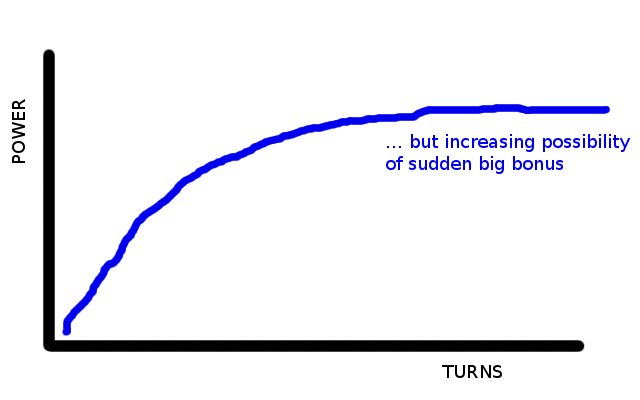
So to be perfectly clear, I think that for this power to be as interesting as possible, the expected “power curve” of the volley would be something like the attached image. It climbs steeply in the beginning, because it should clearly be suboptimal to “volley” as soon as the first thorns appear. But the rate of growth becomes smaller and smaller, so that at some (undefined and contextually determined) point it becomes optimal to use the power rather than wait for a further increase. Except that there is the slight but continually increasing possibility of very powerful rare fruits appearing, which should tempt the player to adopt a “let’s wait one more turn to see if I get the jackpot” stance. But temptations are sometimes best resisted.
The fruits will also allow us to put as many weird effects as we want into this power without changes the complexity of the interface – you’d still only need the “volley” command.
Thoughts?
The fruit idea is excellent as it avoids packing too many commands into a single power (and correct me if I’m wrong buy the design philosophy has been one-command-per-power so far). Would Bodmal’s use of the power visibly change to tale into account this slight thematic shift?
Bodmall’s use of the power could be made identical to that of the player. I haven’t really thought about it, but at first glance it seems like a good idea.
I like this new power proposal too. Can we have fungal growths on the thorn bushes too, so that rust spores are another potential volley effect? Rust spores always struck me as a druidic technology…
Is there a difference between smoke and fog in the game? It seems like the former ought to cause damage (from choking), while the latter might simply affect visibility. But I don’t recall smoke ever causing damage. Anyway, regardless of the existing state of things, one of the powers of the fruits might be a toxic smoke the causes low amounts of damage, but clears faster than regular smoke.
Absolutely.
Nope, they’re the same things. SmokeFog is only mentioned as a flavour text for Bodmal, so I’ll probably remove it now to clear up that potential confusion.
Good idea; what about making it a swarm of angered bees?
Nice, avoids confusion with smoke/fog.
I’ve pushed my attempt at rewriting the scrolls system. I think it works quite nicely, and it avoids cloning objects. github.com/i7/kerkerkruip/compare/scrolls
Nice! I’ll take a closer look later, but here is one thing I’m wondering about:
does that ensure that the pile of bodies will never yield a (non-death-related) scroll of a type that is already identified? Because if so, it’s a change with how it used to work, and I a change I’m not sure I like. And does this also mean that the probability of receiving a scroll that is in many treasure packs is greater than the probability of getting a scroll that is not? That would also be a change, but one that I’m agnostic about.
At the moment, yes it is like you describe. It’s easy enough to just remove the unidentified condition and it will pick any off-stage scroll.
As to the probabilities, it does mean that those in more treasure packs are more likely to be chosen. If you don’t like that we could go back to cloning.
Btw, if your luck is good, you could get several scrolls out of the body parts before finding the corpse. Is that how you mean it to be? Or, we could reduce the rate of finding the corpse further, making the pile more tempting. I have one scroll, do I try for a second? Or a third?
Ok, let’s do that.
It seems fine to me. I only chose my original solution because it was easiest given the cloning system; now that something else is easiest, I see no particular reason to want to keep it.
Yes, that’s intentional. Reducing the chance of finding the corpse is probably a good idea. As a further improvement, could we make it so that both the probability of finding the corpse and the probability of finding a good scroll will rise as the player makes more attempts?
The new Bodmall power has been implemented, with one small exception… the fruit don’t do anything yet. But everything else is in place.  Here’s my idea about the fruit, with the “strength” of the fruit in brackets – this determines how long it will take before the fruit can start to appear, and how many points of body the player must have to make this possible.
- Smoking fruit (3): acts like a smoke grenade.
- Wooden fruit (3): chance to transform metal to wood.
- Rusted fruit (6): acts like a rust grenade.
- Hidden fruit (6): makes the player hidden.
- Buzzing fruit (9): bees come out that damage and distract enemies for some time.
- Crawling fruit (9): worms and beetles come out that deal massive damage to undead.
- Golden fruit (12): grants the player a temporary attack bonus.
- Shimmering fruit (12): teleports everyone in the room to a random location.
- The fruit of kings (14): acts like a package of ment on the player.
The fruit of kings can only appear in the presence of Malygris, to avoid the situation where players “farm” the brambles for the fruit of kings in a fight with a very weak monster. By the way, none of the fruits can be plucked – they can only be launched by the brambles.
Sounds good?
This is a nice selection of fruits. The scores look like they make a linear time-incidence graph with a speed-up at the end, so not very much like the graph you described in the design post, but if you have decreasing chances for each fruit to appear, then the average graph of actual appearances would probably be pretty similar.
With the shimmering fruit, does everyone teleport to the same location? Or do they go to different locations?
An idea for an additional fruit on the powerful end of the scale: causes enemies to go insane, a la the sprout power.
Do any of the area effect fruits affect the player (other than the directed ones that affect only the player)?
Well, all fruits also have a chance of disappearing again, once they are formed; plus I haven’t given you the formula for thorns growth, which happens much more rapidly at the beginning.
I was thinking different locations, because otherwise, what is the use? It would basically be a way to break up groups of enemies and/or escape from a fight that is not going your way.
Sounds good. Should it be temporary or permanent?
Smoke doesn’t affect the player, because if you have the power of Bodmall, you’re smoke immune. You’ll also have an attack bonus with wooden weapons, so the wooden fruit and the rusted shouldn’t be a big problem. (We probably need to give Bodmall a wooden weapon that the player can pick up and use, now that I think of it.) Busszing & crawling don’t affect the player, shimmering is probably most fun if it does.
Since thorns are the element that the player can always bank on, that is probably the more important metric for the curve, of course.
That was exactly my thought–why bother to send all characters to the same place? If the player does that, though–via the teleportation beacon–it could prove interesting. What if there were a way to set a trap in a room? A motion-activated grenade, for example? Turn on the beacon, toss in the motion-triggered grenade, and then go off to find a sucker that you can cause to teleport. (Glancing back to the grenade stuff that began this thread: how about if you can toss a grenade into an adjacent room, but if there’s an enemy in there with opposable thumbs, there’s a chance that the grenade will be tossed right back at you?)
Maybe the fruit grows larger over time, increasing its effect? But that would then need to be the model for all of the fruits I think. On balance, I feel like a temporary effect would be best. Maybe it lasts just a few turns (less than 5)? It should probably last the same or less than the regrowth rate for thorns.
Great, so the blanket answer is that fruits do affect the player, but that certain effects may not apply. (Buzzing and crawling critters act w/intentionality, so their lack of effect on the player is easy to explain.)
As for a wooden weapon for Bodmall, the druid’s staff is of course a key part of the (modern-day) iconography…