Muramasa subverts a few tropes in a way it’s hard to enjoy without having played enough other VNs first. And it revels in misery and shock value, which can certainly come off as cheap. There did come a point in the story where I was like, “author, can you please stop killing children already?!”
All in all, I really enjoyed it, but it certainly isn’t for everyone.
I enjoyed Island very much. A huge part of that was that it had a superb map/diagram tracking the branches I went down. Apart from that, I also very much enjoyed its story and the way that, as Higurashi would also do, it weaves player knowledge of the various paths and branches into its story; so that at a certain point the whole thing of “visiting different endings” is acknowledged into the main story and becomes a plot point.
But if I were to recommend “visual novels for IF people” I might look into the Japanese Adventure Games. If so many of them weren’t eroge.
Come to think of it, there was an old one I quite enjoyed about a protagonist who was an alchemist and whose sister is killed as a witch. The main plot involves him meddling into alchemy trying to bring her back to life form her head (the only thing he managed to retain, and which, incidently, is still alive). It wasn’t a smooth playing experience, but I liked it… if someone recognises this, tell me the name, I can’t remember! EDIT - I hate AI, but for this type of thing, AI works. Animamundi: Dark Alchemist. (alternate, long version, clean audio, cleaner images here, with no voiceover).
I played I was a teenage Exocolonist, there is a dating element starting around puberty, but it’s entirely possible to decline every opportunity, and it’s more side-questy than it would be in a dating sim proper (there are still achievements tied to it, stuff to unlock in a gallery, but it’s not the entire point of the game).
It’s similar in structure to games like Long live the Queen, Princess Maker, etc., where you alternate between an “activity” phase where you pick an activity for the month that will increase some of your stats and a “story” phase every couple months where the main plot moves forwards, with different outcomes depending on your choices and stats (and, unless you disable it, your performance on a Rummy minigame, it’s everywhere), etc.
I think it was created for an audience of teenagers and deals with some difficult topics (grief, the impact of human settlements on the environment, colonisation, etc.) accordingly, which may feel a bit superficial for an adult reader at times. I know it can be a deal breaker for some people, but if one can adjust their expectations, it’s a compelling game/story. I played it twice in a row, the main plot is quite linear, but lots of things didn’t go according to plan the first time around, so I wanted another go. I’ll probably play it again at some point in the future, but I just couldn’t deal with Rummy anymore, I needed a break.
Those are cool - calendar/schedule games with sim elements where you navigate four years of school or some other period of time holding a job, classes, time periods where activities aren’t available. Emily Short’s Bee is an example that is not VN.
Usually the turns are less granular but you have to schedule time to pursue the activities that build your character or relationships. It allows for fires-in-the-desert storytelling with lots in common with QBN.
One thing about Visual Novels is they happily incorporate many other gameplay types. Minigames, like Danganronpa, maxigames like Catherine, or a complete RPG - Persona 5 and others in that series weave the campaign with VN storytelling mechanics.
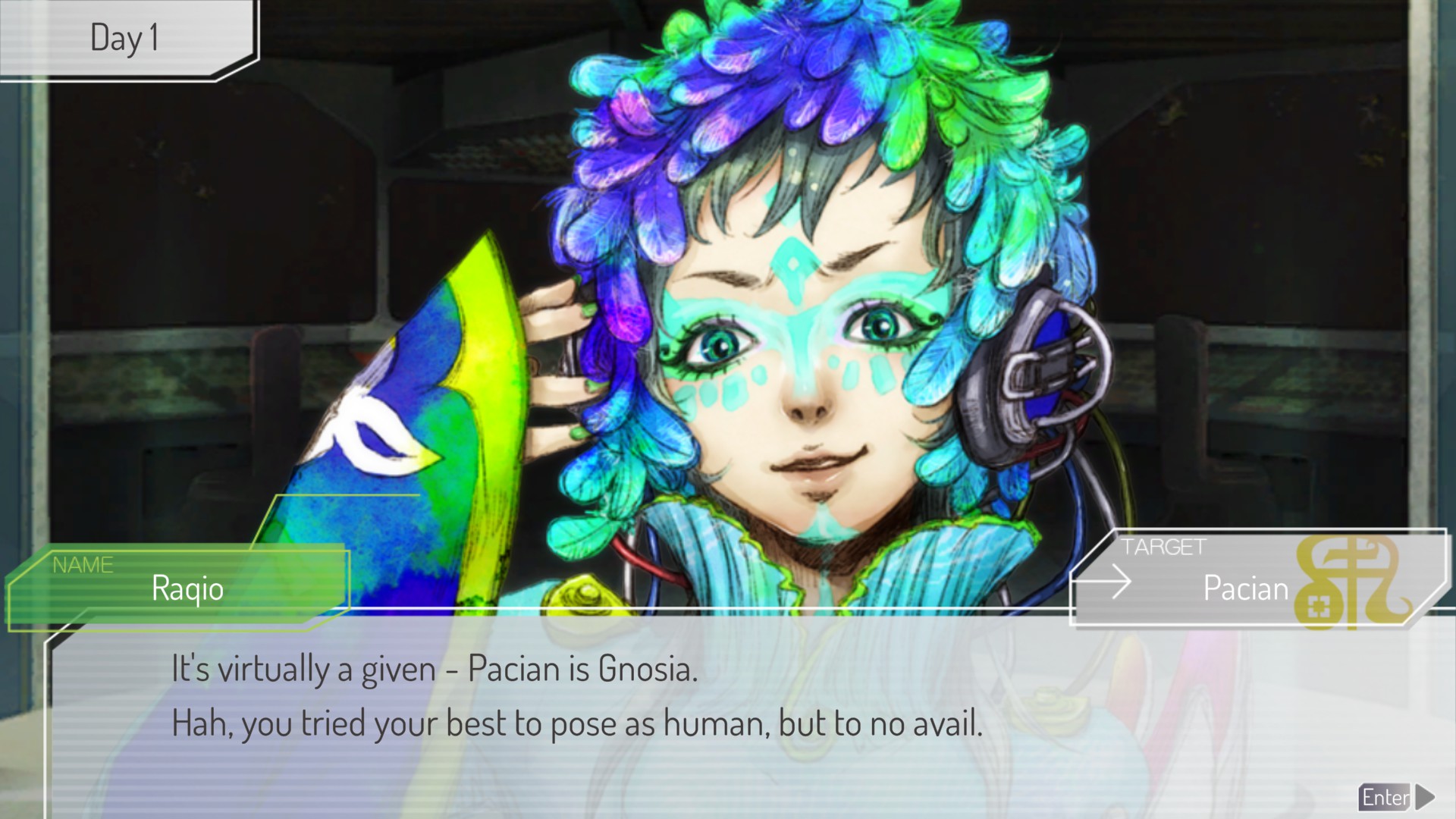
I’ve been meaning to play Gnosia since Choicebeat covered it, and I finally got around to it earlier this year. I thought it was really cool!
Pacian reviews: Gnosia!
I was expecting Gnosia to be “Visual Novel Among Us” - but although it was released after Among Us, it was in development for years before, and it’s actually more of a classic Werewolf setup. I didn’t know much about Werewolf (which, according to Wikipedia, is Andrew Plotkin’s update of an earlier game called “Mafia”), and so I wasn’t expecting just how much this social deduction game would emphasise, well, social deduction. In Among Us or Trouble in Terrorist Town or whatever, you might catch someone in the act of sabotage or murder. But in Gnosia you have to either logically determine who is the Gnosia based on various competing facts, or use your social skills - which are represented by RPG stats that you can level up to increase your chances of, for example, lying successfully or intuiting dishonesty. Quite often, especially at the start, you just have to guess!
There’s a meta-narrative that explains why your character is playing endless rounds of Werewolf and an over-arching goal of escaping the loop while keeping everyone alive and non-Gnosia - which requires learning more about the fourteen other characters stuck with you, such as a dolphin in a wheelchair and a guy who looks like a grey alien but maintains that he’s human. Two of the human characters (and optionally the main character) are non-binary. I’ve seen trans and non-binary fans being mostly positive about their portrayals.
Since finishing it, I’ve been watching the anime adaptation. It’s fun seeing the anime’s main character coming up with in-depth logical deductions to uncover the Gnosia when I was just winging it most of the time!