I came from reviewing Ancient Treasure, Secret Spider - Details, and found this post at the top of my feed and thought they were related for a second. Spider enthusiasts here might enjoy trying that (short) game.
1 Like
Didn’t know they were a thing in D&D, though I really shouldn’t be surprised… I know them mostly from anime… though I think there was one episode of the animated series of The Mummy that had Imhotep fusiong with a secondary villain that’s a giant spider and taking on that body style…
1 Like
I haven’t seen any serious research on the history of the idea, but I think first edition AD&D (and specifically module Q1, Queen of the Demonweb Pits) is the origin of that particular version of the half-human half-spider hybrid. That is, the centaur-but-a-spider thing.
The idea of human-spider hybrids is much older, but as far as I know they weren’t depicted in that particular way earlier. Dante puts Arachne on the first terrace of Purgatory with others guilty of the sin of pride and Doré’s illustration, for example, depicts her as a more or less human figure lying supine with spiderlike legs emergining from her back. Most earlier artists seem to have chosen to depict Arachne (in general, not just in Dante) as either a spider or a woman (usually with a spider or web nearby) but not a hybrid of both.
Same’s true of, for example, the jorogumo, a kind of yokai from Japanese folklore that can take the form of either a woman or a spider. Modern depictions tend to be drider-like, but historical images seem to prefer either a monstrous spider or a woman with a bunch of spiders and/or webs.
There’s also the tsuchigumo, a kind of yokai that appears as a spider with a human face. If you’re familiar with the Shin Megami Tensei games the tsuchigumo is a recurring kind of monster/demon in the games. They sometimes are depicted as huge spiders with human eyes and sometimes a human mouth, or a spider with a kinda mean looking human head (like the version in the megaten games).
The Mummy franchise has the Scorpion King, who (last time I checked) looked like drider only the top half is the Rock and the bottom half is a scorpion. The human-scorpion thing seems like something that must’ve been in a Harryhausen film, but absolutely wasn’t. There are however Harryhausen giant scorpions and a naga, which is the upper half of a woman with a snake’s body. Not invented by Harryhausen, but it seems like the sort of thing that might’ve been an inspiration for David Sutherland when he wrote Queen of the Demonweb Pits sometime in 1980.
And I guess as a note I’ll add that the original drider was a drow-spider hybrid, not a human-spider one. The were specifically supposed to be drow that Lloth “tested” in some unspecified way and becoming a drider is the result of them failing. Lloth was created by Gary Gygax, and she’s exactly the sort of sometimes-humanoid, sometimes-spider creature as the examples discussed above (except the humanoid form is drow instead of human), and she’s frequently depicted as a spider with the head of a drow woman.
3 Likes
Arachne has become the cliched nane for spider women in pop culture, but wasn’t the original myth that she was a mortal weaver turned into a spider as, arguably unjust, punishment for upstaging one of the Greek goddesses at the craft of making textiles?
1 Like
Don’t tell everyone the game includes a spider! Then it won’t be secret!
Yeah, the most popular term I’ve seen for them in modern fandom is “driders” which is the D&D term (because in D&D they’re drow-spiders rather than human-spiders. Hence, drider.)
The Epic of Gilgamesh has the Scorpion-Men, who guard the gates that the sun passes through every day at dawn. Some ancient illustrations show them as scorpion-centaurs, with a scorpion body and a human torso, arms, and head, though oddly enough the more common depiction also gives them human legs. So their front half is an entire human body, and the scorpion abdomen and tail (without any extra legs for support) sticks out under their tailbone.
Yeah, our oldest source on her is the poet Ovid, which comes with a lot of caveats. But according to him, she was a mortal who bragged about being superior to the gods and refused to worship or even acknowledge them. Minerva went to her in disguise and said “hey, you should stop doing that, that’s hubris”, Arachne replied “well if the gods want to stop me they’re welcome to challenge me in person”, and that led to the contest. Arachne won, Minerva destroyed her for it, and eventually she was turned into a spider as a mercy (instead of just dying and being condemned to Tartarus for her hubris).
Now, the difficulty with this is—the myth is alluded to a few times before Ovid (mostly in vague terms like “Minerva hates spiders and nobody knows why”), but Ovid’s is the first full version we have. And the context of Ovid’s work is that his poetry offended the Emperor, who had him exiled to a backwater at the edges of the Empire where he wouldn’t have access to any of his libraries for research. This led to his masterpiece being abandoned half-finished, and Ovid wrote a book of poems called the “Sadnesses” about how much he regretted his exile.
(Maybe it wasn’t just his poetry—he may have also slept with the Emperor’s daughter—but the poetry is the official reason. Like a lot of ancient things, the details are unclear. I like to jokingly say he was exiled for being straight, because the scandalous poem in question describes how he only liked sleeping with women, never men, and this was very unusual in Rome. But it was more that poetry about sex went against Augustus’s moral reforms, so making an example of Ovid was a good way to show that these new laws had teeth.)
So a running theme in Ovid’s work is that people with power (like the gods) will abuse it against anyone who offends them, taking out their anger on easy targets whether or not those targets actually deserve it. In Ovid’s version, for example, Medusa was punished for something that was clearly and demonstrably not her fault, just because she was a convenient target who couldn’t fight back—that element wasn’t in earlier versions of the story. Minerva destroying Arachne for being too skilled is very much in line with this theme.
Did Ovid choose this story specifically because it featured a conflict between artistry and power, which led to the artist being unjustly destroyed? Or did he add those elements himself, like he did with the story of Medusa? Maybe in earlier versions, Arachne lost the contest. Without more sources, we may never know.
That’s the fun of studying ancient literature!
2 Likes
So human-spiders are… hiders? It really doesn’t have the same ring to it.
1 Like
But has anyone imagined humans with a spider for a head?
1 Like
Yeah, the “guy in a scorpion suit” style depiction is the only version I think I’ve seen, not counting fully modern illustrations (which invariably seem to prefer the centaur-ish version).
Scorpions themselves are kinda interesting in that at least medieval art is full of depictions that were clearly executed by someone who had never actually seen a scorpion, so there are lot that are basically “lizard with a pointy tail”.
And for that matter centaurs. Medieval depictions of Sagittarius are typically of something that looks like a “modern” version of a centaur but there’s a distinct subgenre of depictions that are basically just a dude with a bow. The Voynich Manuscript, which contains what is generally accepted to be a set of zodiac images (with a couple of duplications and omissions) has a Sagittarius which is just a dude with a crossbow. But that’s hardly the most unusual thing about the text.
3 Likes
I had an OC like this in middle school once
2 Likes
Achievement Complete!
Something I’ve always wanted to do for many, many, many years is take a photograph of a cellar spider’s face. It always seemed like a really unique challenge, because they’re so spindly that it’s hard to get near their face without touching their legs first. They’re also an extremely anxious species, known for erratically bouncing up and down out of panic, in an attempt to be harder to visually track for larger creatures, like us (and maybe birds).
Anyway, I woke up after 4 hours of sleep. This angered me, and after trying for another hour to fall back to sleep, I gave up and went to the bathroom.
There, I spotted a very large cellar spider, slowly making its way across the floor. There is another large cellar spider that lives by the door, and I verified that this doorman was still in its web, which meant that the floor-traveler was, in fact, a new visitor!
After a bit more study, I realized it was maybe twice the size of the doorman, which was quite the spectacle, since I already knew the doorman as being the particularly-large spider, among the ones in my room and the bathroom. I think the body length of the floor-traveler was almost three-quarters of a centimeter, while the leg span could have almost covered my palm.
Getting a good focus on a spider with my phone lens is extremely hard, and that’s when the spider is holding still. I really wanted to photograph this one, but I wasn’t sure how to get a snapshot of a moving cellar spider with any amount of visible detail.
So I had decided to let it go on its way. It approached the doorman, hesitated for a moment (while the doorman was probably beholding the greater size of the floor-traveler), and then carried on, fitting underneath the door to leave the bathroom.
Once I was finished washing my hands, I made sure to be careful while opening the door, just to avoid possibly trampling the floor-traveler on my way out. I had no way of knowing which direction it went, after passing under the door.
There it was: The floor-traveler was holding itself against the doorframe, completely still.
This was my chance.
I decided to start the photography with more caution, and then steadily move closer, until the floor-traveler would likely start its panic dance. However, it later turns out that this would not be a problem. I crouched down, figured out an approximate manual focus distance, and took some photos. Then, I laid down on the floor, scooched closer to the spider, and took a few more.
The floor-traveler was certainly aware of me from the moment I crouched down, so I’m sure it was wondering if it was in danger by the time I was laying on the floor. However, it was a lot calmer than most cellar spiders I’ve seen. Given its large size, it’s probably survived longer than most, and its body has become difficult to move. The weather has gotten colder outside, too, and I wasn’t sure how long it had been in the house before I found it, so maybe it wasn’t brave; just groggy and unwilling to make any sudden movements.
I managed to get twelve photos in total. I stood up, and the floor-traveler began calmly moving again, as if it understood the concept of a photoshoot, and that the moment had ended. More realistically, it probably felt my presence recede, and concluded that it successfully hid in plain sight from the colossus, so it was safe to move on.
I started sorting the photos by clarity, hoping for detail.
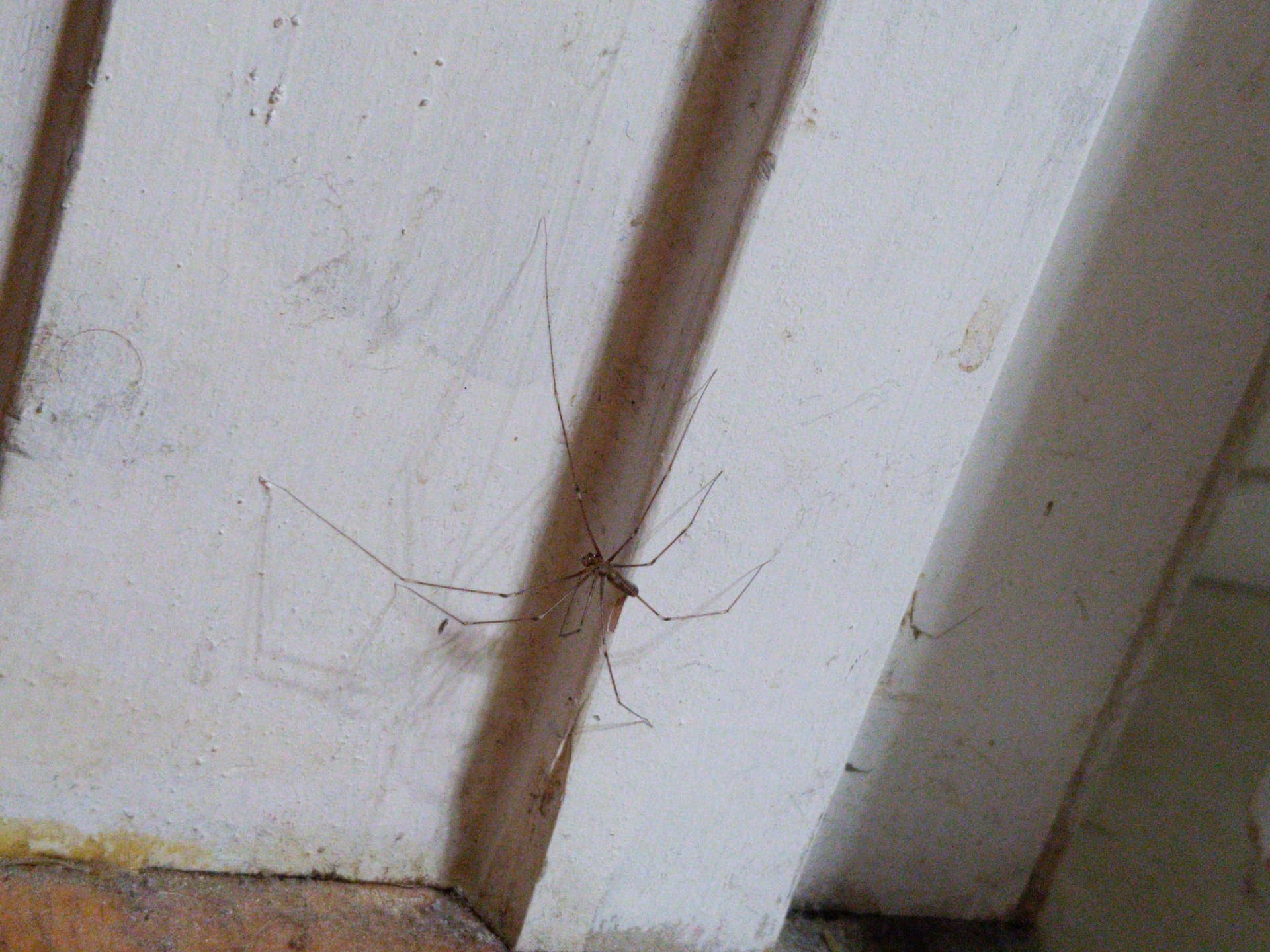
Image description: The long, narrow body of a large cellar spider is held to the inside of a white doorframe by eight, characteristically-long legs, arrayed evenly outward. Its color is a dull, brownish-gray.
Now, let’s zoom in a bit. This next image is an edited version of the previous one. I adjusted the colors make the body details a bit clearer.
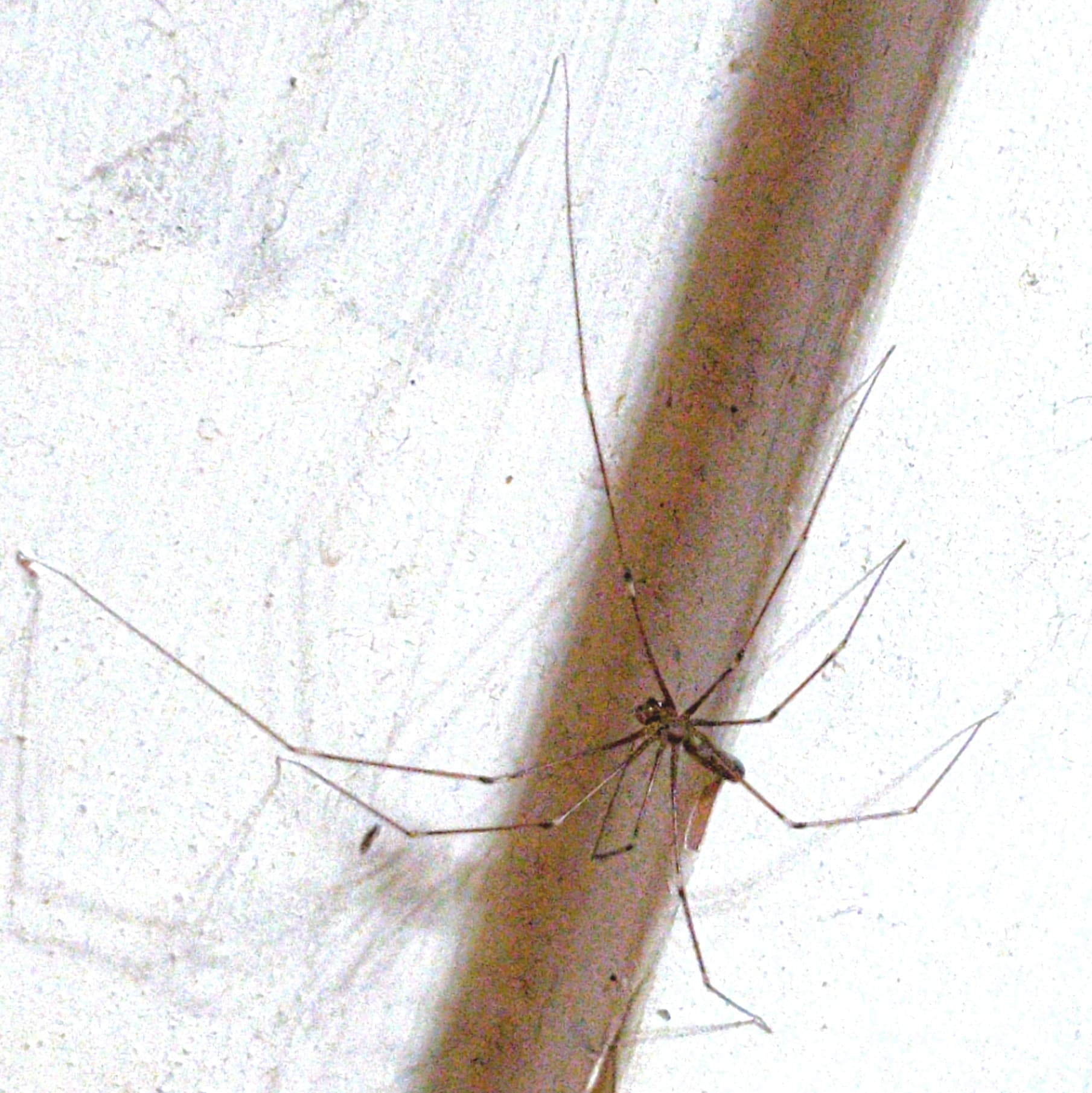
Image description: Same as before, but there is just enough pixel resolution that enlarging the image reveals pedipalps and eyes, visible at the front of the spider’s narrow body. The curve of the prosoma carapace catches the light from the bathroom, and each individual leg glints with thin reflections. The heartmark of the spider is visible as a long, black streak, down the length of the opisthosoma. The pedipalps tucked under the prosoma are clearly visible, even without zooming in further, as their silhouette stands out from the silhouette of the body. If the viewer zooms further in on the prosoma’s front, there are two large, dark spots, with a smaller dark spot in between them.
Now, to say I was giddy would be an understatement. However, my phone’s camera is not meant for small-scale photography, so there was a very real chance that I was not seeing eyes on the spider’s face in this photo. I could see three dark spots, but nothing else hinting at the other five. If I am successfully imaging eyes at this scale, then surely I would be able to find more than three, right? Where were the anterior eyes, in particular? I strongly suspected that I was just capturing a pigment pattern of the carapace, and wasn’t seeing the eyes clearly in the photo.
However, at this point, I was satisfied enough to say that I definitely got the individual pedipalps, which was really cool!! I was okay with walking away with a 50% score!
I decided I needed to check my work against online sources, so I looked up what the eye arrangement of a cellar spider is. Here is a photo from a professional wildlife photographer:
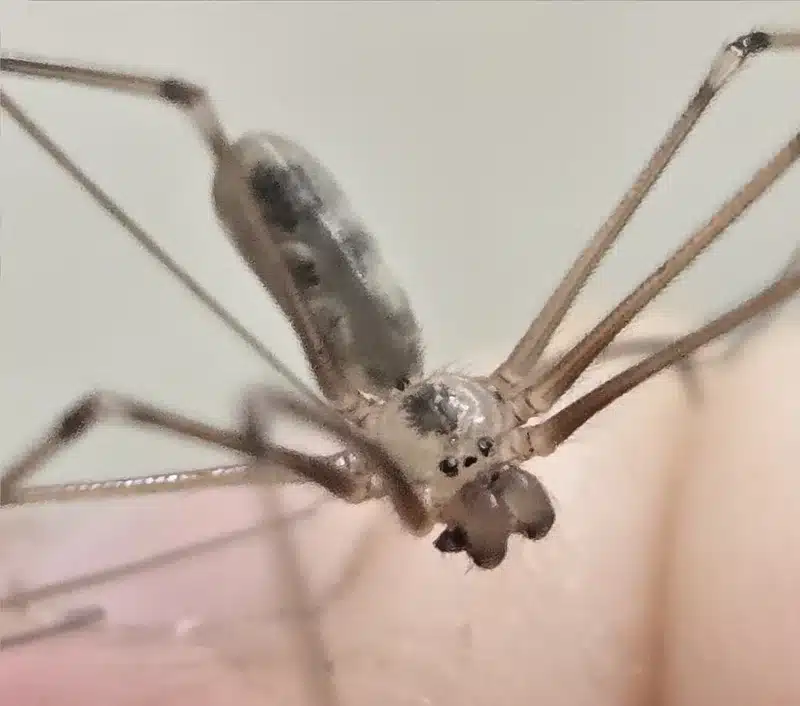
Image description: A close-up, high-fidelity image of a cellar spider. Its translucent carapace makes it look like a living water droplet. A silver patch is visible at the top of its prosoma, like a head of a gray hair, and its heart is visible under the surface of the opisthosoma, outlined with a silvery heartmark. Most notably, the cellar spider species is revealed to have a very strange and unique eye arrangement: three eyes packed tightly together in a left-side cluster, another three eyes packed together in a right-side cluster, and two eyes packed together in a middle cluster. The arrangement gives it the appearance of a cartoon face, like two large eyes and a dark dot for a nose; three dots, in total. This is a face that a child would draw, when they project the simplified patterns of human facial features onto a spider, for a lack of understanding about what arachnid faces typically look like. For a species that is probably the most ubiquitous and stereotypical of all spiders, cohabitating with humans all across the planet for centuries, an observer would understandably find it striking that this face is so unique, and also so strangely easy to anthropomorphize, almost like evolutionary pressures exerted a half-baked attempt to make the spider appear empathetic, much like how dogs evolved eyebrow articulation.
When I saw the professional photo, I was speechless. I looked back at the images I captured myself, and sure enough: the three dark spots were in the correct places. I had successfully photographed the face of a cellar spider!!! 
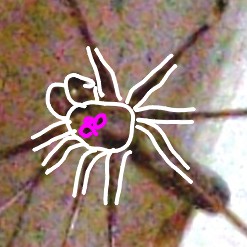
Image description: The spider photo I had taken, with colors boosted. This version is also cropped, to zoom in closer on the face. The prosoma, pedipalps, and legs are each outlined in white (with a digital pen tool), and the three eye clusters are outlined in pink, just to make the features abundantly-clear.
5 Likes
On the spider headed human front… There’s one episode of the 2003 Teen Titans animated series featuring a one-off villain fitting such a description… The main villain of the episode is an insect-themed bad guy named Killer Moth who plans to swarm the city with giant, mutant insects and among his demands, he blackmails Robin into being Kitten, Kiiller Moth’s alpha bitch teenage daughter, date to the prom, something the brat demanded of her father to get back at her boyfriend… Starfire tags along to make sure Kitten doesn’t make any moves on Robin beyond the letter of the deal with Killer Moth, and at some point, the boyfriend, a teen punk with a spider for a head and spider legs long enough to leave his human body dangling below the spider body head… appropriately enough, his name is Fang… and he has a venom that causes temporary paralysis in humans. Fang and robin fight and Kitten and starfire fight while the other titans deal with the swarm of mutant bugs… One of the show’s sillier episodes… can’t recall the episode title and not sure which season it was from, though I think it was from one of the earlier seasons.
Though, regarding medieval scorpions drawn by people who clearly never saw one… I’ve heard the unicorn has its origins as Europeans misinterpreting foreign merchants’ descriptions of rhinos… Though now I’m wondering how much of mythological bestiaries is inaccurate artist interpretation… and where the manticore gets its origins.
And the funny thing is… the combinatoric explosion means there are almost certainly composite critters that have never been featured in a mythological or fantasy bestiary… and come to think of it, as common as Lions are for the treatment(Heck, the original Chimera is part Lion if I’m not mistaken), I don’t think I’ve ever encountered a winged Lion with bat/dragon/pterasaur type wings or insectoid wings… and you’d think someone would have done Tiger, Jaguar, or Cheetah variants of the Sphinx, griffin, or manticore at some point…
2 Likes
Oh please god no.
I’ve seen a bird-eating tarantula - or at least the front half of one in a preserve that was so big it was kept in a rabbit-hutch-type enclosure with 1/2 inch mesh across the door opening.
I’ve gotten much less phobic about spiders in my later years. I actually have a really good method to capture and release the occasional wolf spider I find in the bathroom.
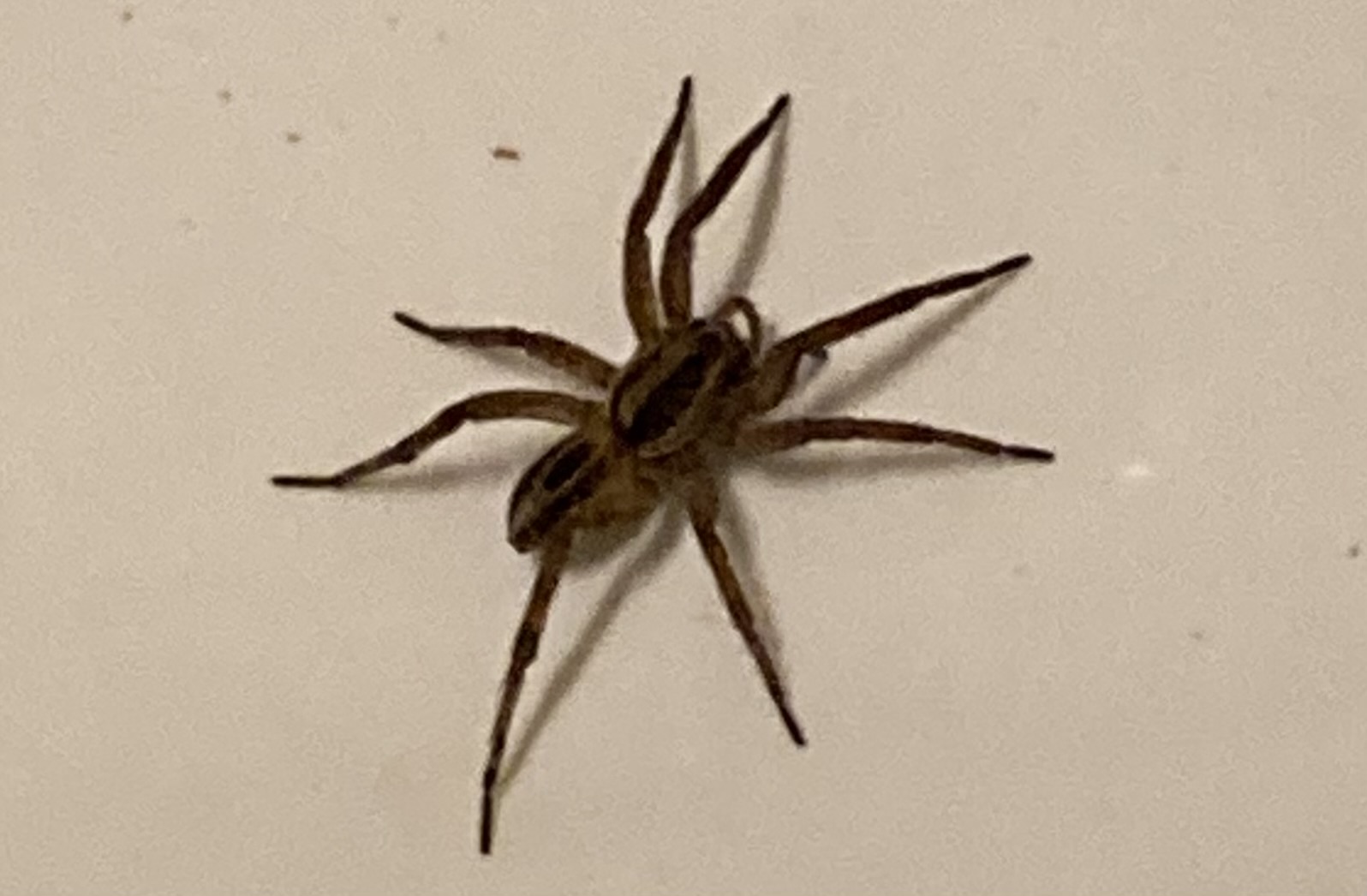
Description: a black and brown wolf spider with two body segments and substantial, slightly hairy legs. Body is under an inch long, leg-span is maybe 1.5 inches
I remember when I lived in Florida if I took a walk in the morning before it got too hot I got to see enormous 12-15 foot high webs in the woods with what people told me were “banana spiders” - they’re enormous with a long black and yellow body and spindly legs that might stretch a foot across.
I did also catch and release a short centipede I found in my apartment a couple weeks ago. They are a bit more aggressive though the venom is not dangerous to humans, but I likely still have one bigger house centipede that lives behind my bookcase and has agreed that it stays back there and does not reproduce. Centipedes are territorial and will kill each other, so I didn’t want that war going on behind my furniture.
1 Like
Beautiful how you bridged the gap between image and language there.
1 Like
I’m really excited to post a photo here in a few hours. I don’t want to upload something without also taking the time to write an image description for it, but I’m also really excited, so I’m just gonna take a moment to share that I’m excited.
Once the initial burst of super busy morning is done, I’ll post it! ^^
Long story short: I just found an amazing web in my room!
3 Likes
I love this teaser trailer for the upcoming drop; the hype is real, haha!
1 Like
It is said that gamers never look up, and I must admit I hadn’t looked up in my room for quite a while. When I did this morning, I beheld this amazing piece of work!

Image description: A photo of the lightbulb of a ceiling fan. Two chains hang free from the left and right sides of the large bulb, one for controlling the speed, and the other for switching the light (independent of the wall switch). These hanging switches have not been touched in a very long time, and an unseen spider has woven a chaotic arrangement of webbing between them. Drops of glue glisten along one of the horizontal lines near the bottom, golden light glitters off a number of Y-shaped arrangements, and two pale dots mark possible prey wraps. The pattern of lines looks vaguely similar to pumpkin innards being stretched and torn free, like something has ripped open a space in the air above me to call home. The fibers are visibly under tension, waiting for something to be drawn into the light, held high behind doom. The startling lack of order means this is not the work of an orb-weaver, but chaos does not imply senseless randomness. These cobwebs are often fine-tuned feats of engineering, and can reveal the current state and goals of its creator. Reinforcement along horizontal paths suggests the hanging chains have a history of waving in the fan breeze, causing tears in previous generations of web designs. The spider has learned and adapted since then, unseen and listening.
I just really love how goth this looks, and I’m very tempted to use this for an album cover.
3 Likes
Worth the hype, this has gothy vibes for days.
1 Like
Hello spider fans!!! One of my favorite YouTubers just posted a fascinating video about spiders which lack venom!
3 Likes
I’m now imagining a drawing of an orb weaver with literal feathers for legs, looking at itself in distress with a  on its head as it panics about where its legs have gone.
1 Like
Not much to report here, because it all happened so fast.
There was a spider who was very determined to make a home in the microwave. I almost mistook it for a bit of debris, because it was doing the “look like a stick” routine where it sticks its legs straight forward and backward.
I managed to move it onto a napkin, and almost lost track of it five times while rushing to my spider jar. At some point, it has entirely abandoned the napkin and was crawling on my hand. Luckily, this seems to be a species I’m not allergic to, so it just tickled a little bit.
I successfully got it into the jar, and was bringing it upstairs to place by the window. This house always needs more defenders against the yearly ladybug invasions.
It was very determined to not leave the jar. Whenever I rotated it, the spider would climb upward. Honestly impressed that it could find any traction inside the jar, because many other spiders and insects can’t.
Finally found some random object to boop it with until it was convinced to leave the jar. I moved away too quickly and accidentally pulled it from the windowsill because the spider had not committed to this new location, and was still attached to the jar, so I gently returned it again to the windowsill.
I waited for it to take a few more exploratory steps, until I saw it tap the wooden surface with its spinnerets. Noting this commitment, I successfully pulled the jar away (without the spider this time) and closed the curtains.
I’m gonna be so real with y’all: It looked like the feather-legged orb weaver in the previous video, and had that same “I am simple debris” pose, but I’m not going to believe myself to be so lucky, and will instead conclude that I found a lookalike species with similar habits.
3 Likes