Is AI Generated IF Discussion OK Here?

On the other hand, if the question is will a small community of independent writers and game designers who largely operate under an auteur theory that prizes individual design skills, personal expression, and high-quality prose, and are largely insulated from the discipline of the market by a non-monetary gift economy, embrace AI tools that currently largely support the cost-efficient creation of medium-quality “content”, I suspect the answer looks a little different.

I’ve got no doubt that eventually the last part of the equation will shift and eventually this stuff will be more normalized within the community - but I suspect the factors I mention above will mean we’ll be among the last to join the bandwagon (adoption of this stuff appears to be happening most quickly within the AAA space, which is of course maximally commodified whereas I’m guessing the only folks less on that trip than we are are like the people still making modules for Unlimited Adventures).

I have a copy of UA sitting right next to my desk.

I think your perspective is slanted from being immersed in a community dedicated to words. As a college instructor, my experience is much different. Students who graduate at the top of their high school class come to college with no clue how to organize thoughts into coherent sentences, much less paragraphs or larger.

I wish I could disagree with Phil, but I cannot. On top of that, you also have to take into consideration the bar set by many productions, whether they be AAA video games or films destined for widespread cinema distribution, is… ummm… Low?

Have you watched The Predator? Or maybe Angel Has Fallen? Both of those films made back twice their production costs. They still put butts in seats. The average film doesn’t have to be great to make up its production costs assuming it wasn’t a billion plus dollar tent-pole monstrosity.

If the writing generation could maintain that level of “quality,” which shouldn’t be an impossible feat, far from it, then they can reduce costs while still producing the same result. Meh is entirely acceptable if people will still pay to see it. The Writer’s Guild of America could smell what’s around the corner with AI provisions being one of the sticking points in the negotiations.

I know writers right here on this forum who could turn out a far better story and dialogue than what’s contained in either of those scripts. It doesn’t matter though, because the corporations monetizing this stuff don’t necessarily need really good, or even good.

They only need good enough.

Perhaps! My perspective is also coming from teaching college students…but specifically seeing the absolute nonsense they put in their ChatGPT-generated essays. Things like (details changed to protect the guilty, but the essence being the same) talking about "words with a C in them, like ‘star’ ".

When you generate a character portrait with Midjourney or whatever, the relevant part is what you specify in the prompt, and people probably won’t focus too hard on the other stuff. But when you generate an essay with ChatGPT, people will actually (hopefully, at least) read every nonsensical sentence of it.

That’s hilarious. I was curious though, so I checked the indifferentlanguages site and only Hungarian word for star has a C in it: csillag. Maybe that particular AI was reading and translating a lot of Hungarian texts.

I use Copilot when coding Inform and it sometimes gives me suggestions for textual content. Does this count as AI generated IF? :stuck_out_tongue:

I’m curious if that’s why some instructors haven’t outright decried and banned AI as a tool even if they don’t want it doing homework for someone directly. As I mentioned it will usually answer questions that might require a simple one sentence answer in book-report form. That kind of mirrors an answer a person might give after a typical internet search. Here’s GPT’s response to “what type of coffee do most people drink?”

The most popular types of coffee vary widely depending on regional preferences and individual taste. However, some of the commonly consumed types of coffee around the world include:

  1. Espresso: A strong and concentrated coffee shot made by forcing hot water through finely-ground coffee beans.

  2. Americano: Made by diluting a shot of espresso with hot water, resulting in a coffee similar in strength to drip coffee but with a different flavor profile.

  3. Latte: Made with espresso and steamed milk, usually

....

topped with a small amount of frothed milk.

  1. Cappuccino: Similar to a latte but with equal parts of espresso, steamed milk, and frothed milk. It has a creamy texture and is often sprinkled with cocoa or cinnamon.

  2. Macchiato: An espresso with a small amount of milk, often served as a shot with a dash of frothed milk.

  3. Flat White: Originating from Australia/New Zealand, it’s similar to a latte but with a higher ratio of coffee to milk and a thin layer of microfoam.

  4. Drip Coffee: Made by dripping boiling water over ground coffee, typically using a filter. This is a common method in many households.

  5. French Press (Press Pot or Plunger Pot): Coarse coffee grounds are steeped in boiling water, and then separated by pressing down a metal or plastic plunger through a mesh sieve.

  6. Cold Brew: Coffee brewed with cold water over an extended period (12-24 hours) and then served over ice. It tends to be less acidic and smoother than hot-brewed coffee.

  7. Iced Coffee: Regular brewed coffee that is cooled down and served over ice.

Preferences can vary, and many people enjoy experimenting with different brewing methods and coffee bean varieties to find their favorite cup of coffee.

Putting the same exact sentence into google search gives me this top hit:

15 Most Popular Types Of Coffee Drinks. Which is very similar, but GPT didn’t lift this verbatim. There’s a different number of options, it rearranges them somewhat, and GPT leaves off “black coffee” which the article opines is the most popular form.

GPT may or may not have sourced this exact article, but it is insightful to compare different examples of how a question might be answered to learn how to structure your own. It’s easy to answer a question; it’s more difficult to answer a question and explain why with supporting research in report form.

I know this will be shocking, but sometimes I don’t feel like writing a detailed answer to someone’s questions. I’ve totally done a lazy response by doing a google search for them and sending them three links I’ve skimmed to make sure they’re appropriate. I don’t need to write a new essay on what a turtle is since it exists. (And it’s a less snarky way of saying hey, you can search the internet as well as I can…)

When I need to cook something new I will Google a recipe, but usually instead of following that recipe I will look up 3-5 more and compare them to see what the common elements are and what I can get by without if I’m missing an ingredient. I’ll use that knowledge to make my own flexible version of the recipe.

That’s ideally what you want an AI to do: have access to a bunch of knowledge and summarize it for you. That’s ideally what you want a college student to be able to do: be asked a question, do the research, and then summarize their findings and perhaps include a smidgen of their own opinion or experience.

No, that counts as you generated IF just as if you did a brainstorm internet rabbit hole search. It’s similar to drawing improv prompts from a hat, discovering that your PC’s pet will be an armadillo and that leads to manual research on armadillos to pad out their idle messages which then inspires new ideas like hey, an armadillo can roll up like a ball; if the PC has the armadillo in the bowling alley, it can help them bowl a strike to solve a puzzle …

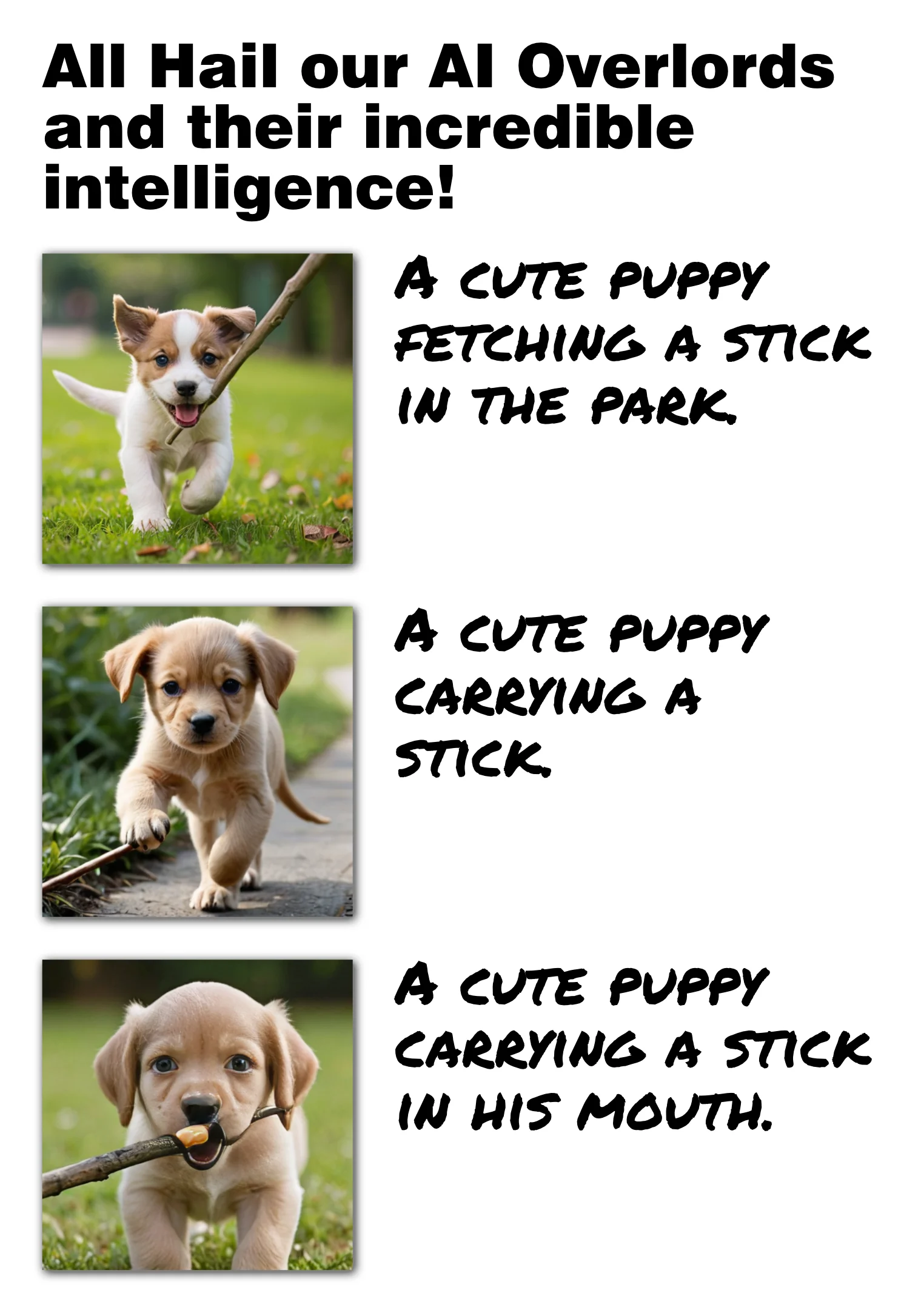
I recently needed synonyms for certain words and I wanted to see if ChatGPT 3.5 would have any novel suggestions. This is what it said:

Sure! Here are some synonyms for “to open” that start with the letters E or F:
Emerge, expand, expose, unfold, unfasten, unlock, unveil

It’s funny how “dumb” these models can be, sometimes!

In this case, it successfully corrected itself when I pointed out its mistake. In other scenarios I’ve found that it does an amazing job of acting like it truly understands my feedback and knows exactly how to fix things – but then still gives me something blatantly wrong, oftentimes repeating the same mistake it already made 2 prompts ago.

I’ve been using it to help me fix my first attempts at Inform 7 code (queries that mostly boil down to “Ally hasn’t read enough of the manual yet” and aren’t really worth asking another human), and it’s definitely been a helpful tool in my learning process. I just have to remember not to fall for its confident tone!

It’s like it loses track of query elements as it goes, possibly as an “expand a bit past the search terms for thoroughness” routine? Which is kind of human, I guess?

I was gonna say “at least all of those have E or F in them if not the starting letter” but “unlock” does not.

It’s like Wheatley from Portal 2 who frequently discovers one actual fact and then tries to brainstorm on it ad-absurdum without additional context to create a stream of bad ideas…as he was designed…

“He’s not just a regular moron. He’s the product of the greatest minds of a generation working together with the express purpose of building the dumbest moron who ever lived. And you just put him in charge of the entire facility.”

– GLaDOS

Well it does, because the size of its “context window” is limited, but it does seem to do worse than that, forgetting things within a few short responses.

The most recent GPT-4 (not available in ChatGPT) has a context window of 128K “tokens” (something like 2/3 of a word), but it can hardly take advantage of that because of this “forgetting” behavior.

I wonder what an LLM would be like, trained on every publicly available parser IF walkthrough.

What prompts would we ask of it?

So this is due to the way they work. They tokenize at a certain level, which does not necessarily mean at the character level. It’s like using whole kanji rather than understanding all the components.

Occasionally through lucky tokenization or association it can tell you stuff about spelling. Many times it can’t easily.

Other examples like it persisting with errors are due to how they are trained to respond. Except in cases where they are trying to shut down inappropriate responses, they err on the side of saying something rather than nothing. It’ll give an answer-shaped response because that has some success in general.

I think it might be funny to ask such an LLM, “How might a buddy story work with Primo Varicella and the robot Floyd?”

9 Likes

Following up on this, I’ve done a bit more work and managed to create a very reliable means of “fixing” the player’s commands whenever a game doesn’t understand them. There are some examples on the LampGPT thread here on this forum, and it is trivial to try on the Infocom games (once you get an OpenAI API key).

The results are good enough that it seems hard to improve on them, even though the implementation is very small (a couple of hundred lines). All of the hard lifting is done by prompting the LLMs in the right way. ChatGPT4 is very good at this stuff.

When applied to just the parser, the LLMs are only used if the original game doesn’t understand the player, so their use doesn’t slow down normal play or cost much.

Thanks. I haven’t had a chance to try this, but it seems like I underestimated how easily an LLM could handle this kind of pre-processing.

…yay…

So, I acquired 2 tarot books:

  1. Tarot of Tales by Melinda Holm
  2. The Fablemakers by Misty Bourne

I got the first book along with the deck, but I didn’t bother to get the animated tarot deck for the second book. You can always roll 2D10 and add it to the page number on the book, skipping out of range values.

So, here a short example for Tarot of Tales.

  1. 43 → 86 Page of Cups
  2. 31 → 62 XXI The World
  3. 80 → 160 Six of Wands

In the past…
Your heart felt so battered and bruised that you closed off your emotions to protect yourself. A gentle being with an open heart came to your aid and helped to show you the strength and beauty in vulnerability, giving you a fresh start.

At present…
The mouth of a massive cave gapes before you. Your lantern allows you to see just a few feet in front of you. You empty your pockets, taking only essentials as you step ahead into this portal to a whole new world.

On the horizon…
A wide open field calls to you. As you walk toward it, you encounter trinkets from your past, emblems of plans gone right and successful manifestations. You stop to remember each one, gathering confidence to embark on your biggest project yet.


I double the rolled values because it’s two pages per card. The book also have 2 other influencing interpretations that I skipped for brevity.

Come to think of it, this is just mostly looking up references from random numbers, easily coded into a program. Something like fortune with custom entries.

Oh no. Does this have a mailbox in the middle of it? If so, It’s gonna be that one game which everybody talks about but I have no idea what it is all over again.

Does this remind me of a certain game?

Really oh no. Not Colossal Cave Adventure at this point in time!