I’m glad you’ll try it out, and if you’ve got ScummVM you can play all sorts of adventure games, but I’d really recommend playing the whole series in that case. It’s really encouraged that you play 5 Days a Stranger and 7 Days a Skeptic first, Trilby’s Notes is the third and builds heavily on the lore. 6 Days a Sacrifice is the last one.
Only Trilby’s Notes uses a parser.
EDIT - You might have seen this “Countdown” series? They are part of the same continuity, and serve as a prequel to 6 Days a Sacrifice.
Individually, and without the context of the series… they’re not great. But within the context, and when looked at as short scenes with limited implementation… they work.
It depends on how you’re defining “interactive”. If you mean “player agency to control the story and shape the player character’s personality via the player character’s actions” then maybe (though Violet would like to have a word) but there are many other ways to define “interactive”.
I don’t think increased screen time is the issue. There’s also been a shift in content (obvious) on screens in a big way, and a major shift in presentation of said content (maybe less obvious). I’ve always spent a ton of time in front of computers since I first started using them in the early 80’s. I also watched a probably unhealthy amount of TV throughout the 70s and 80s. I stopped in college and never really got back into it. A simple way to observe the shift in presentation is to watch movies or tv shows from different decades and count seconds every time the camera cuts to a different perspective. You will observe a drastic shortening the closer you get to the present. Back in the 90s I noticed the Disney channel had a lot of rapid cuts compared to other channels, averaging every 4-5 seconds. It gave me a headache and I would leave the room if someone turned it on. Earlier this year I was at the dentist and they had a TV you could watch but not control from the chair. Some sort of reality-show was on where teams compete to make desserts. For the entire show the camera wouldn’t hold on a single shot longer than 2-3 seconds and sometimes even shorter. It made we want to puke; I actually got motion sickness from it. I think this trend is actually to blame for shorter attention spans. I know I’d sure like to find the person responsible and have some “words” with them.
Warning: Once you try counting camera cuts like this, what might have been unnoticable before will become painfully obvious forevermore. You have been warned.
@Mike_G
I was meaning more mobile screen time and the content we see today so I do agree with you. Phones especially are geared to steal your attention. If someone is doing something constructive with a screen device, that’s usually with a desktop computer.
When we were children, we’d sit and watch TV, but inevitably we’d get bored of that and end up playing with our toys, reading a book, listening to music, or going outside. That doesn’t happen anymore. The phone has billions of videos, billions of songs, billions of websites, billions of games at your fingertips… there’s always something to curb your boredom and you end up not putting the device down. Boredom is the catalyst of creativity. Kids need to learn how to be bored these days… and we need to let them be bored.
Unfortunately this clashes directly to what a bored child can mean to a parent. Being a parent was never easy, but I get the impression it’s only getting harder. A bored child is active, loud, finding boundaries - not misbehaving, necessarily, but demands attention (and supervision). Today’s rapid world gives parents increasingly less time and space to maneuver in; parents are also a victim of this speeding up. I don’t love the idea of children being propped in front of a TV in order to get some rest, but I mean, realistically, that’s going to happen. And it’s probably going to keep happening. This is the world we’ve been creating. We’ve been going “technology will make things ultra fast so you’ll have the time to do what you like”, but in actual fact, we find that time is also monopolised, so we are doing a crapton more and it still never ends and we still don’t have the time we need. Also related to wages and living expenses.
Anyway, I agree with what you say. I just… am not optimistic about addressing it, because there are deep issues that affect the parents too much for it to be as simple as letting the child be bored.
Face it everyone. We’re all just weirdos. We love IF and can’t fathom why everyone else doesn’t. And some of us have bent passions (I build tools, rarely play or write stories).
It’s not as simple as “letting them be bored”, but it’s also not as hard as “managing every moment of their day” either. The toughest part about being a parent is making things unpleasant for your child because you love them and want the best for them.
My son thinks that raising a child in today’s climate is impractical. I told him that it’s never going to be the right time, the important thing is if it’s with the right person.
It strikes me that the original implementors used second person in large part because putting “you” front and center and making you the game’s protagonist was a big selling point of the format. But given that this leads to a lot of repetitive and boring “you can’t do that” sort of responses, there’s something very narratively interesting about having a player character who can say “I can’t do that” or even “no, I won’t do that”, creating a clear distinction between the actions – and possibly even the morals – of the protagonist vs the player.
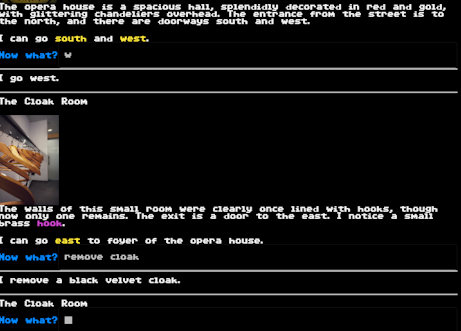
Funnily enough, you can do 1st person in MCIF. I thought it would be interesting to make the game action come back more like thoughts. When I turn it on for Cloak of Darkness, the default feedback is not quite 100% but then the author would probably be supplying their own text anyway and not using defaults. Here is a look:
Yeah, I’m seeing a lot of assumptions here about this and about the role of puzzles in IF.
I’m also far from sold on this idea of bandwidth. Sure, a sentence conveys a certain number of bits of information, but there’s no obvious relationship between the size of a message and the depth of its meaning. There’s a holographic principle in play, in the sense that a flat line of text encodes multidimensional worlds. And what even is the method for comparing quantity of information in a real-time, movie-style game and a text game that proceeds at the pace of the player’s comprehension?
In all fairness, I would assume some of the reduction in time between camera cuts is down to advances in technology making it easier to do dynamic camera work and that some older programming is more static than its creators would have liked because the technology and/or budget just wasn’t there to provide the desired dynamism… of course, just because you can doesn’t mean you should, it’s easy to fall into the trap of thinking dynamism is always better, and knowing when a shot should be static for dramatic effect and knowing when dynamism crosses the line into chaos and being deliberate about when to cross that line are underappreciated aspects of cinematography, similar to how the use of silence is an underappreciated aspect of sound design… of course, it doesn’t help that most of big media cares more about hacking attention than they do about enabling creation and dynamism is eyecatching.
Also, my screen time has plummeted from probably 12+ hours a day before I went blind to technically zero post-blindness, but I still suffer some of the attention span reductions that have come about thanks to the changing media landscape. Even with no screen in the equation, the modern internet makes accessing almost any piece of media that isn’t lost borderline trivial without ever leaving the house. In the 90s, cable gave you at most a half gross television channels and you’d be lucky if even a dozen had any programming you cared for and unless you had a VCR, you had to schedule your day around when shows came on, and unless you ahad the money and storage space for lots of tapes, you were limited in what you could save for viewing on your time, oyou were lucky if you got a half dozen radio stations, proably only one per music genre and then only the most mainstream music from the most mainstream genres, 90s computers and internet could barely handle anything bigger than low quality mp3s and jpgs and if you did find a whole movie or television episode for download, it was either crap quality or took up a sizeable fraction of your harddrive and forkover for physical media was the only option for anything beyond the airwaves. Now, I have oer 40 television series, hundredsof music albums, dozens of audiobooks, thousandsof YouTube videos, among other stuff, stored on an a memory card the size of my pinky fingernail and the card is only 90% full… granted, most of the video content is just the audio since, as a blind person, I don’t really care about video and the memory card is only a quarter the capcity of my main data drive, but my harddrive has the video files some of that audio was extracted from. If I permanently lost internet access, I likely have enoungh media downloaded to keep me busy for months, if not years, to the point choice paralysis is an issue.
There can be fair pushback on “bandwidth” as a term, without doubt! But I don’t think the underlying point depends on it, so let me restate without it.
Every piece of fiction is interactive in the sense that you have to do something to receive it: watch, read, or play. That’s a spectrum, not a binary, and “interactive fiction” as a genre label is honestly a bit of a misnomer, because by that definition, a Call of Duty campaign is interactive fiction too. It’s got a story, and you interact with it. So is a movie, at the level of “you have to pay attention and construct meaning.” The term never carved reality at a joint; it was just claimed by one small corner of a much broader spectrum early on and stuck there.
What actually matters, I think, isn’t whether something is “interactive” but how many different senses are in play at once while you’re interacting. And the market’s already run this experiment for us, twice, with a clean result both times. The reading public chose books over parser-based fiction, decisively. The gaming public chose the graphical, multi-sensory direction too. And you can watch it happen in real time in the historical record: the CRPG and the text adventure emerged together, from the same D&D-inspired roots in the mid-70s, and then split. The CRPG kept adding channels (graphics, then better graphics, then sound, then voice), and it’s the dominant form today, infusing just about every genre. The text adventure stayed almost entirely in the one channel it started in, and it moved to the hobbyist sidelines. Same ancestry, same era, opposite trajectories, and the variable that moved between them is exactly “how many modes of sense are engaged at once.”
So, yes, something is absolutely getting compressed when you go from a multi-sensory form to a text-only one. I don’t think that’s actually in dispute; both audiences voted on it. The real question, and I think this is your point too, is what that compression specifically costs, and whether it’s a cost everyone should care about or just a tradeoff some people are fine making. Which loops back to the first point: since all fiction is interactive fiction by degree, the real question was never “why doesn’t IF work,” it’s “why did most people prefer the direction that adds more sensory channels over the direction that doesn’t,” and I think that’s a much easier question to actually answer.
Okay, but then why didn’t the same thing happen to books? Movies added exactly the sensory channels I’m crediting for the CRPG’s dominance, and books are still here, not remotely sidelined the way text adventures were.
I think the answer is that books and text adventures aren’t actually the same kind of “single-channel” thing, even though both are plain text. Go back to the window/mirror distinction from earlier: a novel’s one job is producing depth: a reader inhabiting another mind from the inside, with all its contradictions and blind spots. That’s not a job extrasensory channels replace; it’s a job they can’t do at all. A film can show you a face, a voice, a room, but it can only imply interiority through performance; it can’t hand you direct, narrated access to what someone is thinking the way prose can. So when film added channels, it didn’t out-compete the novel’s core function; it competed for a different function (spectacle, pacing, sensory presence) while leaving the “window into a mind” job essentially uncontested. That’s why some things do adapt well to film (plot, incident, image) and some famously don’t (interiority-heavy novels tend to lose the most in adaptation, which is itself evidence for the claim).
The text adventure never had that kind of exclusive job. The “you” was built for agency, not interiority. A thin mirror, not a window, from the start. So when a richer-channel competitor showed up, offering more agency satisfaction (better graphics, sound, physical feedback), there was no protected function left for text to retreat to. Books survived the sensory arms race because they were never really competing on the axis on which the arms race was fought. Text adventures didn’t, because they were.
Thanks, Jeff. I continue to find this a really interesting and well stated line of thought. I think a logical (and unsurprising) conclusion of this line of thought is that there likely is no path to mainstream popularity of text adventures – there is only finding people who might be predisposed to enjoying that sort of fiction by exposing them to it, and letting them decide for themselves. Which, arguably, applies to many of the subjects covered by a general education, aka, why I was taught to play the recorder in high school.
Broadly, I think that’s the right conclusion, and it’s basically what the classroom experiments confirmed for me, not just in the aggregate but in a specific way that I should probably reinforce here. It wasn’t just that some writers and readers liked it and some didn’t. It broke fairly cleanly along the axis we’ve been circling this whole thread: the people who lit up were the ones who already wanted the “window” experience badly enough to tolerate a thin, agency-built “you,” or who already valued reconstruction-as-pleasure enough that any resumption cost was minimal. I think it’s important to call out that the ones who bounced off weren’t wrong about the medium, and the medium wasn’t failing them. They just wanted a different job done. A writer who wants full control of interiority is never going to be happy handing narrative control to a reader, no matter how well the form is executed. That’s not a design flaw to fix; it’s a mismatch to identify.
Which is maybe the actual practical upshot for anyone coming at this from the dev side, like the OP: we can stop asking “how do we make this appeal more broadly” and start asking “how do we find the predisposition faster.” The whole thread’s been implicitly arguing that IF isn’t an underdeveloped mass medium; it’s a correctly sized niche medium whose audience is defined by a specific taste (comfort with agency-thin protagonists, tolerance for resumption costs, pleasure in reconstruction over spectacle) rather than by exposure or marketing. Once you see it that way, my crossword comparison from earlier in the thread stops being a consolation prize and starts being the actual model: nobody’s trying to get the crossword into the mainstream, per se, and crosswords are doing fine.
Small side note, since it’s oddly on-topic: I’ve been writing my own IF interpreter (Voxam) and building acceptance tests against a bunch of games, Infocom and otherwise: the test suite’s here if anyone’s curious what that looks like. And going through them game by game, replaying stuff I grew up on and genuinely loved, I found the experience … pretty miserable. Not “this hasn’t aged well” miserable, but actually just not fun, repeatedly, across games I had (or so I thought) a real affection for.
I think it’s actually consistent with everything above, in an uncomfortable way. Building an interpreter puts you in exactly the wrong relationship to the “you.” You’re not inhabiting the thin mirror, you’re staring at its plumbing, verifying that “take lamp” produces the exact expected output. There’s no room left for the reconstruction-as-pleasure the medium depends on, because you already know the answer; you’re just confirming it parses. It’s a bit like the difference between watching a magic trick and reading the method behind it. The trick doesn’t fail, but the specific pleasure it was built to produce is structurally unavailable to you once you’re checking its mechanism instead of experiencing it.
How is this relevant? Only that it may say something about how fragile that predisposition I mentioned really is: it’s not just about having the taste for reconstruction, it’s about being in a posture that allows it.
I think a lot of the super-fast cuts in modern shows and constant jumping back and forth in time is designed to not allow you time to process information linearly and notice that the content is pure crap. Note I don’t mean time-travel movies; I mean interviewing people pre or post some event and mixing that footage in continuously with the actual event. This garbage doesn’t just fill TV and sporting events; a fair number of Youtube videos, etc. do this as well.
Of course, it is possible to have very fast cutting and still have everybody understand exactly what is going on in a scene, but only if you’re a genius like, for example, Margaret Sixel, who edited her husband George Miller’s film Mad Max: Fury Road. George Miller is also a genius for knowing exactly how to shoot an action scene. Lesser directors will use fast cutting in an attempt to hide the fact that they don’t.
 It’s really encouraged that you play 5 Days a Stranger and 7 Days a Skeptic first, Trilby’s Notes is the third and builds heavily on the lore. 6 Days a Sacrifice is the last one.