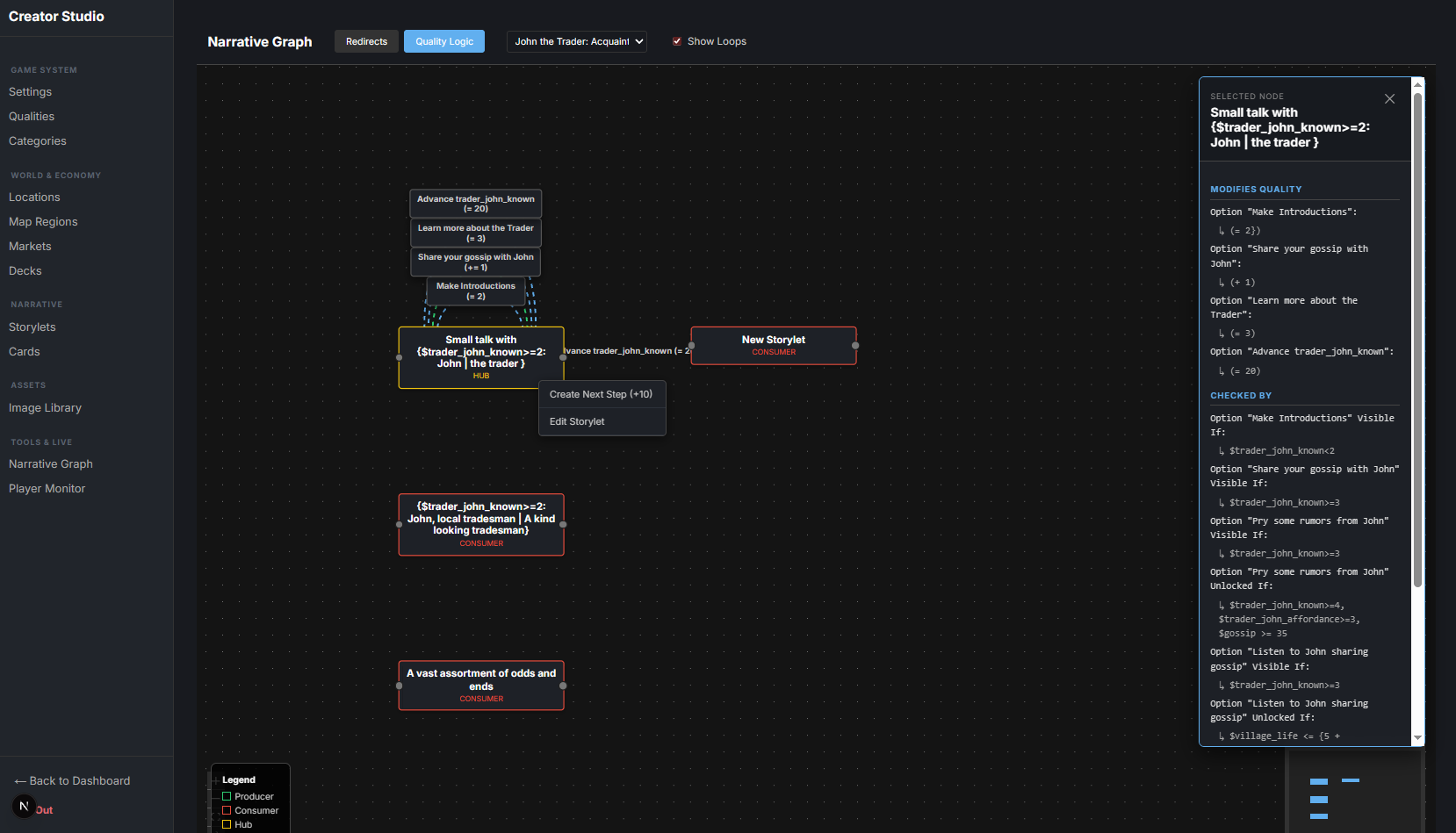
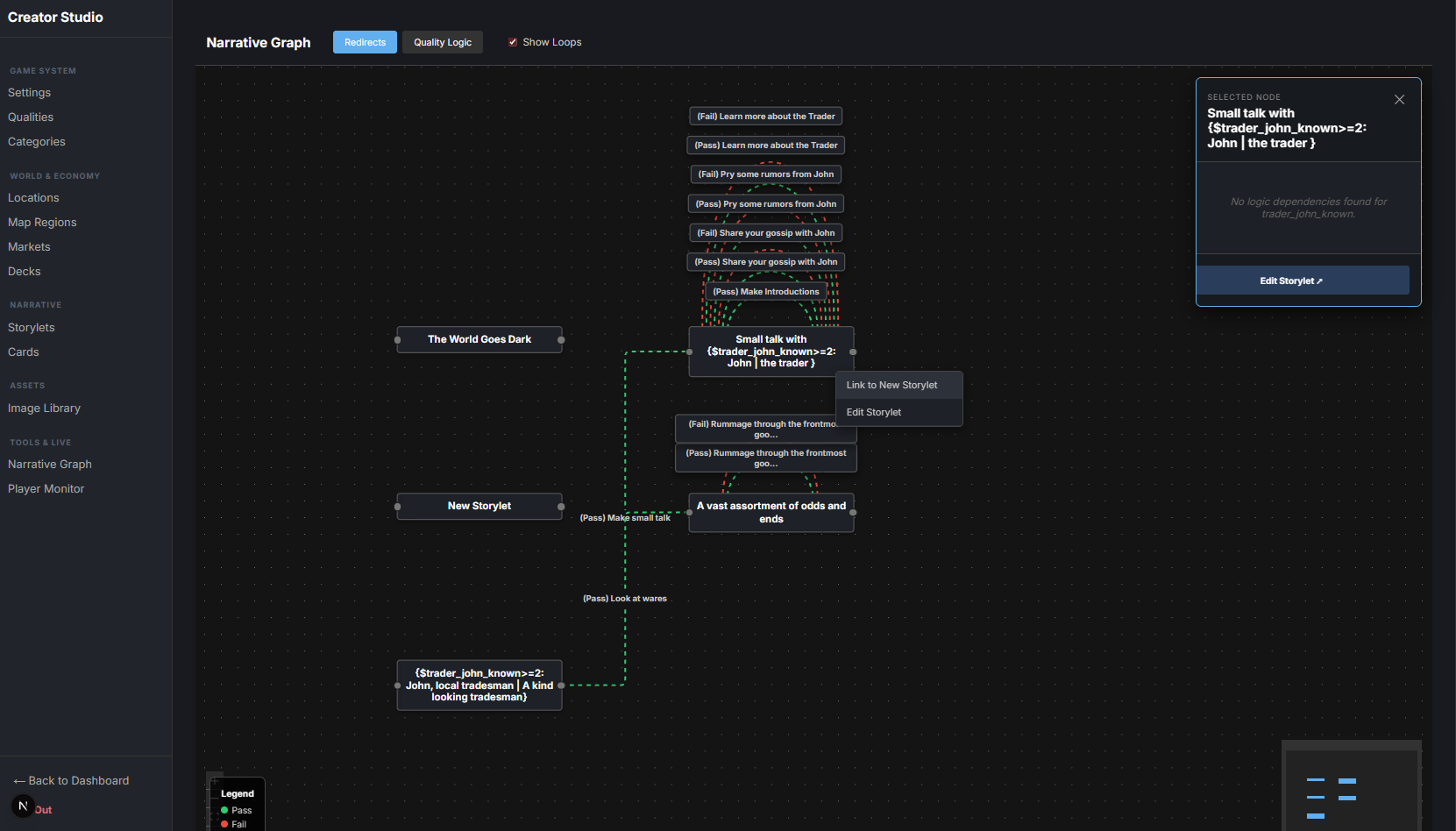
Yeah, that’s mostly not bad.
I think the TL;DR here is: use Dendry if you just want to start with something Ink or ChoiceScript-like that lets you branch out into storylets. Or use DendryNexus if you’re attached to StoryNexus’s card-deck/hand of cards presentation style and RPG-like random skill checks. Use MQBN for Twine/SugarCube but it’s a little more flexible and a little more work for the author to decide how to use it probably.
I’d recommend @Hituro’s MouseQBN over my TinyQBN as I haven’t touched mine in years. MQBN is actively used and maintained, and probably better thought out than TinyQBN (I did think about it a lot, but it was the first publicly available storylet library for Twine and I definitely made some mistakes).
Twine/Harlowe has storylets built-in, although they’re pretty barebones: it gives you the core pieces to make them work however you want but it’s batteries-not-included, if you will.
Dendry is probably your best bet if you’re OK with the UI style of the updated Bee and Autumn Chen’s games. There is a little bit of setup, but smwhr’s guide that I linked in the first post should make it manageable, and once you get started the syntax is pretty friendly: mostly just write text-followed-by choices sort of similar to Ink (except Dendry uses - instead of * and + for the choice markers).
Here's a snippet from Bee, for example, with a little bit of commentary from me
Options like - @eavesdrop: Eavesdrop on Jerome and Flauberta go to the section named “eavesdrop”, which is then defined with @eavesdrop at the start of a line.
But the twist here is that you can have multiple sections named @eavesdrop, with different conditions, and it’ll go to the first one that matches the current game state.
You can also have options that go to #plot or whatever and it’ll fill out the list of choices using scenes with that tag.
That kind of thing. So you can start with basic branching and expand from there as necessary.
title: Church Jumble Sale
subtitle: Helping sort goods for the annual fundraiser.
new-page: yes
view-if: month = 14
frequency: 1000
on-arrival: month += 1
tags: menace, plot, top

= Church Jumble Sale

It's jumble sale at the Church, and the children have been gotten together to help sort and price the easy things. Lettice is doing the DVDs, and Lisa Perry is mending donated clothing with a little frowning crease between her eyebrows. Your job is to find the books in the collection and sort them into $1, $2, $5, and $10 boxes, and put special labels on box sets.

- @fountainhead: Flip through *The Fountainhead*.
- @erase: Carefully erase pencil marks from *The Boys' and Girls' Cookbook*.
- @eavesdrop: Eavesdrop on Jerome and Flauberta.
- @chat-with: Chat with Jerome.
- @chat-with-2: Chat with Jerome and Flauberta.


@eavesdrop
view-if: jerome > 1 and jerome < 4 and child-led < 1
on-arrival: jerome += 1

"We'd get a better price if we were selling this stuff online," Jerome is saying to Flauberta. "Selling locally is for suckers."

Flauberta is taking inventory of board games to make sure they have all their pieces. She tapes a sign to the top of a Scrabble box that says, "Missing P."

"We could be filling out Social Studies Workbook 23A: Societies of Subsaharan Africa," she says to Jerome.

"Good point," he says.
By default, Dendry has a presentation that’s similar to ChoiceScript (except that you click the choices directly instead of selecting the choice and then clicking the button to go).
DendryNexus is an add-on for Dendry that imitates StoryNexus’s presentation style, where you draw a hand of (default three) cards from a deck and then select them. It also adds StoryNexus’s stat-check system, where you can roll a random check against a skill level, and your skills increase (succeed or fail) when you use them.