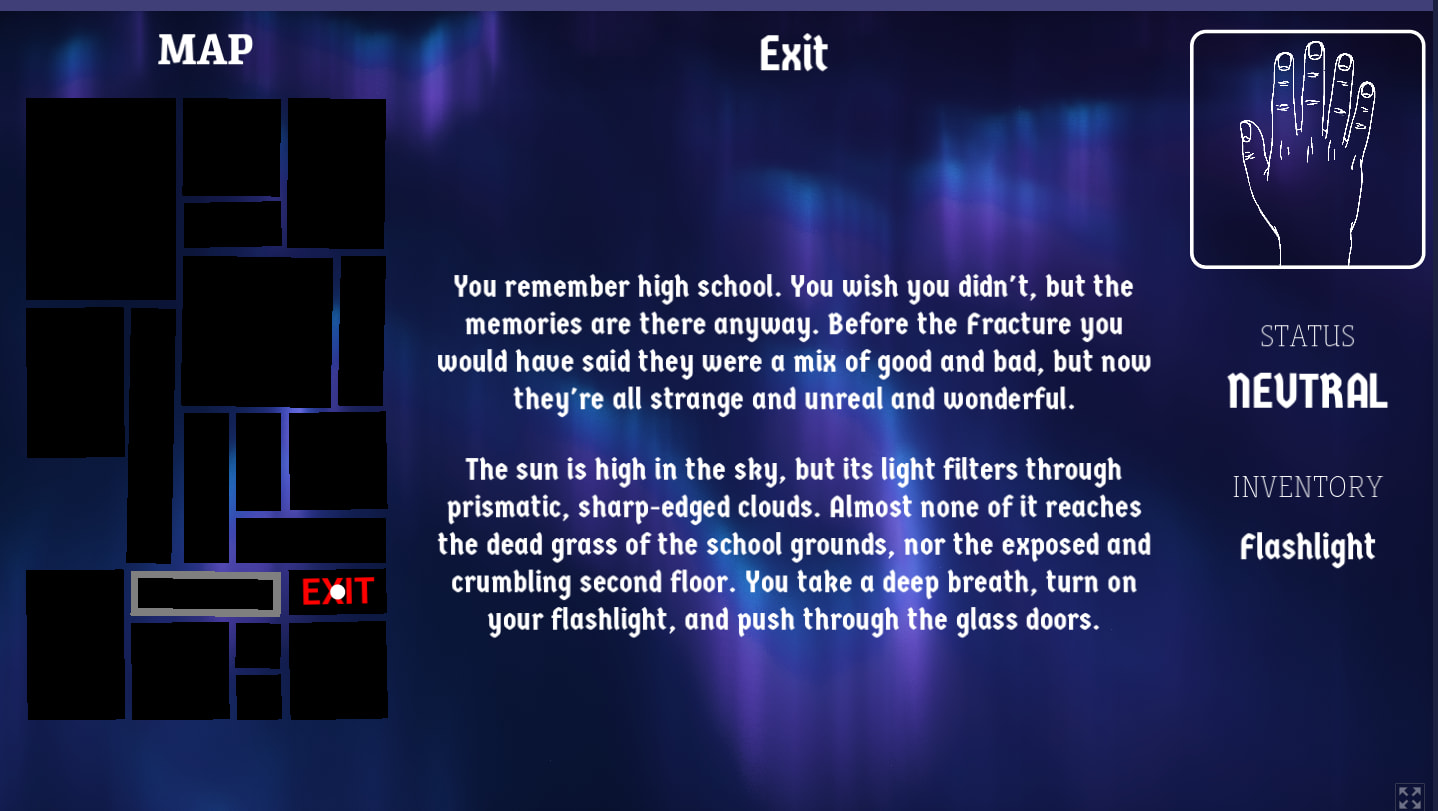
This is the first piece of what I might call “craft writing” that I’ve encountered in the jam. This isn’t a commonplace term. What do I mean? I would say that it calls attention to its literary or artistic qualities, and those qualities are strongly foregrounded over common elements of linear narrative. When Monotype is working well, it is a series of associative leaps between fragmented episodes. Only one fragment prints per screen view, and a single link leads to the next. Monotype is ultimately a kinetic work, as there are no choice points or branches.
This, the first and only untitled fragment, is a solid cold opening:
You’re hunched amongst the undergrowth, by the roadside, several steps from the car. It’s late. You should be anywhere other than here, but cannot, or will not, move another step.
The next fragment, which we reach upon clicking the words “It’s Late,” is in different circumstances.
Quarry
The two of you step off the path, which is not itself all that well lit, onto a trail leading up the mountainside, which is not lit at all. You stumble along for a bit waiting for your eyes to adjust, give up, turn on the flashlight.
Not too far ahead the trail levels out and passes below a series of excavations into the rockface. The light reflects off the concrete blocks jutting out of the ground. It’s hard to see much else. You walk slowly, coming now to the largest of the excavations, which, even in late winter, has been already overtaken by cleavers, thistles and wild mustard.
You let the flashlight rest on the old heap of machinery at its centre and involuntarily clasp your other hand around a small, absent object.
This is arresting and well made. Who is this other person? Naming specific local flora is evocative and enforces a sense of reality despite the strangeness. Using this fragmentary technique, the author is able to anchor passages with singular, compelling details.
We learn from the game’s description that the author “… dredged out the usual stuff: dissociative states, monomania, printmaking and spooky mountains.” Some of this goes without saying: the protagonist returns, again and again, to do printmaking in the aforementioned quarry.
This, the repeated act of laying out a blank, black field of ink over the plate, and, while it is still wet, scrubbing, scraping, slowly, meticulously pulling from it the same figures again and again in subtly different configurations: mountains, machinery, long irrational shadows, beacons.
The title Monotype is darkly playful, then, in that it not only refers to a typeset but also the protagonist, a monomanic type. I think I would have preferred to work out the dissociative nature of the protagonist myself. Rather than trying to sort out, on my own, what this text is about, I’m given the answer before I begin. Would I have figured it out on my own? I suppose there’s no knowing now, but an important counter-question is, “Would the author have done anything different if they hadn’t explained themselves?”
I imagine the author has heard that the ending should be more definitive or else more explicit. I feel that the ending is rather definitive, and the final phrase is this attempt to put a bow on things:
But, unemployed and absent other options, this is the most viable one you’ve got. Here, at least, is a template.
I think that this is unfulfilling, not because it isn’t definitive, but because it is a little too definitive. It’s at odds with the rest of the piece, tonally. Perhaps it doesn’t need more, but less. When is this actually over? Sooner, I think.
If I were a reader for this in a workshop, I would be enthusiastic about it. There are many fine sentences, and the fragmentary approach is quite effective for this specific piece. I would, perhaps against conventional wisdom, encourage compression rather than expansion, and I’d reconsider telling people what things mean, but this is fine literary writing: a great, different kind of horror that stands apart from everything I’ve seen so far.