Tangentially, I worked at IMDB for a couple of years building movie ad banners for imdb.com. They had their own in-house banner specs and rolled their own using marketing assets provided by the studios, rather than accepting whatever industry standard banners the studios ad agencies would otherwise have provided. They ranged in scope from typical headers and skyscrapers to full-size page takeovers, usually with a movie trailer baked in, and a link out to whatever movie website.
Yeah, during the 2000 and 2010s especially, after any mainstream movie I’d come home from it and see what was on the website. I’d download any desktop wallpapers the studios were offering – which was one of the main things on each site – for films I liked. But I’d also look at any silly games, virtual toys, and occasionally, promo videos. Once they stopped providing wallpapers, I lost interest.
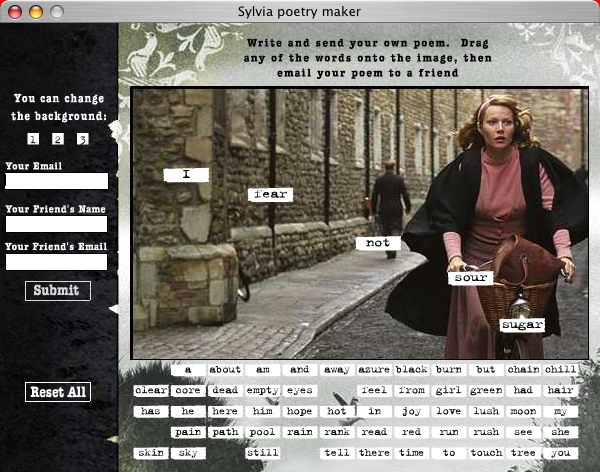
For an example of fun gimmicks they’d have on these sites, here’s a screenshot I took back in the day of the poetry-making page on the website for the 2003 Sylvia Plath biopic film Sylvia. (And that film is not a barrel of laughs!) Note how you could then send your poem to a friend by entering their email address.
I have to admit the studios did good Blair-Witch-like work with Smile 2. The protagonist’s songs were shared on social media with false-meets-real-seeding conversations about what had happened to the singer, with the side-effect that you got the singer’s songs from the film that didn’t necessarily appear in full in the film.
However that’s more the exception, now. The studio sites have largely become sucky, over-similar placeholdery things offering obligatory links to social media.
-Wade
Personally I encourage fanfiction (as noted about Materia of Railei), asking only for a complimentary copy.
but politically, on IP, I follow the goering’s reasoning (“If i heard the word “IP” I draw the gun”) so, I generally ignore the debate about greed-induced nonsense and kept the flamethrower in the holster 

debate closed for me.
Best regards from Italy,
dott. Piergiorgio.
Works that significantly modify the material (parody, satire, critique, fanfic, etc) fall under fair use. It’s called “transformative work”. Note that fanfic didn’t always count and sometimes is still a grey area, but nowadays is mostly left alone. I haven’t played Veeder’s Orient Express game but given his Little Match Girl series I would assume this, too, is transformative.
The existence and definition of the “Fair Use” concept is not consistent across all Legal Regions that have Copyright related laws. So an Author that intends to create a work that depends on “Fair Use” needs to be aware of this fact, especially if they intend to release their work in other Legal Regions than their own.
Not just movies, but back in the days before corporate social media, plenty of corporations across all industries would have dedicated websites for every major product line for every major market and the cash cows would have dedicated sites for each major release. Television broadcasters had websites for each cable TV network and some networks would have sites for specific programming blocks, Nintendo hao had the main Nintendo.com and Pokemon.com, but there were also dedicated sites for some Zelda releases and specific Pokmeon releases, Plenty of .coms targeted at a US audience would have a .ca, .co.uk, .fr, .de, .co.jp, etc. Lego had a website dedicated to throwbots and a completely different website dedicated to Slizers when the two were the same product line, just with different names and backstories depending on which side of the Atlantic you were on, and the idiocy that is geoblocking hadn’t been invented yet or was rarely used, so the Canadian, British, and Australian websites where often just as usable as the American websites and in the days when simple shockwave and flash games where all the rage, those international sites often had such games exclusive to them and sometimes even the French, German, Japanese, etc. websites, even when their text was available exclusively in the dominant language of the site’s home country, sometimes had exclusive wallpapers or games that were accessible to the illiterate. Though admittedly, fansites were almost always a better source of information than official sources, especially for properties of foreign origin where the official English websites only had information on what was officially available in English… Now, I’m not sure when the last time I visited a website with a country-specific domain, especially if we ignore sites where country domains have been hijacked for a different purpose(e.g. .tv wasn’t originally meant for sites related to television shows or networks and .me wasn’t meant for personal websites, but I doubt there are many people who can name which countries those domains belong to off top of their heads).
But yeah, even if everything just redirects to their corporate websites, large corporations like buying up domains that are vaguely related to any of their products or anything that sounds like it could be their products(e.g. Nintendo and/or the Pokemon company owns a lot of pokemon[insertColorWord].tld domains for colors that have never been used for naming a pokemon version), though I’d argue that’s separate from the legal concept of Trademark, though it does intersect… also, I’m reminded of the time Microsoft sued a guy named Mike Rowe over the domain mikerowsoft.com or someone with a similiar name over a similar domain, I’m not sure on the exact spellings of the name or domain… and don’t recall the outcome… Though if memory serves, part of why they are called Blu-Rays is because Blue is too common a word for trademark… not sure why the ray part got through without deliberate mispelling though…
Honestly, I don’t like that corporations are even allowed to own IP and that the doctrine of work for hire basically means it’s legal for an employer to take all the credit and money and leave the creator with nothing if the creator ever has a falling out with their employer and that a creator can be sued for building off their own past work following such a falling out. Also don’t like that copyright’s duration has been buffed into the exosphere and would like to be cut down to either what the original copyright act set it at or to life of the author or 20 years, whichever is shorter… I also don’t like that trademark has no well defined limit and genericization mostly comes down to arbitration in the courts, that patents are priced such that corporations can liberally file superfluous patents on ideas they have no intention of pursuing while independant inventors often can’t afford to patent their designs, that corporations can bully creators of derivative works that are fair use by any reasonable standard into giving up because a successful lawsuit defense would bankrupt them, that independant creators often can’t afford to take genuine infringers to court, that the duration of patents is often long enough to hamper the iteration most tech requires to get good, etc. I like the general idea of copyright, but it’s implementation does very little to help those who genuinely need its protections while empowering corporations to the point it kind of discourages creative output when it was meant to encourage such.
It was much bigger in the early 2000s when Flash was a thing. It was possible with basic HTML (like with the Space Jam site @Dannii mentioned) and it’s still possible … but Flash really encouraged developers to make creative websites.
It seemed to be especially important for marketing family movies, because Flash was a good way to put in web games and interactivity. But it was more than that … pretty much every product from toys to cereal had a tie-in website. If you had any product, your website was competing for eyeballs with things like Homestar Runner, Club Penguin, and Newgrounds. The sheer amount of web games that, for example, Lego had in the 2000s was overwhelming.
I remember websites getting more standardized leading up to and around the 2010s. Arguably, the iPhone contributed to the death of Flash, but even without that, websites were getting more standardized anyway. Social media was also more important than getting people to a website at that point.
Lots of the old-tie in sites don’t fully work anymore, at least not easily, but the web design museum has a good collection of screenshots … 2004 seems to be a peak year.
I really miss this sort of thing. In fact, I considered it as a career in middle and high school. Web design (separate from development) looked like it was going to be an easy and rapidly growing path at the time, but that’s not how it turned out job market-wise.
I think you meant trademark? Patents are different.
I mostly agree. My feeling is that if we must live in a world with copyright the only sane way to do so is 1. Limited to a reasonable period (reasonable being the contentious part). 2. Must be held by a human or humans, never a corporation. 3. Non-transferrable. After the period expires or the author dies, that’s the end of copyright protection.
None of this author’s life + X years bullshit, where you can’t even tell if a work is copyrighted when the author disappears.
Reminds me of this 99% Invisible: https://99percentinvisible.org/episode/there-is-a-light-that-never-goes-out/
So more like the original Statute of Anne…
The new law prescribed a copyright term of
14years, with a provision for renewal for a similar term, during which only the author and the printers to whom they chose to license their works could publish the author’s creations.
note: Only a single renewal was allowed, so the maximum copyright period was 28 years.
…which the United States originally based their own Copyright laws on until 1831, when they doubled the initial term to 28 years to extend the possible maximum to 42 years.
Thus starting the slow journey to the nightmare the US (and other Legal Regions) finds itself (themselves) in now, where very little copyrightable material actually finds its way into the Public Domain, unless the rights holder(s) decide to relinquish/open-up the relevant rights early.
Sorry to join the party late on this one.
Each territory has different provisions regarding copyright term. Australia is mentioned, and ‘lifetime plus seventy’ is now a fairly standard term, but exceptions abound. e.g. for the UK: Copyright Notice: Duration of copyright (term) - GOV.UK
Except for very old works, e.g. Charles Dickens, if you are looking for (relative) legal certainty as regards freedom to use, you are probably best off approaching the rights holder (if known) to get permission in advance. This is also true if you know or suspect that the work is still very much in copyright.
The US provisions regarding fair use have been mentioned above, but different provisions apply in different territories and, even knowing the law in detail, it’s still a crapshoot as to whether you would actually prevail in a dispute (and you can’t afford to get into a dispute in the first place, believe me). US copyright in particular is hugely subjective, and there is definitely a tendency towards deciding cases on a case-by-case finger-in-the-air basis, rather than developing a corpus of clear precedent.
If you are going to devote significant resources to a fanfic project, or if you are hoping to realise commercial gains, I would generally err towards seeking permission from the rights holder or not doing it.
For smaller scale, informal, non-commercial projects, you might want to roll the dice. If you have no significant assets or presence in the US, you are probably more in the clear, but nothing is certain. It costs people money to enforce copyright, so there is a level of inertia before people will take action, though again it depends who holds the rights and how litigious they are generally. For example, I wouldn’t fancy making a Little Mermaid game with undertones of sexual shenanigans, etc. because Disney would probably nuke me from orbit. (Note that Disney can still nuke me from orbit with litigation costs even if I have an apparently strong case on the merits.)
But yeah, there’s a huge amount of detail and complication with copyright terms and copyright infringement, and it’s really very subjective, so my overall advice would be to do whatever you can to not have to figure out either.
And briefly a world on related rights that have been mentioned:
Trade mark - fine detail varies by territory as always, but trade marks are registered rights that you infringe by (more or less) using the claimed mark for a good or service on the list of goods and services for the mark. If you look up any trade mark online, you can see the goods and services it is registered for. This is how similar or identical marks can be held by different companies without (much) conflict.
Passing off/unfair competition - there are unregistered semi-equivalents to trade marks, where you can have a cause of action against someone for selling something which could be (deliberately) confused with your own brand. This is a black hole of money for litigation, but just to note that there are ways that big brands can come after you if you are riffing on their brand in a way that they don’t like.
Well, that’s it, really, for stuff that is likely to collide in the IF space. But other kinds of rights exist that may become relevant if you are using any graphical similarities to brands or characters, and it varies again by territory. Using the name or face of actors associated with works can cause issues. If you use graphical stuff, there are other kinds of copyright and other types of trade mark that may be relevant, and maybe registered designs, etc. Again, the more you borrow, the more you will find it easier to just get permission first or simply not do it.