Can we just ban AI content on IFComp?

If I may, I would like to bring up one thing with respect to the use of AI in the comp.

This was the comp’s ‘front end’ in 1996:

This is what it looks like now:

You’ll note that there’s one particularly glaring difference: the existence of cover art.

Cover art started as a thing some people added to their games if they had the time and inclination. Over time, more and more people included it, as they noticed that the games with cover art got significantly more attention than games without. At this point, it has become, essentially, a requirement if you want people to take your game seriously.

This is a pretty weird requirement to put on a text-based game! And it puts pressure on people to do something they’re not necessarily very good at, on a wide variety of levels. They’re probably not good artists themselves, they probably have an artistic sense of what they like far beyond their own skill level.

So one can understand how these forces converge to push people to use AI-generated cover art: they can fulfil a weird obligation that they don’t care about with something that looks much better (at least in their own minds) than anything they could make themselves. Because they are wordsmiths, not imagesmiths.

I personally could not possibly care less about AI-generated cover art, mostly because I already don’t care about cover art in the first place. If it’s going to be a problem, one solution would be simple: just don’t have cover art at all, and make the standard once again ‘these are text games with titles, not video games with art’. If people want art, they can stick it in the game itself.

However! That seems very unlikely to fly, and even I can’t deny that it’s cute to have a bit of splash to go along with the games. And like it or not, it’s still true that they do help the games get more attention, especially outside of our direct circles of IF fans.

So, a proposal: if we ban AI-generated cover art, can some brave volunteers step forward and offer to make cover art, for free, for any IF Comp entry that wants it? I am imagining some combination of artist volunteers plus perhaps the IFTF using some of the prize funds (or a separate donation category?) to pay artists a nominal/reasonable fee. It seems to me that this would fill the same need that AI art currently fills, while also making us come together as a community more strongly, not only as a statement about why AI art is unnecessary, but proving it with our own time and effort.

14 Likes

this would be a good idea tbh

6 Likes

I would argue this is still no reason to require AI. I can see why some people gravitate to it as it’s quick, easy, and gives a (sometimes) somewhat commissioned piece look. However there are entire stock sites out there with images you can use freely.

This would be a potential possibility but also seems fraught with problems. What if some games don’t get an artist? That would put them at a disadvantage (and be pretty demoralizing-no one cares about your game enough to want to make something for it). What if someone makes coverart, but the game author doesn’t like it or feels it didn’t represent the game properly and doesn’t want it used. (Now we’ve got ticked off artists). What if some people are receiving beautiful hand drawn art, while others get an unedited stock image with the name of the game pasted on? What if an artist doesn’t complete the art leaving a game in the lurch on release day? Just seems like a lot of potential unhappiness that could result of all doesn’t go to plan.

10 Likes

I was actually thinking about this very thing while following along with the discourse, and would love to contribute to a community resource for art! I agree that having channels for artists to be matched with authors, in whatever way is deemed feasible to organize and fair to all parties, could really help entrants feel like they don’t have to rely on generative AI.

(Though I’d encourage people not to stress too much about art in the first place—even very simple covers can be effective, and several of the highest-ranked games in past years have had the kind of art that almost anyone would be able to make with just a bit of patience and the right tools.)

Alongside opportunities for author/artist collabs, we could also maintain a masterpost pointing people towards places where they can find great art or resources for free; stock photos, pictures of public-domain paintings and such (could be especially appealing for those who like the photorealistic feel of gen AI), software suggestions, image editing tips, etc.

13 Likes

Yeah, exactly this. Here’s the cover art from last year’s winner:

(That’s a public domain image plus some words in fonts).

Here’s 2023:

(More fonts plus some rotated clipart, I think?)

2022 had some commissioned art, admittedly; 2021’s winner was a photo of a pile of floppy disks. The cover of 2020’s winner looks like it was drawn by a six-year-old (and quite possibly was).

So I also think it’d be cool for authors and the IFTF to think about ways to partner with folks in the community to get good, non-AI cover art into circulation, especially if there was a fair recompense for their labor, but let’s be clear that genAI art isn’t solving an actual problem here!

14 Likes

Agree. Nice cover art helps attract eyes, but only to a point. If the game is good it’ll stand alone. (Especially given the reviews that happen for ifcomp). And all the beautiful cover art in the world, can’t help a game that’s unpopular or poorly written/buggy etc.

And there are some lovely stock and CCO images out there. I’ve used some really pretty classical paintings for some of mine that have had a bit of minor editing for colour and/or cropping (which could be skipped and still look ok) and then the name of the game typed on. Your just have to know where to look (easily fixed with a stock sites list) and be prepared to put in a little more searching time rather than typing a prompt into an AI.

5 Likes
12 Likes

This is a good example why all this is so difficult. There is no black/white usage of genAI.

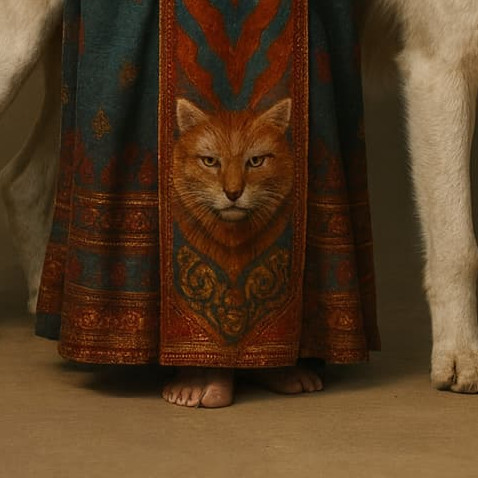
The first picture is original art (here CC0 by Kai Stachowiak), consider it original art by an i.f. author. The two alternatives are converted from the original with genAI and technically speaking new creations, but probably close enough to the original to be derivative work, at least the comic style. You could probably even get the comic result with filters and adjustments in something like Photoshop.

How would a rule solve this? Honestly, I do not know…

(Generated images)

It is a similar matter with coding. You could add AI pieces here and there and probably nobody will notice, either because the code isn’t visible at all or because you cannot identify the code. It is very easy to define rules that are not enforceable… and thus pretty worthless. I guess all rules require a certain amount of trust and honour among the community. As it is with the current approach.

1 Like

My impression is that it’s getting harder to find stock image sites which are willing to vouch that their images are not GenAI. I’m pretty sure there’s at least one piece of cover art in this year’s IFComp that is using an AI-generated stock image without the author being aware of it …

10 Likes

With discussion winding (?) down (?), I’ll just bang one one unpopular drum that seems to be overlooked:

I am not at all interested in reading other people’s AI slop.

But, I am extremely interested in trying experimental IF that uses LLMs to create never-before-seen player experiences, and I’m worried that overly broad “no gen-AI” rules will unnecessarily stifle developments in this area.

I mean, think about it: we’ve spent decades trying to give the player the illusion that they can type anything, the computer will understand, and the game world and story will respond accordingly. Now, we suddenly have technology that can actually understand anything you type and reason at near-human levels about how it might affect the game world. No one has yet figured out how to harness that power for something more compelling than slop or hallucinations, but we’ll get there eventually.

My preferred compromise would be to ban pre-generated AI content, but not the live use of LLMs during gameplay. This doesn’t solve all problems, but it does eliminate most of the slop while keeping the door open to genuinely interesting and transformative experiments.

1 Like

That’s part of the problem. I source images from all over the place together with my own work. I’ve recently noticed that it’s getting very hard to find free or freely usable stock images that aren’t AI generated.

3 Likes

I realise this wasn’t held up as an example of AI images being good, but I do find the cat head phasing through the skirt amusing all the same:

The point about this being comparable to a Photoshop filter is an interesting one. I really don’t think it is. That owl in the comic-style version is new even if there’s something resembling an animal head at the bottom of the original image. There are details here like the yellow crosses on the skirt that are too small to have been present in the original pixel art. The wolf in both generated images has a distinctly different pose - standing with head turned towards the viewer, rather than walking directly towards the right. I think you might be able to get broadly the same comic-style effect somehow using filters, but it wouldn’t bung in all those extras.

To me, this seems like an area where a ban on AI images would clear up some current issues. At the moment, I couldn’t use that original artwork without permission - but could I use one of the generated versions as cover art or an illustration? The current rules would seem to allow it, especially if I had found the AI derivative on a stock image site rather than knowingly generated it based on the original myself.

I’m sympathetic to the problem this poses for people trying to make use of stock images (which is a massive pain for me personally), but even if someone incorporated an AI element by accident, I can only really see two possible outcomes:

  1. The usage is something like the classic “single stock image with the game title on it” cover, and that single image can easily be swapped out if IFComp spots it and alerts the author.
  2. The usage is a small part of a complicated image made from parts of multiple stock images, and nobody is likely to spot it in the first place (though it might be a pain to fix if they do).

Such a rule probably wouldn’t be universally enforceable, but I think it could easily eliminate the majority of images that have been generated from a prompt and submitted without any editing, and would close the loophole of effectively being permitted to use anybody else’s work without permission so long as you laundered it with an image generator.

3 Likes

Can I be an asshole and request a spoiler on that AI image? They creep me out…

I’m happy to design covers for people, I was already thinking of offering it as a prize! I usually use my own photography. Which is another easy way around the stock photo issue: sure, you might not have the most amazing props to hand, but I’m sure you can find something to take a photo of that represents your game.

And if people are convinced that AI could eventually be used in an interesting way, then I think the better solution is to make your own competition for that pursuit. If anything good comes of it, then I’m sure there could be a discussion to reconsider their inclusion in this comp. I won’t be waiting with bated breath though. “You can type anything and it responds appropriately!” is a wonderful fantasy. But it doesn’t make sense as a piece of game design. What you are describing is a TTRPG where the referee is replaced by some very unhealthy software.

10 Likes

Yes, definitely not an example for a good result, but it was a single pass conversion with the most simple prompt (convert to photorealistic and convert to Claire Ligne comic style). You could probably get them closer, but what I meant to make clear is that with AI it is very difficult to draw a line where editing and enhancing starts and ends.

It could be either original work that gets modified with AI or AI stuff that gets modified by humans.

To make it clear: there are many, many very valid objections and concerns on this thread. It is long, but gives a lot of valuable insights, I guess. Today there are many threads everywhere, where it is all about throwing arguments at each other without listening. This is not one of those threads, IMHO. And we have so different backgrounds that we naturally have different views on all this. For example if find it steep to say I do not play games that have an ai cover art, but I am rather having a coder background. If you are coming from a more artistic background I can imagine that draws other emotions.

This AI tech is so invasive in so many places and on the other side opens so many new options in the workflows, I fear it might be impossible to create a rulebook that solves these problems. If someone aims to hide AI usage, he will ignore the rules, no matter if there is some kind of tagging or hard rules. I think, in the end, you can only solve this by trust - knowing that you cannot rule out cheaters.

2 Likes

Sorry for creeping you out. I might be bitter, but this was really a simple conversion with GPT5 with the most simple prompt. The original pixel art is a CC0 image I got from a picture archive.

Technically the created images are new. If I understand the workflow right, they create a huge prompt describing very detailed what the engine detects on the original picture and then feed this to DallE3.

Indeed, frightening. It is an extreme example of using ai for enhancing (?), lets say modifying original artwork. Where would a rule draw the line? ( and equally for code, music, feelies,…)

Spoilers for the original post are added now

1 Like

The fact that you can use an AI transformer to style transform an existing image is, IMO, more reason to ban those images because it’s frequently used as a way to launder plagiarism. I also don’t think this is like using a photoshop filter at all; what’s going on there really is that the GAN is taking an image as well as a text prompt as a prompt, rather than just taking a text prompt. There’s no real process distinction between the two things.

It’s also impossible to distinguish an AI image generated from a text prompt from an AI image generated from a text + image prompt. When prompted just so, GANs can generate images that very closely resemble source images in their training data; so even if you have the source image to compare the generated image to, you can’t be 100% sure that it’s a style transform rather than an image generated from a text prompt, without getting detailed receipts from the person who generated the image.

It is in fact possible to do this by accident. All AI images are on some level plagiaristic, but you absolutely can generate an image that is very clearly plagiarizing a specific artist’s work, without realizing it.

The thing is that all the instances we do have of people using AI art on covers look bad. They make the games they’re attached to look worse. People think that it’s a better alternative to a very simple image (eg, just white text on a black background) but in practice those images can only ever communicate one thing, which is “I put low effort into this but I want you to think I put in high effort”.

I’ve seen people invest a lot of time and effort into understanding and getting good with these AI tools to generate image, and the product of their work… still looks mediocre at best. But here we’re talking mostly about people who have not invested time into developing any skill at producing images, using these tools to generate something without a lot of effort to fill space. The results speak for themselves.

Ultimately there’s always been a slight unfairness to how games draw attention to themselves in the comp; if someone like Chandler puts a game into the comp, way more people are going to play it than a first-time author’s game. Having nice cover art will draw attention to your game. But the comp’s judging culture (things like encouraging people to play games in a random order) and the actual scoring rules (the comp’s scoring formula doesn’t care about how many people play your game, just the rating you get from people who do) are both designed to work against this.

People are overthinking this pretty badly, I think. I was more positively inclined, based on cover art, towards Andrew Schultz’ game than towards any of the entries with AI art.

The thing is that even though I do genuinely think that authors using these tools are only hurting themselves, it’s not going to stop because there’s not going to be a strong enough signal; games in the comp just aren’t judged based on their art anyway, which is why this shouldn’t be such a big deal in the first place. Banning it, however, would stop people from glancing at the comp page, seeing all the slop, and being immediately turned off.

16 Likes

Yes it is, so I run my picks through AI detectors if uploaded within the last few years. Hivemind seems to be fairly accurate that I’ve seen. And if course anything uploaded before AI was in common use is pretty safe.

2 Likes

Indeed, using a GAN is completely different from using Photoshop and filters. But the question is, can you spot the difference if an author is editing own stuff with either way. I think you end up where you have to trust the author being honest about the tech used.

The idea with banning cover art on the comp page sounds very useful. I must confess I cannot really say how much the cover art influenced my selection of games I tried, but indeed in this place you could easily stop using it.

I might write a blog post about this (‘so you want to make cover art for your IF, yet you don’t know how to draw’) but two very useful resources are:

  1. creative commons images on flickr, which are all but guaranteed to be actual photographs someone took with their very own god-given DSLR
  2. various databases of public domain images like www.oldbookillustrations.com/

I really don’t see a point to banning cover art in general. Again, IFComp is not really an attention contest. Cover art mostly does the job of helping communicate a game’s themes and tone immediately, alongside the blurb, which I think 1. encourages people to play more games overall, 2. is helpful to people looking for something they might like.

Ultimately I think that’s something to highlight here: **the main point of cover art is not to make your game look ‘professional’ (this is an amateur contest!) but to clue potential players as to what it’s about.** A lot of the AI art in the comp this year is also quite bad based on this rubric, because it’s maximalist and has no real curation of what the image is trying to say! The Penny Nichols cover, for example, just looks like a jumble of color at a glance, and looking at it closely doesn’t say much about genre, format, tone, vibes, etc.

12 Likes

That would actually make me kind of sad, and seems to be throwing the baby out with the bathwater. Personally, I like seeing artwork for games. If it’s pretty and has a lot of thought put into it so I can tell what the genre is about/tone in a glance, more the better, but I don’t hold it against games that don’t have it either. It’s a nice add on as it were. It’s like saying books shouldn’t have nice covers because all you’re mainly interested in is the story within.

Ages ago, I put a list of stock sites up over on the COG forums. I can find it if it’s helpful? Not all are now AI free, which is where running a decent AI detector through images can be helpful if they’re recent uploads (I don’t trust the stock sites to police it because they often don’t.)

3 Likes