Scavs, by David Hunter
Scavs, a game about an overlord AI (called the System) exploiting the cogs in its extractive machine, mines a rich and popular thematic vein. I’m a sucker for a cathartic Stick it to the System message, but I want something new when a creator plays on a common theme: a fresh take, a unique voice, a complexity of gameplay, an innovative setting, something to set this work apart from similar stories.
What’s Scavs got for us? I had fun playing this game (a good start!). You’re a middle manager Guy in the Chair directing underlings through a hostile landscape to nab the canisters that System eats for fuel. You’ve got a quota, and sometimes your scav doesn’t want to do/go/try X; will you make ‘em? Whenever there’s downtime, your scavenger will try to tell you about themselves; chatting increases rapport but earns a scoldy email from System. The gameplay isn’t particularly hard, but there’s a sense of tension. The actual design of the game is good, with solid UI and styling, and I had the music on for my playthrough.
The game mechanics are a little thin and don’t always support the theme. Rapport seems to matter only to a final, optional “best” ending, and building rapport doesn’t negatively impact you beyond scoldy messages. It’s possible to meet quota and get your scav out while being chatty and considerate; there’s no gameplay or story reason not to be nice, with one exception discussed below. I wanted some more tension here; maybe an operator performance review score with consequences (demotion to scav?). Something like this could’ve made kindness a liability, adding extra tension and making a more incisive procedural argument.
Another quibble: the map upgrades are added as duplicate maps with extra indicators so that you have to flip through your assorted maps in sequence. Why weren’t we just upgrading a single map? You consult it often, and flipping between five nearly identical maps becomes a serious pain point.
I need to talk about the writing, so I’ll start with something I liked a lot, the objective to collect containers of already-processed helium-3, remnants of a previous failed mining op. It’s elegantly simple and works with the themes. Like, the real scavengers aren’t the friends we made along the way but the System itself, man. Similarly clever, all descriptions of the planet are relayed by your scavs; most of the game’s text is their dialog, which is a good way to justify the relatively blank slate of the analytical, removed PC.
So. The rest of it. A self-critical eye is a skill, valuable but hard to develop. I do the writing for our games, and I’m lucky to have a partner skilled at textual analysis who’s unafraid to tell me when the tone or style isn’t working. This game needed an external eye, because the writing doesn’t work—or it does, but it works (strongly) against the ideas this game wants to convey. Scavs presents itself as a game about acknowledging humanity in yourself and others, about seeing others as people. The game’s writing, then, should make the scavs seem like people with individuality, with specific reactions and lives. These are people enslaved by the System, traumatized by loss, aware they might be doomed. Their reaction to all of this is to elaborately monologue at every opportunity. Jyn enters a shelter and says this:
Jyn: Look at that! Patterns laid across the wall like… like giant butterfly’s wings. It’s a mold bloom. Someone left food in here. Whatever spores rode in with them found this dark little pocket of the world and, for a week or two, it lived. Spread. Reached out. It thrived in the warmth and the stillness this little cabin offered.
Jyn: And then, like everything that matters, it starved in the very home that had let it thrive. Now there’s just this: the ghost of a butterfly’s wing, reaching… dying… Everything turns to dust here.
Jyn: Ah! There’s a storage crate… Alright! Found some Helium-3!
I love a raw line as much as the next guy, but people don’t talk like this. The pattern- overcooked monologue ending in a whiplash snap back to the pragmatic- is constant. I might overlook a heightened tone if it were showing us something about the speakers, but many (not all) flowery descriptions are stock writing that’s repeated by both scavs even within the same playthrough. As a result, they don’t feel like real people and they don’t feel distinct from each other. This is a critical issue in a game that sets out to tell this kind of story.
There’s also a Good Ending  that gives us a soap opera twist ending that pulls the punch on a message about class solidarity by revealing Jyn and Karth are related. They make peace not because they realize their shared position within a destructive system, but because they’re family and their rage was based on a misunderstanding. That Good Ending is also achievable only if you force your reluctant scav to do something possibly-fatal, and the only reason to think it’ll work is that at that point you’ve tried everything else. The game thereby suggests the only way to beat the System is to play its game and gamble with your subordinate’s life. I’d accept a “resistance requires risk” message, but “resistance requires the privileged to risk other’s lives” or “the privileged and insulated must force the oppressed to risk themselves in hopes they realize solidarity”… yikes. Again, I think having the PC incur some risk would really add to the game on a play and a story level.
I spent a decent amount of time mulling over why I was so dissatisfied; I hope this doesn’t come across as cruel. I don’t spend this much effort on a critique of games I think are truly bad. There’s good stuff here! It was fun to play! Others will probably like it better than I did!
The Chart
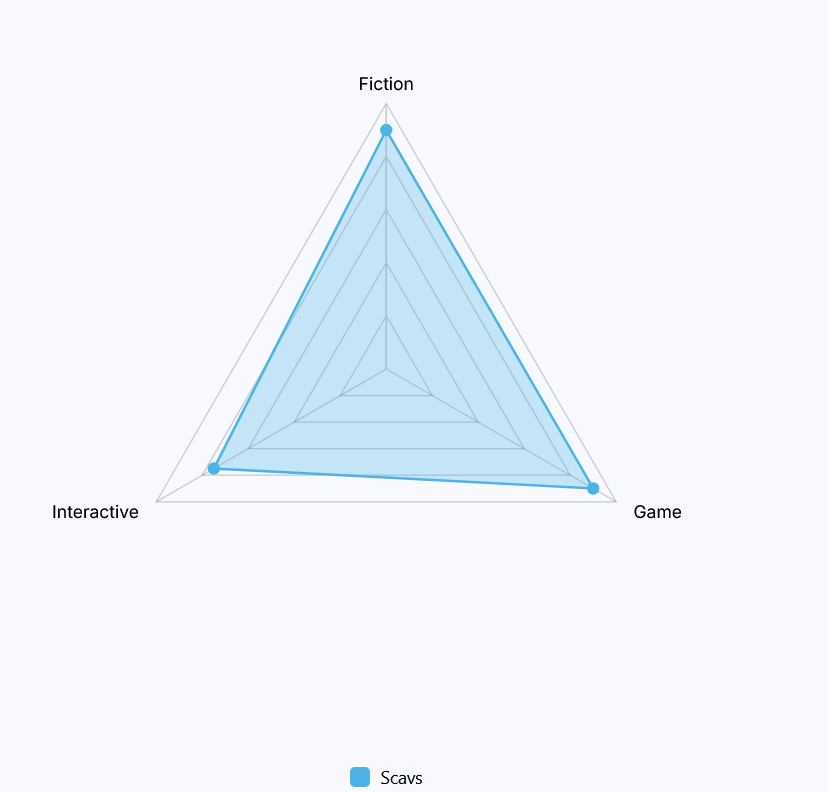
Interactivity - You make choices, retrieve items and data that open up new options, seek shelter. It’d say this is fairly high interactivity.
Fiction - I noted above a place where the narrative didn’t justify the action required to progress, but otherwise it contextualizes and requires the actions you take to play this game.
Game - Definitely a game: there’s a clear goal (100 units of 3He), there’s friction and the possibility of failure; that’s a game. (I think it’s pretty easy, and there’s not much variation in the steps taken to achieve the goal, so it’s not “max game”.)