You do know your comment about Sharpee being way too verbose was the button that sent me off to research building Chord, right?
1 Like
That’s because ive been there before. I made the same mistake back in 2018. At the time i was working on a new system. I made a game for introcomp called “Mothership”. The game worked, but was only part 1 of the story.
Here are some pictures.
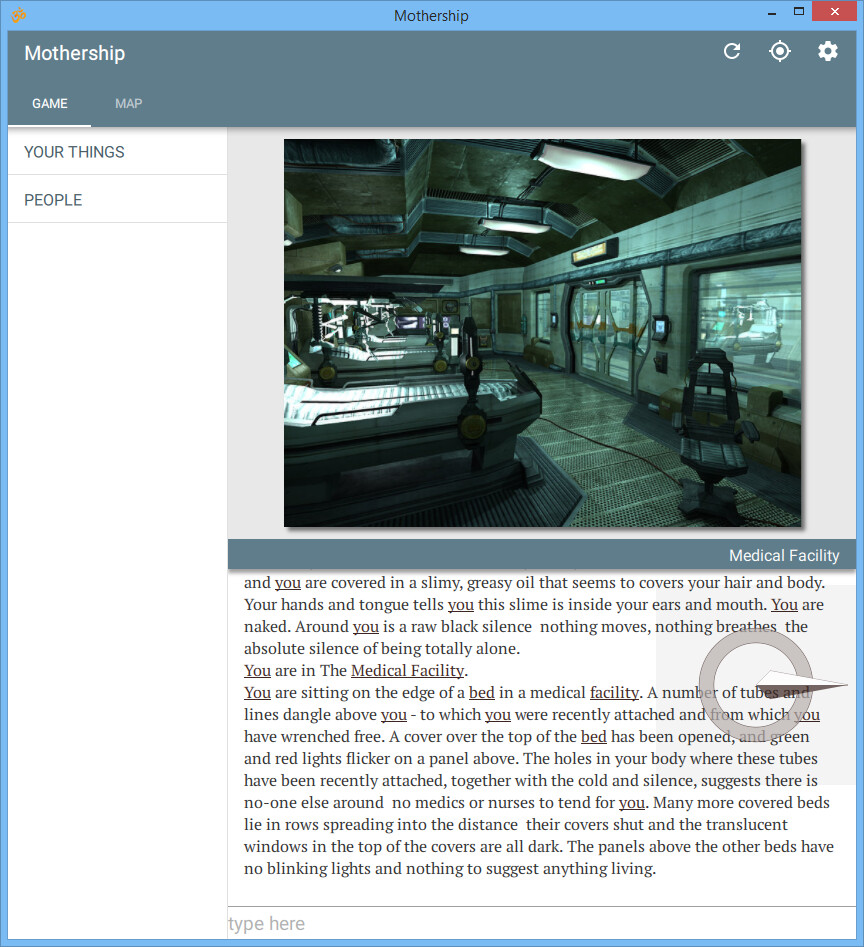
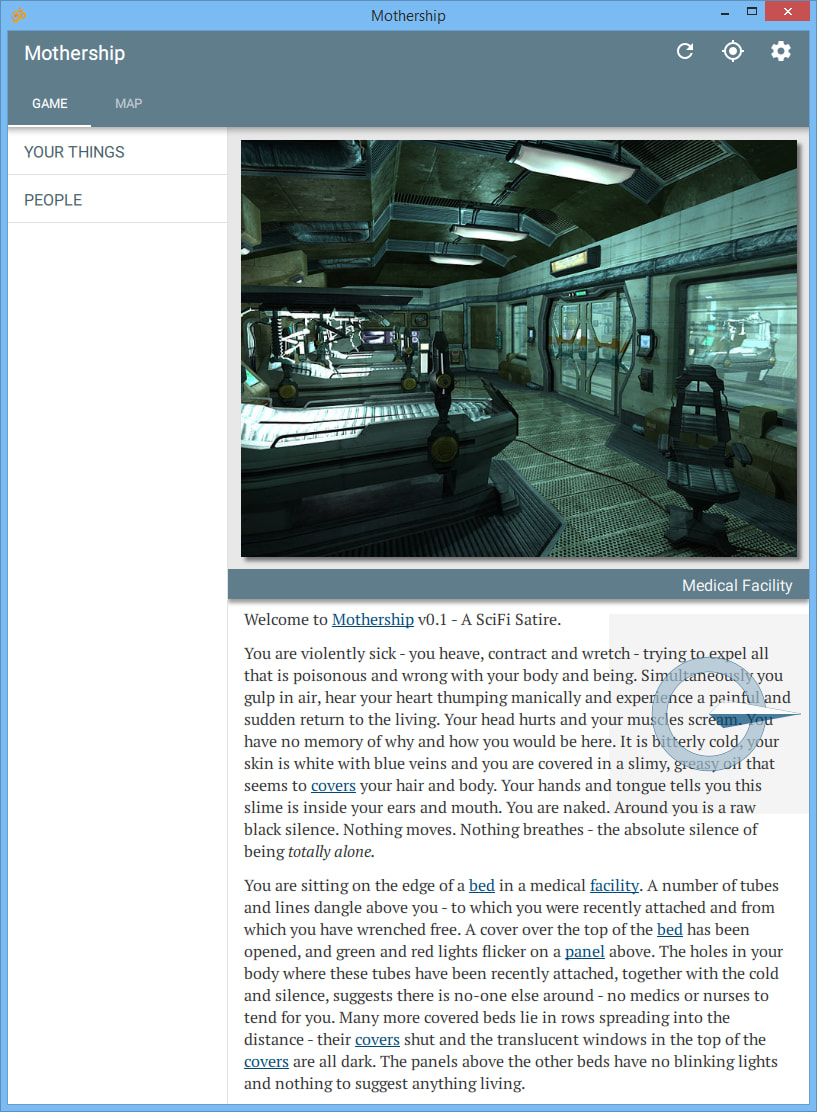
My system at the time was a homoiconic language (called KL) with a very small set of primitives. Ideal, i thought, for bootstrapping an IF system. But there was a problem; it got messy fast. Here’s a small excerpt of the source code to Mothership.
(defobj corridor {
  room
  (at ship)
   (gx 1) (gy 0) (exits {
                        (north controlroom)
                        (west medical)
                        (east hatch)
                        (south dorm)
                        })
   (name "Central Corridor")
   (picture "images/corridor.jpg")
   (sound "sounds/hum2.ogg")
   (focus
    {
    (r-getup (fn () ((f-getup) ())))
    (r-look "You're in the central corridor. Routes leads off in all directions; north, south, east and west")

    (r-look2 "\n\nI know this description is a bit short, but it's a _[corridor]_ - what can I say. Use your imagination or look at the picture which we ripped off from another game. No, honestly, these pictures are just placeholders until Amy gets around to drawing the real ones. That, and the fact that it's just too hot here to do anything really _that_ creative.")

    (r-look3 (cats "Unfortunately, the [corridor] description is still"
                   (ch "bad" "poor" "terrible" "appalling" "boring" "uninspired" "dull" "lame" "a stub" "dreadful")))
    (actions
     (
      (0 getup r-getup (EV (re (re-not get-up))))
      (1 look r-look)
      (1 look r-look2 (EV (re (re-not corridor-look))))
      (1 look r-look3 (EV (rea corridor-look)))
      )
     )
    })
   })

(defobj cabins {
  container
  (at dorm)
  (is hidden)
  (name "cabins")
  (focus
   {
   (r-look1 "Now, one of these cabins must be yours?")
   (r-look2 (f-push 'cabins-found (f-puthere 'clothes "Ahah! Found it. You open the door and find your clothes inside")))
   (r-look3 "It's your dorm cabin")
   (actions
    (
     (1 look r-look1 (EV (re "[^cabins-look]*")))
     (1 look r-look2 (EV (re "[^cabins-look]*cabins-look[^cabins-look]*")))
     (1 look r-look3 (EV (re ".*cabins-found.*")))
     )
    )
   })
  })
See the problem. One missing bracket and you’re stuffed! Yes i know tools can help a lot with this kind of thing, but the basic idea was broken, and expecting clever tools to fix it, wasn’t the answer either. Your original syntax, with its brackets all over, reminded me of this.
What i did:
New Design Goal
Strand’s original mission was to achieve the, so called, 90% rule:
Do 90% of what games want really well and leave the remaining 10% to game design.
The motivation for this goal was the supposition that 9/10 features could be made simply and easy to author whilst the annoying and complicated 10% could be isolated from poisoning the main 90%.
In other words, the central goal of Strand was ease of authoring and therefore its corollary, rapid development.
Strategy
Ease of authoring was to be achieved by inventing a non-technical domain specific language (Strand). It was important that this language did not resemble programming with its inevitable collection of weird symbols and annoying syntax.
Because, whether you’re a programmer or not, this is still a development impediment.
How nice it would be to “bosh-out” whole swathes of gameplay without programming; without variables, loops, if-then-else statements and all the other rubbish programming languages force on you.
But how?
Following the 9/10 idea, it was envisaged that Strand would handle the 90% without programming and the remaining 10% would be relegated to a companion, traditional programming language.
Because, for example, if someone wanted to have a chess game coded inside their game, it would clearly require a general programming system to be implemented. Such a thing would be deemed to fall into the 10% and thus be implemented outside of Strand.
The Strand IF system would therefore consist of a complementary blend of two languages; a DSL, called Strand and a system language called KL.
What Happened
Strand easily handled 99.9% of all cases, vastly overachieving its 90% original remit. There are almost no KL bits in any game i’ve written since then. The occasional one-liner, and all those are in the library anyhow.
Yes, I think Chord is a good choice.
1 Like
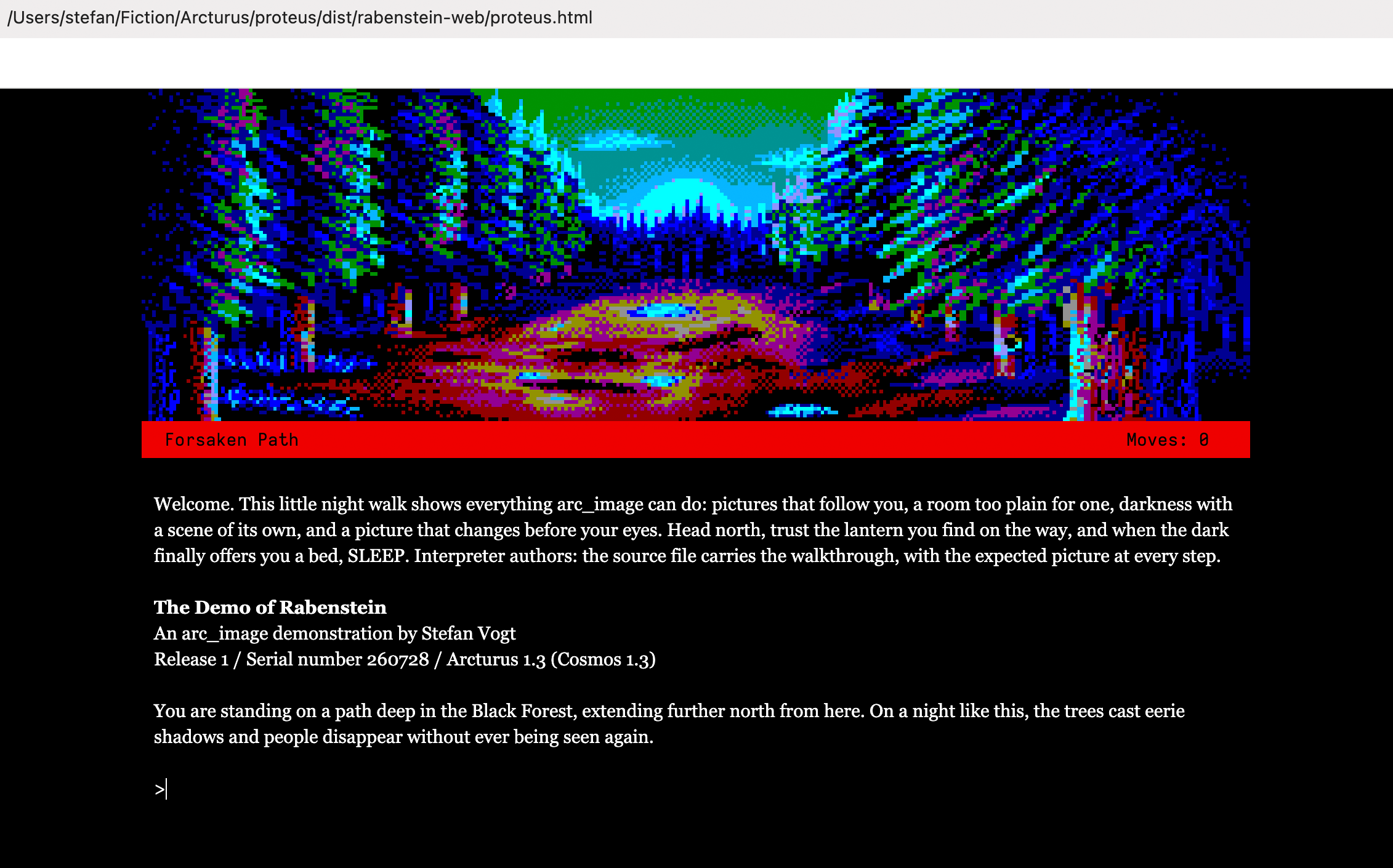
Arcturus games now play on the web
The new tool is called Proteus, and it takes the finished game you already have (.blorband .zblorbare created by arcimg):
proteus mygame.zblorb -o mygame.html
proteus mygame.z5 mygame.blorb -o mygame.html
proteus mygame.z5 -o mygame.html
Note: a bare .z5 or .z8 gives you a text-only game.
The output is one self-contained HTML file, typically under a megabyte with pictures included, that plays in any browser. It carries the interpreter, the arc_image picture band, Z-machine colours, and save/restore in the browser’s local storage. Upload it to itch.io or your own site and you’re done.
Proteus itself is a single amalgamated Python file with no dependencies: everything needed to build the page ships inside the tool, so there are no template directories or resource folders to manage.
Proteus is a fork of @Dannii Willis’ Parchment, trimmed to the Z-machine only and taught arc_image, with Dannii’s own ZVM engine at its heart, back in active service. The quality of both projects is why this went smoothly. Thank you, @Dannii. The fork is MIT like upstream and lives in the Arcturus repository with full provenance; the page itself credits Parchment.
Honest limits: Proteus is built and tested for Arcturus games specifically.
Also in this release, arcimg now packs pictures as standard Blorb by default (picture id N is Blorb resource Pict N), and with the story embedded the whole game travels as one zblorb. The short-lived .arcres format is retired.
You can download Proteus from the repository; the link is on the main repository page. Place it next to arcc and the other tools, and arcc --update takes care of it from then on, updated with the rest.
7 Likes
This looks like a great solution to the Inform 6 vs Dialog vs ZIL debate, for me at least. I have 3 requests of @8Bit_Era, and a fun challenge for the Arcturus Discord server.
The requests:
- Support braces and semicolons with a compiler switch or internal source directive
- Support sound effects via the Infocom sound format.
- Create a program (Arcsnd) to convert .wav files to the Infocom .snd file format.
The challenge, just for fun: Create a text-based CRPG, exclusively in Arcturus, that is as fun to play as something like the original Ultima, with one PC and ally NPCs, with monsters, combat, and magic, mostly in text.
Alternatively: Port the Inform sample game “Balances” to Arcturus.
1 Like
Challenge accepted. Porting Balances it is 
I will look into your requests for you.
I finished work on Haumea, the Arcturus standard interpreter for Amstrad CPC. The screenshots show it running in CPC’s system theme but it has full capability for Z-machine colors. It prompts you at the beginning when a story file uses them and whether you want to apply Z-machine colors or not. This is the way Infocom did it with their DOS interpreter.
Clarification: Arcturus standard interpreter means: Z-machine 1.1 standard compliant interpreter with arc_image support.
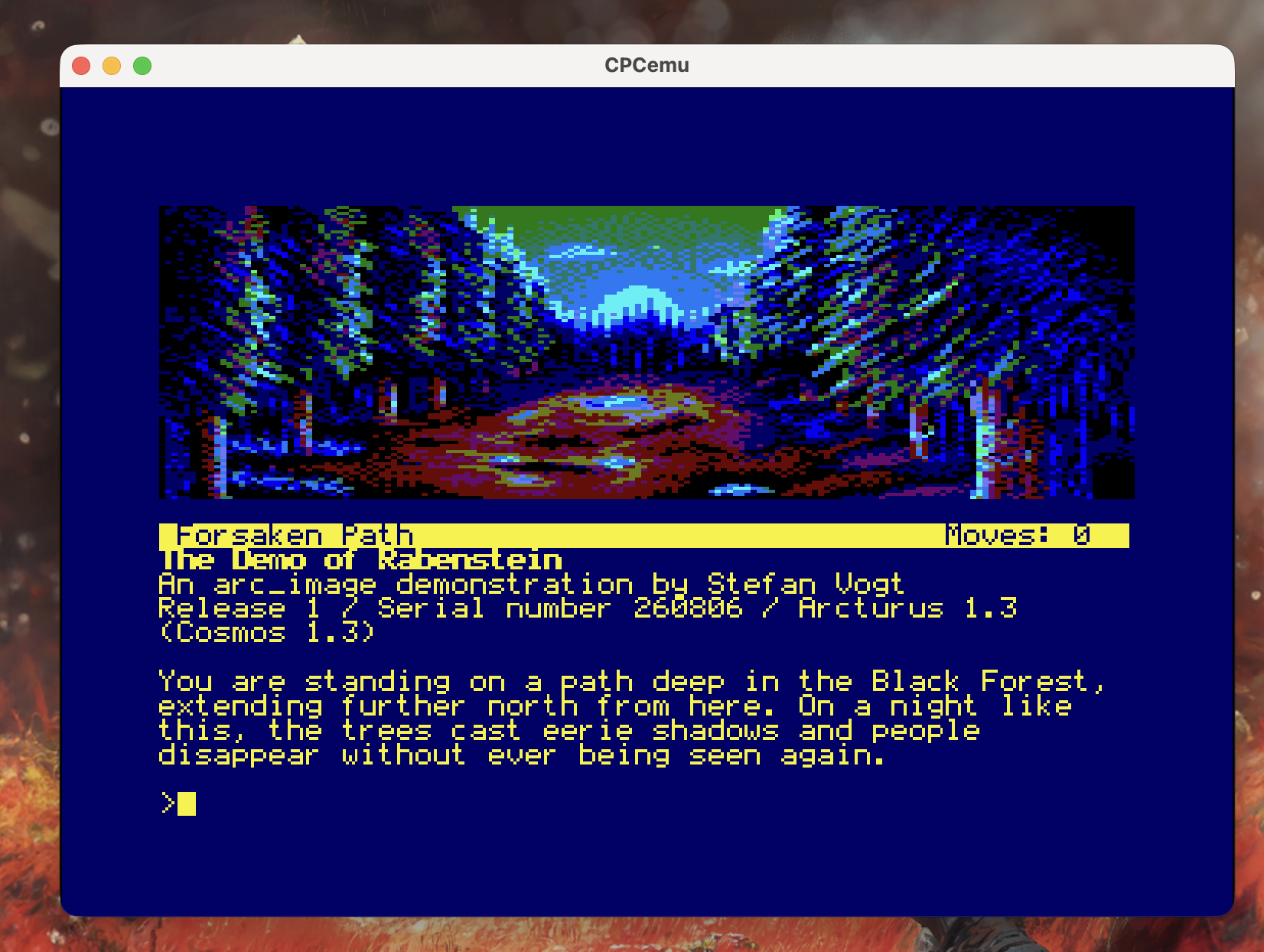
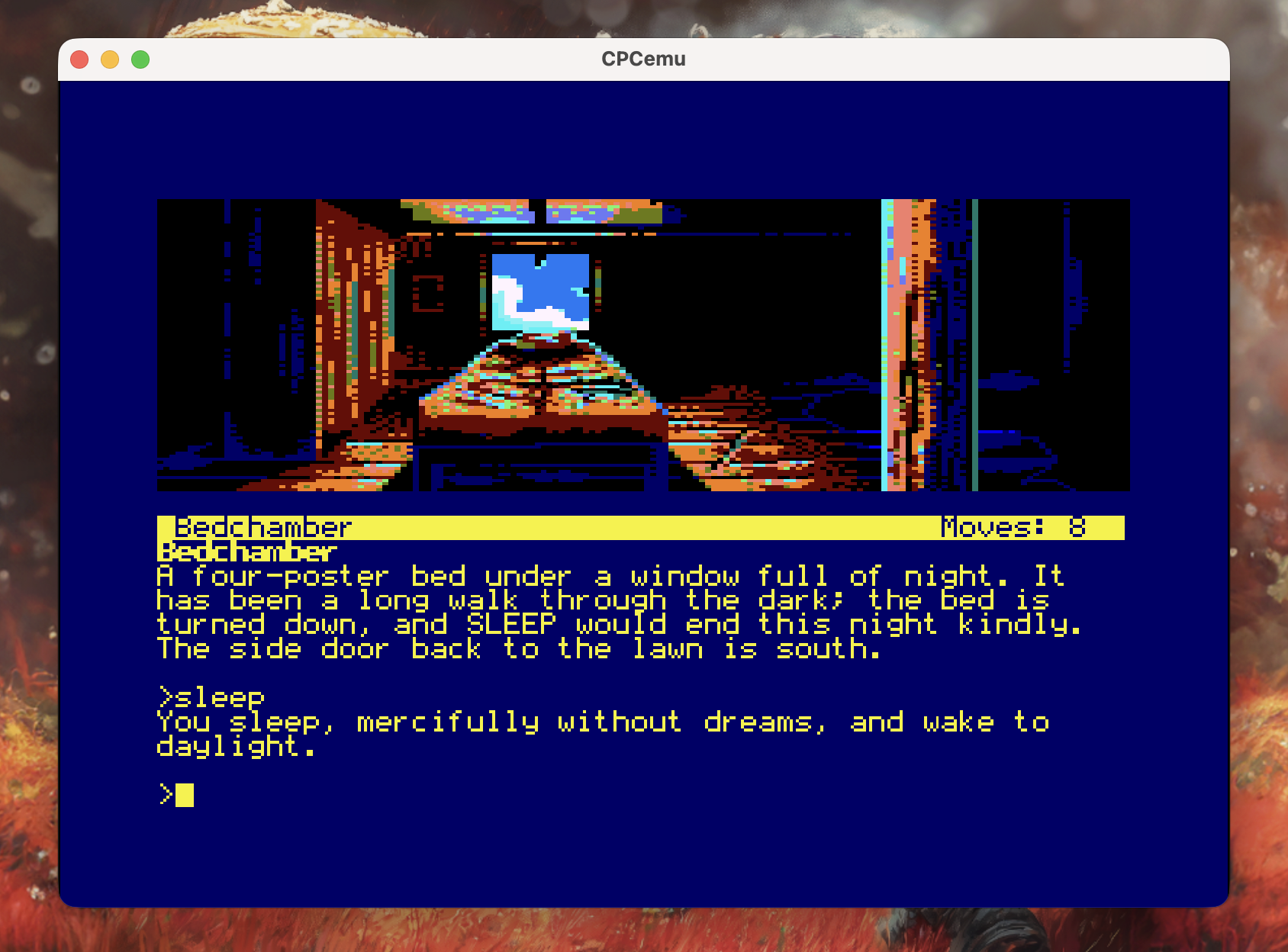
I am also working on a bunch of other interpreters, and updates on my existing ones. All sources are going to be released soon and Haumea will become available. I am currently holding back the release since I am finalising the release of Hibernated 2 and the file was heavily used in the repository to test the interpreter from milestone to milestone. Among other testfiles of course. Full support of accented characters, full pass of TerpEtude and CZECH.
4 Likes
I’m glad that all these languages exists and wasn’t aware that there where a “debate” to find some ultimate language. Depending on your background and/or preferences you may find one more to your liking, but that doesn’t mean that the others, in my opinion, are inferior in any way.
6 Likes
To my mind, cross-pollination between these languages can only be a good thing! Once IFComp is over I’m going to work on making Dialog support arc_image. (And probably asking for a slight extension to its semantics to fit Dialog’s screen model.)
4 Likes
Images are cool. Sound effects are really cool. Hopefully he’ll have his arc_sound equivalent working by then.
I totally agree. I believe there is no such thing as an ultimate language. My goal simply was creating a language that is very readable, where little code can get you very far. And since we are all individuals with different preferences, it will certainly not be for everyone. I confess that I tried to find some middle ground between the available languages: the readability of Inform 7, the unique modern features found in Dialog, the zcode optimized and small to run on 8-bit machines, just like what Puny and ZIL produce. So without these other languages, Arcturus would be nowhere near to what it became. It’s not only important but also inspiring that we have an ecosystem of different languages. And they all have their strengths.
4 Likes
Totally. I am currently working on pathfinding logic, where Dialog is the role model and quality I am for. Happy to support you with the arc_image feature in Dialog. Regarding the semantics: let me know what you need once you have some time and I’ll look into it 
I have a question about on after go. I got confused by the handbook which gives one example of using this. The handbook seemed to imply that both on after and on after go need to be part of the same room definition and I was initially unable to figure out why the on after go event was not firing.
Aside, I was trying to implement the “floorboard used as a bridge which collapses after two crossings” in Planet of Death, which is where I encountered this.
It turns out that the on after go south event needs to be in the south room, not the north room. Now from a programming perspective, that makes sense, but perhaps the handbook could make that clearer?
Is the timing of the on after go event as intended, that is, after the room description has been shown? I’m not saying it’s wrong, just curious as one can always make use of on enter to have the event fire before the room description.
Here is a contrived example.
game
    title  "On After Go"
    author "EdwardianDuck"
    headline "Illustrating a question about on after go"
    start northroom

room northroom
    name "North room"
    desc "The north room. Exit is south."
    south southroom
    on go south
        say "Northroom event : ON GO SOUTH - fires immediately"
        continue
    on after go south
        say "Northroom event : ON AFTER GO SOUTH - never fires"
    on after go north
        say "Northroom event : ON AFTER GO NORTH - fires after room description"
    on enter when way is north
        say "Northroom event : ON ENTER WHEN WAY IS NORTH - fires before room description"


thing cube in northroom
    name "cube"
    words cube
    desc "A cube."

room southroom
    name "South room"
    desc "The south room. Exit is north."
    north northroom
    on go north
        say "Southroom : ON GO NORTH - fires immediately"
        continue
    on after go north
        say "Southroom : ON GO AFTER NORTH - never fires"
    on after go south
        say "Southroom event : ON GO AFTER SOUTH - fires after room description"
    on enter when way is south
        say "Southroom event : ON ENTER WHEN WAY IS SOUTH - fires before room description"

thing orb in southroom
    name "orb"
    words orb
    desc "An orb."
Good catch, your programming instinct read it right btw: it is by design, and the handbook example was genuinely misleading. That’s fixed as of today… the example now shows the two rooms.
The rule in one sentence: on after <verb> runs in the world the action made. By the time the after pass fires, the walk has completed and here is the destination, so a room’s on after go <direction> answers walks that ARRIVE in that room. The departure side of the same walk belongs to the origin’s plain on go (which can continue into the real move), and a handler that must hear every crossing wherever it lands can be written free-standing at file level:
on after go south when here is chasm_south
    say "The floorboard groans behind you."
The timing is also as intended: the after pass runs after the action’s full report, room description included. The before-description hook is exactly the one you found, the destination’s on enter.
For your collapsing floorboard, both shapes work: an on after go in each bank room, or one free-standing handler counting crossings (mind that a specific on after go south shadows a bare on after go, most-specific-wins as everywhere). Great to see Planet of Death walking on Arcturus floorboards, by the way.
1 Like
As a side note, this is why Dialog’s standard library redirects “go” to a separate action “leave”, which takes the original room and the direction as its objects—that is, “go south” in the Foyer is redirected to “leave the Foyer south”. That way you can write rules about going that don’t have to check “here”, and thus don’t have to worry about “here” changing halfway through the action.
4 Likes
MCIF uses the concept of location, last location, new location, target location, portal value, and portal type to have rules based on player and object directions, through doors, windows, and passages. You can be as generic as you want or specific as you want and ordering of the rules controls specificity.
2 Likes
Yeah, that’s Inform 7’s approach: “going” is treated specially by the compiler to handle any combination of source, destination, direction, door, vehicle, and pushed object. Dialog can’t do that because actions are implemented entirely at the library level, not the compiler level, so it uses some workarounds:
- The standard “go” action is translated into “leave [room] [dir]”, with the source and the direction as its two objects. The destination can be computed inside the action rules if needed.
- There are two alternate actions, “leave [room] [dir] with [object]” and “leave [room] [dir] by [vehicle]”. These cannot be combined: you have either a pushed object or a vehicle, not both.
- Dialog’s action syntax means that it’s easy to write rules that apply to all three of these, which is why they’re worded as they are.
- Entering a room is not an action, but there’s a special predicate
(prevent entering $Room)that can block any attempt to enter that room by any means—since that’s a relatively common use case and calculating the destination of a movement is a bit unwieldy.
Inform 6, meanwhile, has “going” trigger a bunch of special routines that can return magic numbers to affect the action. If you try to “go” while in a vehicle, for example, the vehicle’s “before going” routine will be called, which can return 0 to block the movement, 1 to let it happen normally, 2 to block it silently, and 3 to do something special instead. In I6, in fact, a “vehicle” is simply an object whose “before going” routine returns a nonzero value!
It’s a thorny problem; “going” is so fundamental to a lot of parser IF that it tends to need special treatment compared to the other actions.
3 Likes
Because MCIF is a state machine, the problems arising out of using just a single dispatch model go away.
2 posts were merged into an existing topic: MAD Candy Interactive Fiction Studio 1.2 is now released
Since the thread has become a nice survey of how systems treat “going”, one more data point from my still very young system.
Arcturus deliberately gives going no special dispatch treatment. Instead, two general rules that apply to every action happen to dissolve the problems being described here:
First, handlers dispatch against the world as it stands. A room’s on go south runs before the move, so here is reliably the origin; a room’s on after go south runs in the world the action made, so here is reliably the destination, and the handler lives in the room the walk arrives in. The “here changes halfway through the action” race that Dialog solves by re-targeting go to leave [room] [dir] is answered structurally instead: no handler ever observes the transition, because the before-side and the after-side are different handlers in different rooms. (A handler that must hear every walk regardless of where it lands is written free-standing at file level.)
Second, the report is a seam of its own. A handler in the origin can register the movement’s report with alter "..." (oh and actually facepalm because this is how I should have answered @EdwardianDuck) and then continue into the normal move. the registered line fires only if the walk completes, between the move and the new room’s description. That’s the slot I6 reaches with the before-routine return codes: origin-authored narration of a completed departure, without magic numbers and without destination-side code, and a refused walk discards it unfired.
Exits themselves are a four-tier ladder, most specific wins: a static exit, a computed exit (a block returning a room or nothing, required to be side-effect-free so anything may read it repeatedly), a per-direction handler, and a per-room on go other fallback for every direction that has no exit. Doors are objects the walk resolves through.
Where I agree with Daniel: the full I7 “going” clause with source, destination, door, vehicle and pushed object in one rule head is genuinely powerful, and Arcturus doesn’t attempt that combinatorial form.
2 Likes
@EdwardianDuck I just had a facepalm moment.
A follow-up on the floorboard, because there’s a fourth timing slot I left out of my earlier answer, and it deserves a proper introduction: it’s the one that matches your original instinct of writing the rule in the north room.
What alter is. Every standard action in Arcturus ends by speaking its report: “You take the flute with you.”, “Down it goes.”, the new room’s description. alter is the seam for exactly that last step: default mechanics, your wording. A handler says alter "..." and then continues into the normal action; the action runs in full (the object tree, scoring, all bookkeeping), and at report time your registered line speaks instead of the library’s.
The important word is registered. alter doesn’t print on the spot; it files the line and fires it only if the action actually succeeds. A refused take, a blocked walk, a door that won’t open: the refusal answers alone and your registration is silently discarded, so it can never narrate a success that didn’t happen. That’s also what separates it from a plain say before continue, which prints immediately and unconditionally, and is the right tool when you want flavor for the attempt rather than the report of the result.
There are two forms. The one-liner:
thing flute in reliquary
    on take
        alter "The flute comes to your hand as if it had been waiting."
        continue
The default take line stays silent; the flute is truly taken. And the block form, for wording composed from state:
    on drop
        alter block
            show("You lay the flute down")
            if here is crypt
                show(", and the dark leans in to listen")
            say "."
        continue
Applied to movement, which is where your question lives: register it in the room you leave, and it fires after the walk completes, before the new room’s description:
room northroom
    on go south
        alter "The floorboard groans and splits behind you."
        continue
No destination-room code needed, and if the walk is refused for any reason, nothing groans.
So the full timing table for a walk has four slots: the origin’s on go (before the move, here is still the origin), an alter registered there (after the move succeeds, before the description), the destination’s on enter (before the description), and the destination’s on after go (after the description). For your collapsing bridge specifically, I’d split the work along that table: count crossings in on after go, since it only ever sees completed crossings, and let alter in the origin do the groaning. The worked example ships in the repo as examples/features/alter.storyarc.