Garry! C’mon, the whole point of the challenge was to test random discoverability! I said you could NOT type Hadean, or Lands, and only use functions on the page.
-Wade
Garry! C’mon, the whole point of the challenge was to test random discoverability! I said you could NOT type Hadean, or Lands, and only use functions on the page.
-Wade
Sorry, I must have skipped over the challenge bit. I thought you were having a go at itch.io. I think @zarf lists appropriate genres and tags, so if you search by any of those, you’ll find it…eventually.
Unlike CASA and IFDB which list only 10,000+ and 14,000+ games respectively, itch.io has 1.2 million+ games, so it’s very easy for your game to get lost in the crowd.
There’s probably a difference between finding a game that matches certain tags to play… and finding a specific game.
I was trying to find a particular game that I know is on Steam (without using its name)… and to be honest, typing a free search of text adventure then choosing tags text-based and sci-fi did present it (in a bundle!) as the 21st title.
I’m not sure how easy it would be for me to randomly stumble across it, but I guess it may appear in places like my recommendation queue if I’d been playing lots of similar games of that type.
Discoverability is a huge issue with every single store and content platform… including itch, steam, PSN and even Netflix.
They do indeed.
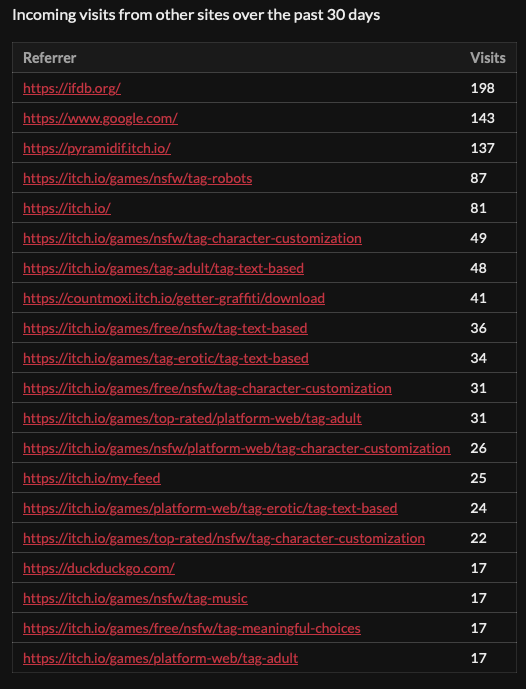
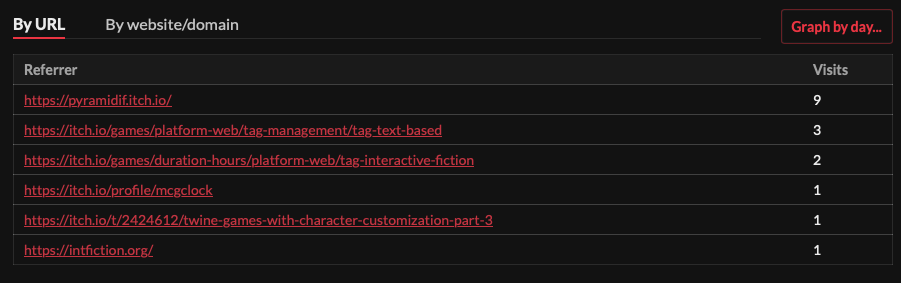
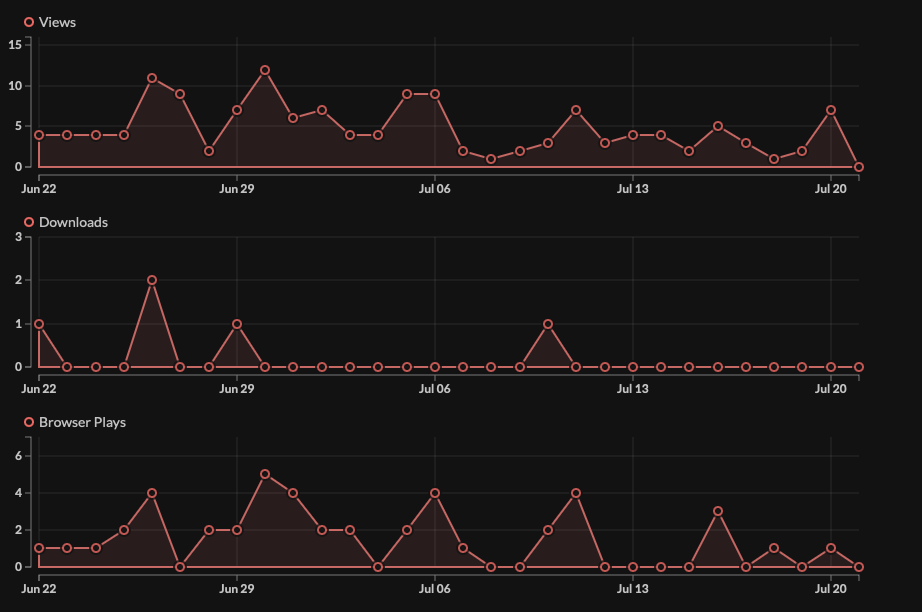
Referrer is where the player linked in from; when you see the site is itch with a tag reference, that’s the tag the player found the game searching for.
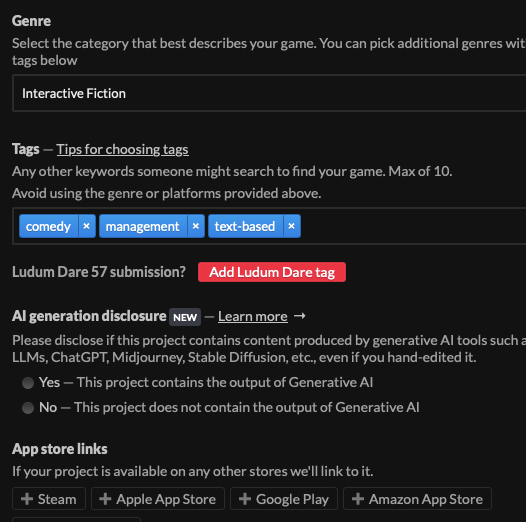
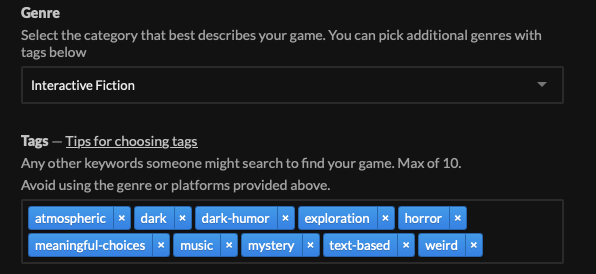
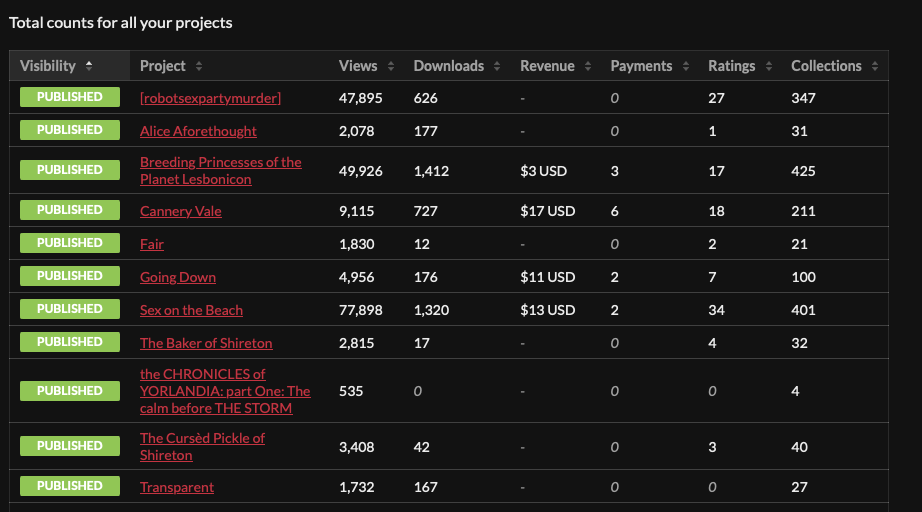
Part of the fault in not finding interactive fiction on itch I suspect is many authors do not tag their games. “Interactive Fiction” is a genre and “text-based” is a tag that I bet many authors do not choose, and likely isn’t a huge search term, but I get more hits based on genre and tags. My adult games with accurate tags get a lot more views. Authors can choose up to ten tags, and the main tags tend to be offered as search terms. I myself have done a poor job with Baker of Shireton.
Here’s my Cannery Vale tagging and it gets a bit more traffic.
So, we can’t solve the itch search problem, except to encourage authors to tag their game well. Your game likely will get discovered more by the tagged content than the type of game. Of course many searchers aren’t looking for text-based games, but popular tags get more traffic.
Out of town right now so I’m behind on pings. Glad I seem to be doing something right!
Edit: oh, and as far as Itch’s SEO is concerned, I’d bet your search pulls my game simply because “text adventure space inform” matches a lot of what’s in the game’s title and the short desc.
Do you think author permission would be required if a Steam anthology were free and individual game authorship was clearly indicated (unlike the people behind IF games reuploaded…without consent).
Since most of these games are already freely available on IFDB, I don’t see why individual authors would have an issue with being included in a “The Lost Treasures of Inform 7” anthology.
It’s still copyright infringement even if no money changes hands.
But it’s true that many many games have copies on IF Archive (the IFDB doesn’t actually host anything): I wonder what the license terms actually are there? Hmm. Looks like some people may have provided a broader license but “Any material with no attached license is presumed to be licensed for personal use only.”
So in practice you’d be highly unlikely to get in legal trouble if you made a free anthology on itch or something, but whether you’d get it past the review at Steam where they presumably actually have a legal team is… you might? I gather it’s kind of arbitrary and spotty.
But also whether it’d be worth the fee, and how much it’d help with visibility? Maybe. I’m skeptical.
I mean, legally one may have a leg to stand on there as most free IF is released under various Creative Commons licenses that only require attribution, not permission, but actually doing that without asking would be a great way to get on a lot of people’s bad side. If nothing else, I would be highly suspicious of anyone claiming to do that “for the good of the community” without making a good faith effort to contact authors and I would suspect ulterior motives. For most authors discoverability outside the community is not a problem that needs to be solved, and for some people who make games dealing with sensitive or controversial subjects mass discoverability may be decidedly not wanted.
If anyone actually tried this I think we’d see a shift en masse to people releasing their work under more restrictive licenses (CC BY-NC-ND or similar).
In terms of “would it be illegal not to ask” no, in terms of “would it make me an asshole not to ask” yes.
This is why the upload form has selection buttons for
It’s simpler all around if authors upload their own files, but we know that occasionally some historic material surfaces. We don’t want to blanket-reject that stuff even if the author is no longer available.
(Also of course there’s competition package uploads where it’s the organizer doing it, not the author.)
In the earliest days of the archive, we didn’t have any license terms in place because everybody took them for granted. Exactly what they took for granted is somewhat fuzzy, but I generally go with “You can download and play these games, personal use only.”
On the other hand, there’s that eXoIF package from a few weeks ago. Nobody seems to be fussing about that.
Yeah, I was surprised about that – but on the other hand it seemed like their whole schtick was doing illegal packaging so I figured maybe everybody figured that it wasn’t worth saying anything unless you were going to pay a lawyer to go after them?
most free IF is released under various Creative Commons licenses that only require attribution
Is this actually true? I think “freeware” is the most common license type on IFDB at a glance.
(Nearly 80 pages of freeware vs. less than 10 pages for creative commons, public domain, and cc combined).
It’s hard to say how many of those authors intended “freeware” to permit redistribution or not, since it could be used either way. Or whether non-authors uploaded the games and applied ‘freeware’ in the absence of other information. And a lot of games don’t have licenses/readmes that clarify this.
Indie game developers in general seem more possessive and against reuploading now than 20 years ago, so I expect most recent freeware IF games aren’t meant to be reuploaded by third parties by default.
Though as you noted @encorm I expect at least some people would be open to being part of a compilation with proper outreach.
Fair enough, although I think @pieartsy’s point still stands either way in that reuploading freeware without permission isn’t illegal but would be a dick move.
I think @JoshGrams is right that redistributing certain freeware would be an outright copyright violation in a lot of cases (though probably hard for the author to do anything about beyond filing a DRM takedown request).
Either way, yeah, getting permission would be the best course.
(My comment was less directed at yours specifically and more using it as a jumping off point).
Most games don’t specify a license at all, is my sense.
(Pretty sure the IFDB people tag it “freeware” in that case, but I doubt many games use that word.)
Probably a bit of both … maybe I’m overestimating how many people make or edit entries for their own games though.
Looking at my own games, it seems like I’ve neglected to put a license in the IFDB entry more than I thought.
I mean, given that, at least according to the opening paragraph of the Wikipedia page, “freeware” just means: “I’ll give you this for free but still hold copyright over it” - doesn’t that describe most of our games where no explicit license has been chosen?
(Personally, I consider my games freeware in the “redistribute it as long you don’t modify it or take credit for it” mould from the good old days, but I wouldn’t claim to speak for anyone else.)
Since Creative Commons has been mentioned, they also have licenses that work like that (for example CC BY-NC-ND), which might be a little more explicit than just calling it “freeware” (which can be interpreted in multiple ways).
according to the opening paragraph of the Wikipedia page, “freeware” just means: “I’ll give you this for free but still hold copyright over it” - doesn’t that describe most of our games where no explicit license has been chosen?
The Wikipedia page says that freeware isn’t actually a single type of agreement, and that it includes both software that can and can’t be distributed.
“For instance, modification, redistribution by third parties, and reverse engineering are permitted by some publishers but prohibited by others.”
Legally, the author/publisher holds copyright even if they don’t include a license agreement, I think.
Personally, I consider my games freeware in the “redistribute it as long you don’t modify it or take credit for it” mould from the good old days, but I wouldn’t claim to speak for anyone else.)
Yeah, that’s pretty much what I’m getting at - the de facto treatment of freeware has changed from the ‘old days’ to now.
Great suggestion to use the Creative Commons licensing, which anyone can apply for free.
CC-BY is the one that allows free use with attribution; CC-BY-NC allows use with credit but restricts commercial use, which is the one that would prevent websites from charging people to redistribute your game. ND is “no derivative work” to prevent someone from remixing your work or writing fan-fiction of it.
Applying a CC license does not mean you cannot negotiate separately with someone who wants to pay you or get permission to do something cool with your games.